Tradition: Algonquian Mythology, American Mythology
Alternative Names: Windigo, Wiindigoo, Wīhtikōw, Whitego
Category: Giant
The Myth
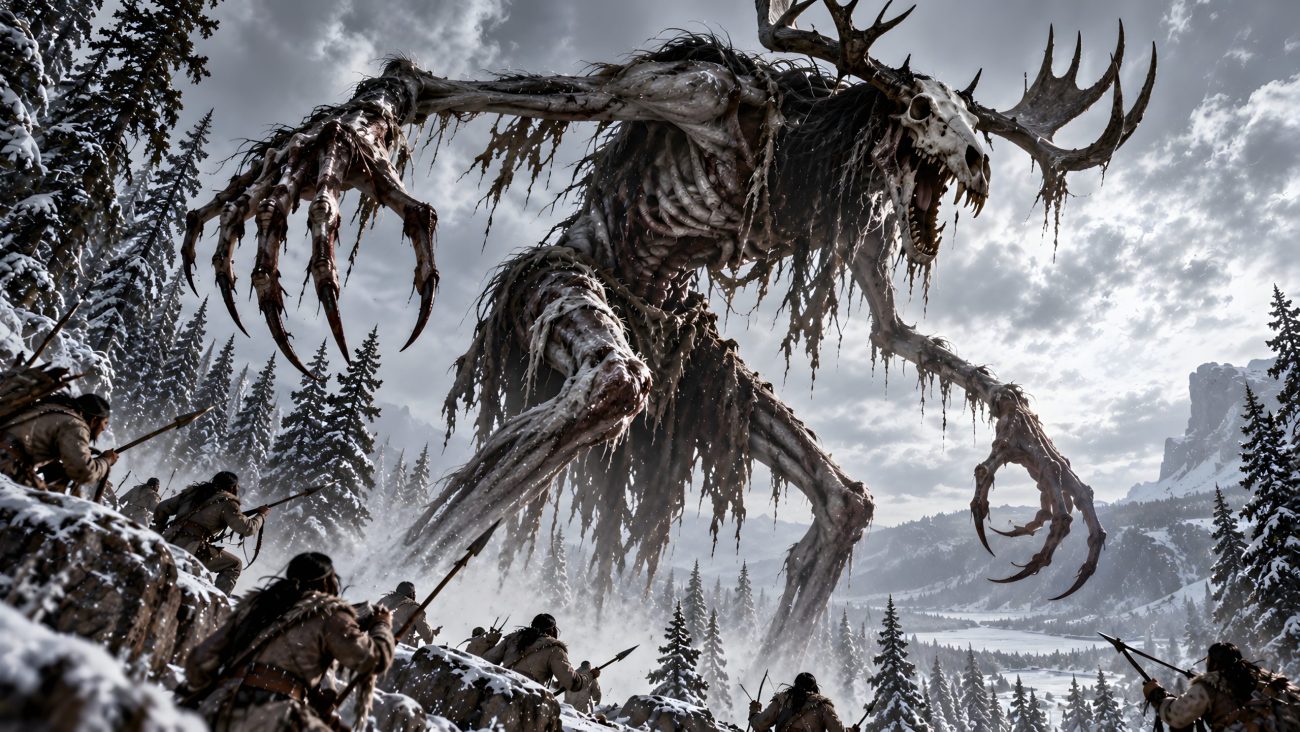
The Wendigo is a malevolent supernatural being in the traditional beliefs of several Algonquian-speaking peoples, including the Ojibwe, Saulteaux, Cree, Naskapi, and Innu. Closely associated with winter, cold, famine, and starvation, it embodies the terrifying consequences of insatiable hunger and destructive greed. Depending on the tradition, the Wendigo appears as an evil spirit capable of possessing human beings or as a monstrous, cannibalistic creature with human-like characteristics.
Descriptions of the Wendigo vary between communities. In some traditions, particularly among the Ojibwe, Eastern Cree, Westmain Swampy Cree, Naskapi, and Innu, it is depicted as a giant far larger than an ordinary human. One description portrays it as a horrifyingly emaciated figure, with desiccated skin stretched tightly over its bones, sunken eyes, an ashen complexion, and torn, bloody lips. Its decaying flesh gives off a foul stench associated with death and corruption. Other depictions emphasize its icy heart, while its approach may be heralded by an unnatural chill or a terrible odor.
The Wendigo’s defining characteristic is its endless hunger. According to some traditions, whenever it consumes a human being, it grows larger in proportion to the meal it has eaten. Despite its increasing size, it remains perpetually starved and can never be satisfied. This contradiction between enormous appetite and skeletal thinness makes the Wendigo an embodiment of gluttony, greed, and excess. It continually seeks new victims, killing and devouring people without ever reaching a state of fulfillment. Although monstrous, it does not necessarily lose its human ability to speak or reason. Some stories describe Wendigos communicating with their intended victims, threatening them, or attempting to deceive them.
One traditional story tells of a Wendigo that steals a boy but delays eating him because the child is too thin. The monster carries a knife and repeatedly cuts the boy’s hand to determine whether he has grown fat enough to eat. When they approach a human settlement, the Wendigo sends the boy to obtain food and orders him to return quickly. Instead, the boy warns the villagers of the monster’s presence and shows them his injured hand. The Wendigo calls after him, demanding that he stop telling lies, but the villagers recognize the danger and attack the creature. They cut off its legs, only to discover that it remains alive and consumes the marrow from its severed bones. When questioned about the fatness of its victims, the monster boasts that it has eaten many people. The villagers ultimately kill it and cut its body into pieces.
Wendigo traditions also describe how human beings can become associated with the monster. In some accounts, a person who resorts to cannibalism to survive may transform into a Wendigo. Other traditions connect transformation with overwhelming greed or prolonged contact with the creature. These beliefs reinforce the importance of moderation, cooperation, and respect for the community, especially during periods of famine when desperation might threaten established social obligations. Among the Assiniboine, Cree, and Ojibwe, a satirical ceremonial dance known as wiindigookaanzhimowin was sometimes performed during famine to emphasize the seriousness of the Wendigo taboo. Participants wore masks and danced backward around a drum.
The Wendigo remains one of the most recognizable figures in Algonquian folklore, representing the horrifying transformation of hunger into an uncontrollable desire to consume others. Its traditional meaning is closely tied to the dangers of starvation, selfishness, and the abandonment of communal responsibilities. Although modern literature and horror fiction have developed many additional versions of the creature, its traditional forms reflect a deeper fear: that the pursuit of survival or personal satisfaction can become a destructive hunger that no amount of consumption can ever appease.
Sources
“Wendigo.” Wikipedia: The Free Encyclopedia. Wikimedia Foundation. Accessed October 17, 2026. https://en.wikipedia.org/wiki/Wendigo