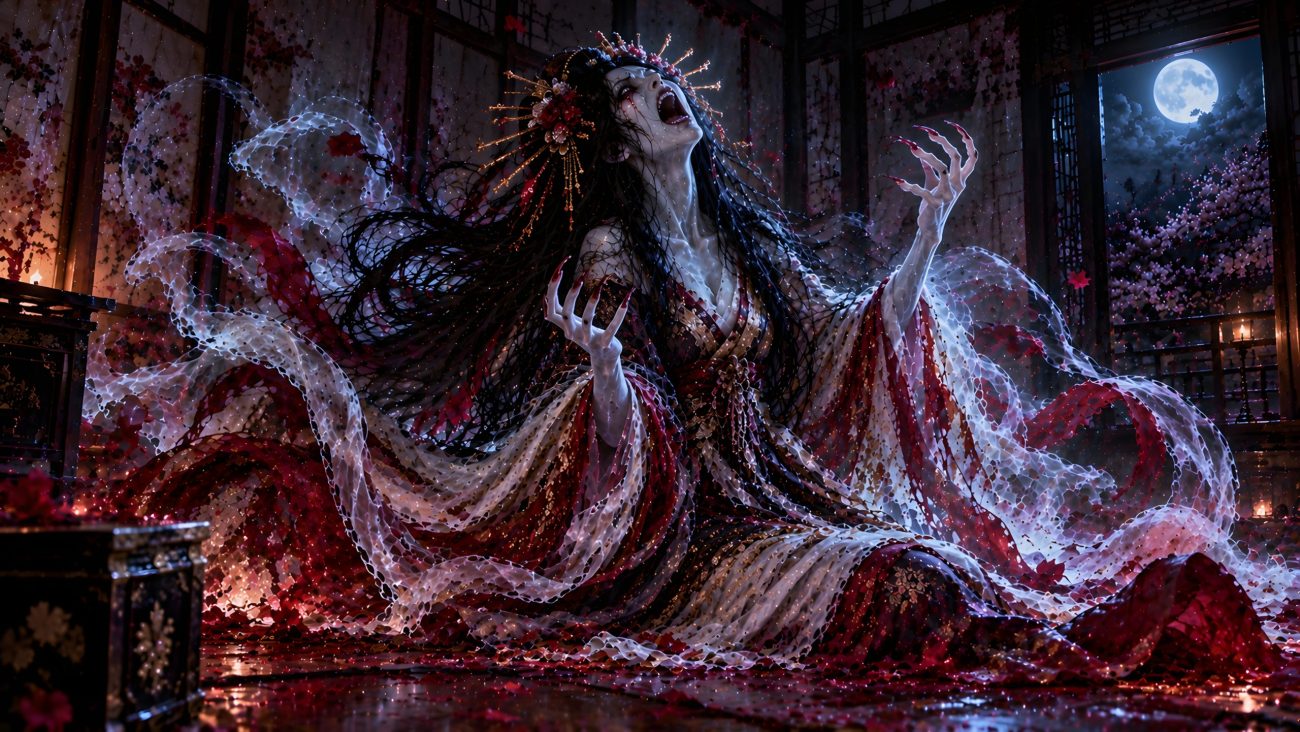
Tradition: Japanese Mythology
Alternative Names: Rokujo no Miyasundokoro, Lady Rokujo’s Living Spirit, Rokujo’s Vengeful Spirit
Category: Ghost
The Myth
Lady Rokujo is a noblewoman from The Tale of Genji, a classic work of Japanese literature, who becomes infamous for the destructive power of her jealous and vengeful spirit. The daughter of a minister, she became the consort of a Crown Prince at the age of sixteen and gave birth to a daughter. After the Crown Prince died when she was twenty, she began a relationship with Hikaru Genji, a younger nobleman. Lady Rokujo was proud, educated, and dignified, but she also struggled with her age and status in relation to Genji. Her intense and complicated affection overwhelmed him, and he gradually distanced himself from her.
In the chapter known as Aoi, Lady Rokujo’s resentment erupts after she is publicly humiliated during a dispute over the placement of carriages at the Kamo Festival. A servant of Aoi, Genji’s principal wife, treats her disrespectfully, leaving Lady Rokujo consumed by shame and anger. Although she remains physically unaware of what is happening, her living spirit leaves her body and torments the pregnant Aoi. After a difficult labor, Aoi gives birth to a son, but her condition deteriorates and she dies a few days later. Lady Rokujo realizes that her spirit has been acting independently when she notices the scent of poppies, used in prayers and rituals, clinging to her clothing. Genji also witnesses her living spirit while attending to Aoi. Horrified by what she has become, Lady Rokujo decides to end her relationship with Genji. She later bids him farewell at Nonomiya and travels to Ise with her daughter, who serves as an imperial princess at the Ise Shrine.
Lady Rokujo eventually returns to Kyoto, entrusts her daughter’s guardianship to Genji, and dies of illness. Yet her attachment to Genji appears to persist beyond death. Her spirit subsequently torments Murasaki no Ue and Onna San no Miya, directing hateful words toward Genji and demonstrating that her jealousy has not been extinguished. Her daughter grieves over rumors that her mother’s spirit has not found peace, and a memorial service is performed at Genji’s urging.
Lady Rokujo’s transformation into a vengeful spirit became especially influential in Japanese theatre and demon imagery. In the Noh play Aoi no Ue, she appears first as a suffering woman and then transforms into a terrifying spirit and demon, while Aoi herself is represented onstage by a kimono. Her story is also associated with the hannya mask, which represents a woman consumed by jealousy and resentment. The mask’s connection to Lady Rokujo was explained through a legend in which the recitation of the Prajnaparamita Sutra frightens away her vengeful spirit. The artist Toriyama Sekien connected this episode to the name hannya, while also depicting the supernatural oboroguruma, inspired by the carriage dispute at the Kamo Festival. Lady Rokujo thus became one of the most enduring literary examples of how jealousy, humiliation, and unresolved attachment could transform a woman into a terrifying supernatural being.
Sources
“六条御息所 [Rokujo no Miyasudokoro].” 新版TYZ 妖怪図鑑 (New TYZ Yokai Encyclopedia). https://tyz-yokai.blog.jp/archives/1059982793.html