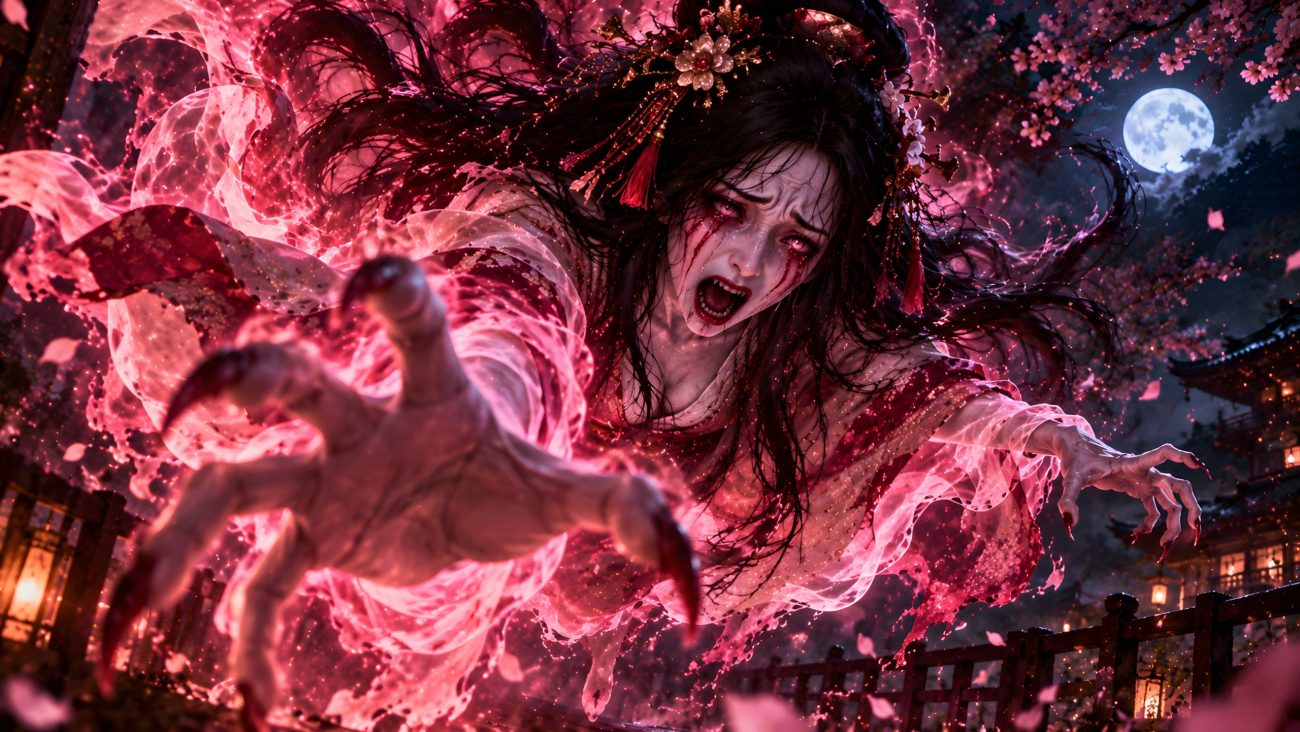
Tradition: Japanese Mythology
Alternative Names: Sayogoromo Osayo, 小夜衣おさよ
Category: Ghost
The Myth
Osayo is a tragic woman who becomes a vengeful ghost in Konomaboshi Hakone no Shikabue, a Kabuki play written by Kawatake Mokuami and first performed in 1880. Born into the Iozaki family in Shizuoka, she is a beautiful and dutiful woman married to Iwabuchi Kurobei, a former samurai. After the Meiji Restoration, Kurobei’s business ventures fail and his debts mount, forcing Osayo to sell herself to a brothel called Ebiya in Odawara to support him. Working under the name Sayogoromo Osayo, she quickly becomes one of the most popular courtesans in the region. Despite attracting the attention of Gantetsu, a monk and regular customer who knows her history, Osayo remains devoted to her husband and refuses to abandon him. Her loyalty persists even as she entrusts her young daughter, Omitsu, to the care of an old acquaintance, the sword sharpener Ryosuke, while continuing to work to support Kurobei.
One day, Kurobei visits Osayo and claims that his debts have become so overwhelming that he intends to take his own life. When debt collectors arrive demanding more than one hundred yen, Osayo is desperate to help him. The innkeeper Jubei and his wife Osen take pity on the couple, lending the money needed to settle the supposed debt. Osayo later discovers that the entire scene was a deception: the collectors were Kurobei’s accomplices, and he had squandered the money she earned on his mistress, Yamaneko Okitsu, and his own indulgences. Devastated by his betrayal, Osayo is taken by Jubei to Hakone to recover. There, at the Fukuzumi Inn, she encounters both her former fiancé, Atsuhara Isonosuke, and Kurobei with Okitsu, who mock her suffering. Overcome by rage, Osayo confronts the pair with her mother’s keepsake, a Muramasa dagger. Kurobei wounds her while resisting, then attempts to kill her at Okitsu’s urging. As she dies in the mountains of Hakone, Osayo declares that her resentment will not disappear simply because people in the modern age deny the existence of ghosts. Her death marks the beginning of her transformation into an onryō, a spirit consumed by vengeance.
After returning to Tokyo, Kurobei claims that Osayo was murdered by bandits and takes Okitsu as his second wife. He soon falls gravely ill, however, and is tormented by visions of Osayo appearing in the shadows and accusing him of her murder. When the dagger he sold comes into the possession of Isonosuke, and Kurobei’s younger brother Yoshichi begins questioning him, Kurobei finally confesses his crime. He resolves to commit seppuku, hoping to preserve his family’s honor and atone for his actions, but Osayo’s ghost continues to appear before him. She acknowledges that his remorse is justified but refuses to let him escape through suicide, declaring that her hatred will not be satisfied until she has killed him herself. His delirium intensifies, and an attempted exorcism led by Gantetsu descends into violence. Clutching the dagger, Kurobei attacks Gantetsu, while Yoshichi wounds Kurobei during the struggle. Driven into complete madness, Kurobei flees and attacks the former accomplices who helped deceive Osayo, as well as Okitsu. Okitsu, who has discovered that she is Ryosuke’s long-lost daughter and regrets her past actions, accepts her fate and dies by Kurobei’s blade. Yoshichi takes responsibility for Kurobei’s crimes before the authorities, leaving Kurobei ruined and alone. The play reflects the anxieties of the Meiji period, when supernatural apparitions were increasingly explained as symptoms of nervous disorders, yet ghost stories continued to portray vengeful spirits with terrifying immediacy.
Sources
“Osayo.” 新版TYZ 妖怪図鑑 (New TYZ Yokai Encyclopedia). https://tyz-yokai.blog.jp/archives/1077741630.html