Tradition: Japanese Mythology
Alternative Names: Iwatou, 岩藤
Category: Ghost
The Myth
Iwafuji is a notorious female villain in Japanese jōruri and Kabuki theatre, best known for her role in Kagami-yama Kokyō no Nishikie. She serves as a lady-in-waiting to Ohime, the daughter of Minamoto no Yoritomo, and conspires with her brother, Kenzawa Danjō, to seize power within the household. Driven by jealousy toward Onoe, a senior retainer who enjoys the princess’s trust, Iwafuji uses cruel schemes to humiliate her rival and ultimately drive her to suicide. Iwafuji’s triumph is short-lived, however, as Onoe’s maid, Ohatsu, avenges her mistress by killing the villainous lady-in-waiting. Iwafuji became a celebrated theatrical villain, and her character was reportedly inspired by real ladies-in-waiting in the households of powerful feudal lords. When the actor Onoe Matsusuke I played Iwafuji in 1805, rumors spread that the performance portrayed a senior woman of the women’s quarters at Edo Castle, prompting an investigation by the town magistrate’s office.
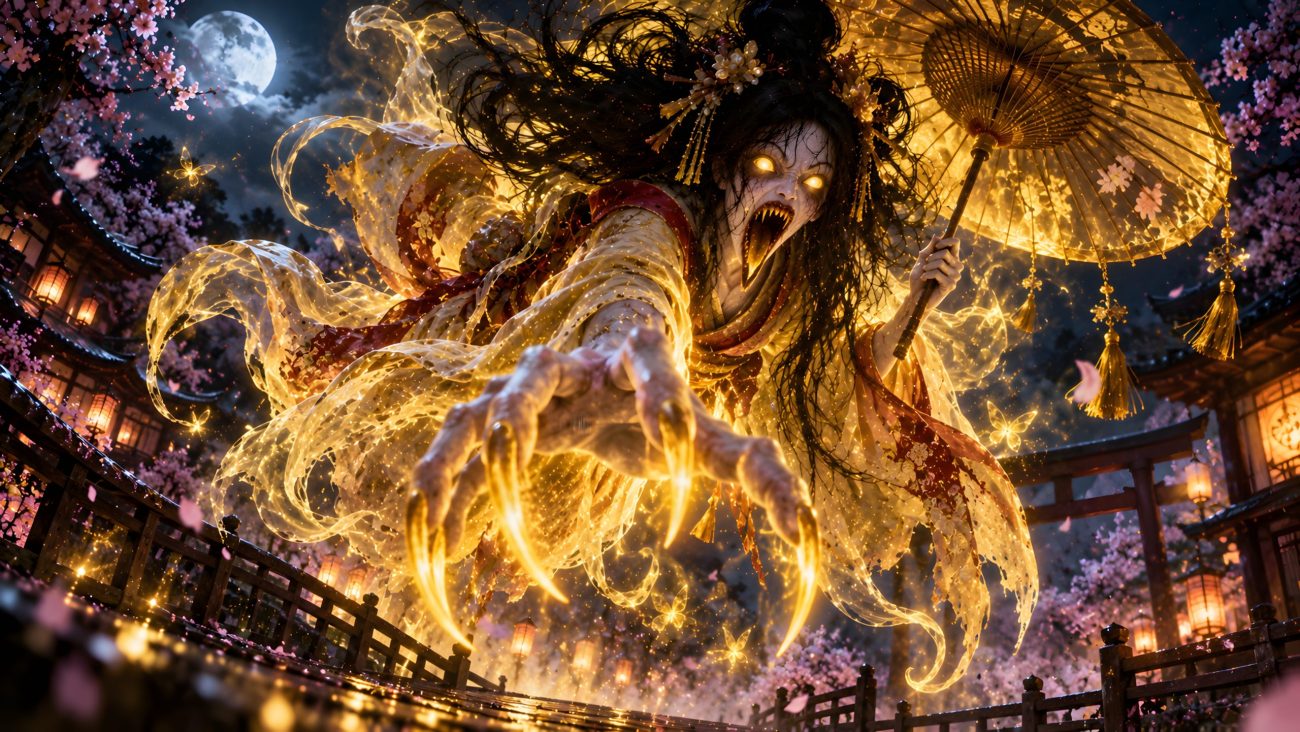
In later plays that continue Iwafuji’s story, she returns from the dead as a vengeful ghost. One prominent version appears in Kagami-yama Gonichi no Iwafuji, also known as Kotsuyose no Iwafuji, written by Kawatake Mokuami and first performed in 1860. In this story, Iwafuji’s remains are left in a horse burial ground after her death at Ohatsu’s hands. Her spirit lingers there until Ohatsu, who has earned praise for her loyalty and become the second Onoe, visits to pray for the repose of her predecessor’s soul. A dark flame suddenly rises, and scattered bones gather together before flesh begins to return to the corpse. Iwafuji reappears with disheveled hair and decaying skin, greeting Ohatsu with a curse and promising to haunt the Taga family, torment Hanazono-hime, and assist Mochizuki Danjō in his plot to seize power. Although a protective sword briefly drives her away, she returns in a beautiful, almost supernatural form, carrying a parasol and playing with butterflies as she floats through the air above the cherry blossoms.
Iwafuji continues her revenge by helping the conspirators undermine the Taga household. When Hanazono-hime falls ill under the influence of a malevolent spirit, the villains falsely accuse the second Onoe of cursing her. Iwafuji disguises herself as Danjō and uses forged documents and accusations to corner Onoe, even repeating the humiliation inflicted upon the first Onoe by beating her with a sandal. The ghost’s deception is eventually exposed when Sekiya uses a shrine of Kishimojin to make her vanish and restore the palace to its proper state. Iwafuji later confronts Onoe again, wielding a snake-eye umbrella and renewing her curses, but Inukiyo drives her away by presenting the sacred image of Kishimojin. This time, her spirit finally disappears, and her body returns to a skeleton before shattering into pieces. The play’s spectacular scene in which the resurrected Iwafuji floats through the air is known as Fuwa Fuwa and remains one of the story’s theatrical highlights. Through her resurrection and repeated attempts at revenge, Iwafuji becomes a figure of relentless malice whose grudges persist beyond death.
Sources
“Iwafuji.” 新版TYZ 妖怪図鑑 (New TYZ Yokai Encyclopedia). https://tyz-yokai.blog.jp/archives/1077741612.html