Tradition: French Mythology
Alternative Names: Washerwomen of the Night, Kannerez Noz, Bean Nighe, Mille-Lorraines, Teurdous
Category: Fairy
The Myth
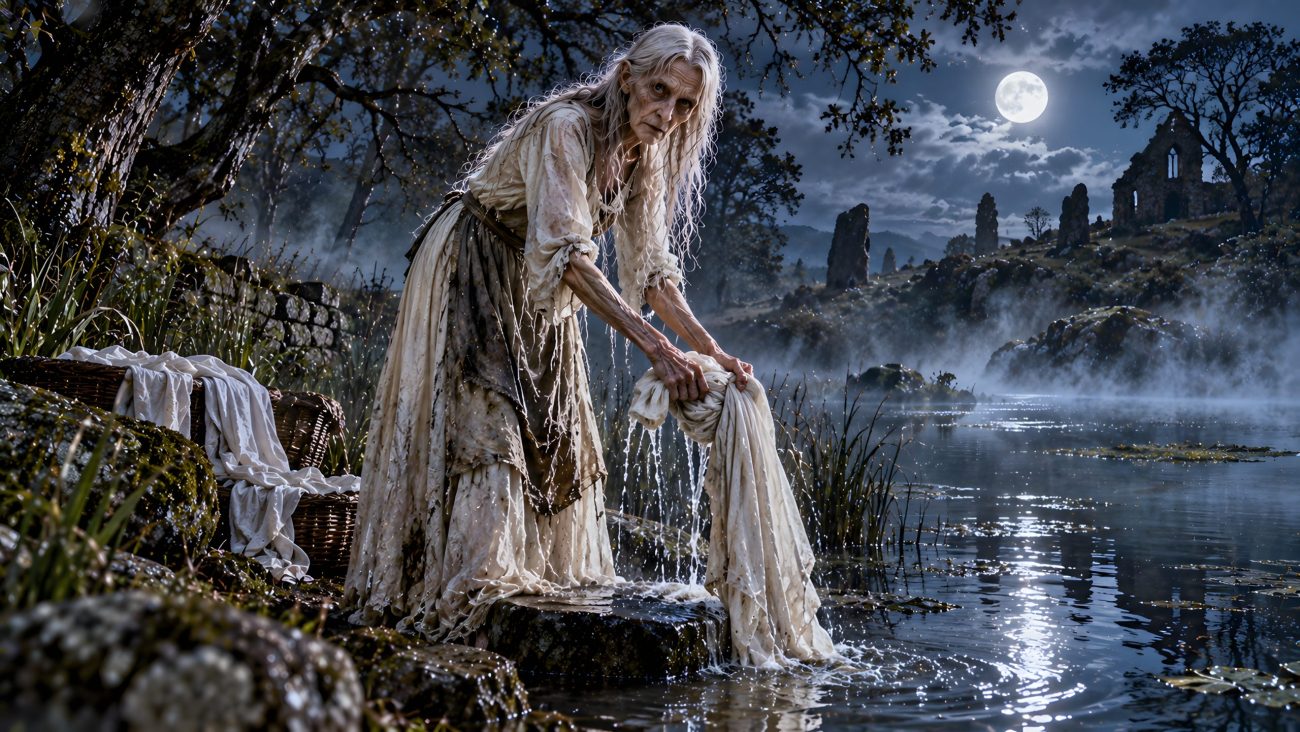
The Lavandières de Nuit are supernatural washerwomen who appear at night beside ponds, rivers, and other bodies of water. They are usually imagined as tall, gaunt, withered old women, although the Gollières a Noz of Romandie are described as beautiful as they are cruel. Some sing while they wash, earning the name Kannerez Noz, or “night singers.” Their songs are mournful and are sometimes associated with the dead; in Morbihan they are said to sing of wringing rags and the shrouds of dead wives. Some washerwomen are condemned spirits forced to wash a burial shroud as punishment for sins committed during life. Among them are women who worked at their laundry on Sundays, greedy misers who refused proper clothing to the poor, and women guilty of infanticide. In the darkest stories, the sheets they wash remain stained with blood and reveal the outline of the murdered child.
The Lavandières are especially dangerous when they encounter people at night. In Brittany, they may call upon passers-by to help wring their laundry. Those who refuse can be drowned, while those who agree may have their arms broken or be forced to continue until exhaustion. The only way to survive the task is to wring the cloth in precisely the same direction as the washerwomen, following every turn they make throughout the night. A single mistake can result in the victim being crushed and twisted to death. Another escape is to tell them, “Wring out your sins, and I will wring out mine.” Running away can also save a person, while freshly ploughed fields are places the washerwomen cannot cross. The sign of the cross and biblical verses are likewise said to protect against them. Different communities tell of their own washerwomen: the Lavandière of Chantepie endlessly washes the dirty shroud in which she buried her husband; those of Fond-de-Fond hold up the bodies of the newly dead; those around Landéda spare goodhearted people but tie sinners into knots; and several washerwomen gather at the pond of Roc-Reu, where anyone attempting to touch them is drowned.
Related traditions appear throughout the Celtic and French-speaking world. The Bean Nighe of the British Isles are women who died in childbirth and are condemned to wash the clothes of people destined to drown until the day they themselves were supposed to die. Seeing one can therefore foretell death. Some are connected with the Morrigan and wash the clothing of the dead; in one tale, Cú Chulainn encounters the daughter of Bodhbh washing bloodstained clothes while weeping, shortly before his death in battle. Around Dinan, the Teurdous is a rare male counterpart who offers to help washerwomen wring their clothes, only to break their arms if they accept. The Mille-Lorraines of Lower Normandy form fairy circles around ponds, while the Lavandière of Noes Gourdais is said to appear in the early morning with a skull instead of a head. Around Dinan, these supernatural washerwomen became so strongly associated with the night that strange sounds from frogs and toads were sometimes interpreted as their washboards and singing. There were also real women who washed clothing at night, whether because they worked during the day or wished to avoid being seen, and even thieves exploited the legend: one French warden once encountered two spectral-looking washerwomen and spent the entire night helping them wash fine clothing, only to discover afterward that the garments had been stolen from a nearby castle.
Sources
“Lavandière de Nuit.” A Book of Creatures. April 17, 2015. A Book of Creatures
https://abookofcreatures.com/2015/04/17/lavandiere-de-nuit