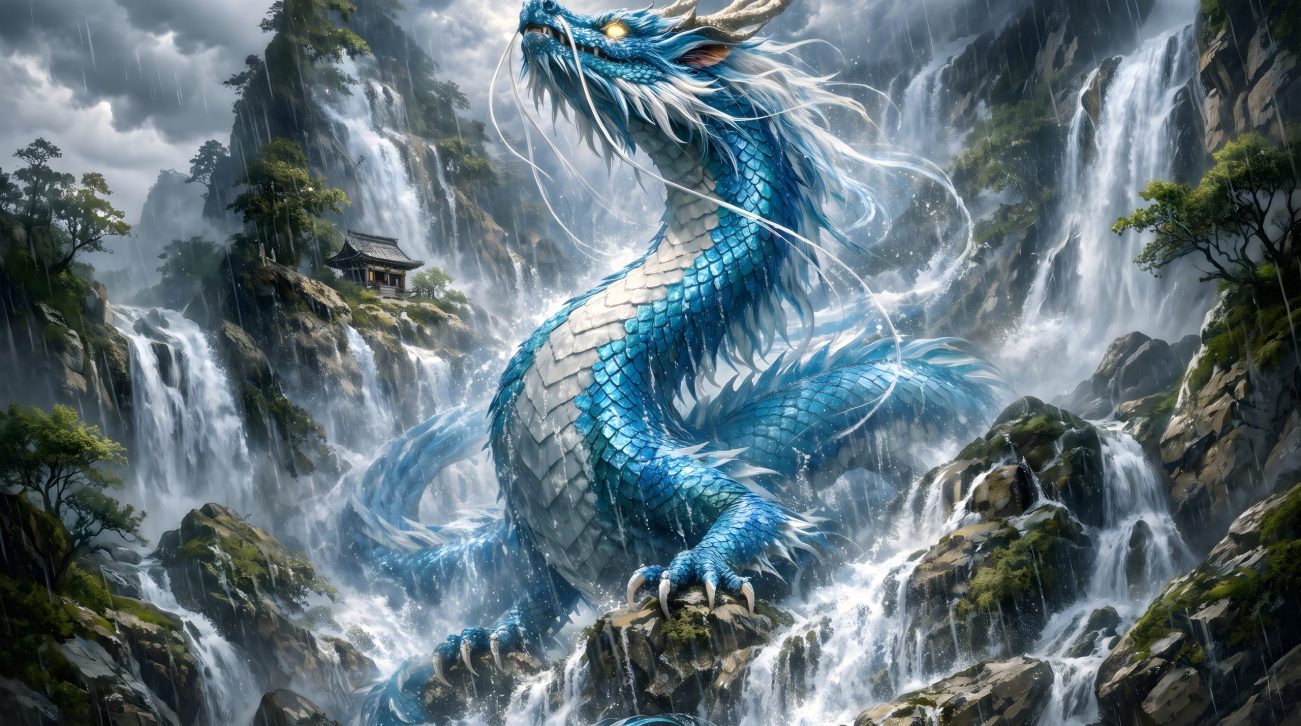
Tradition: Japanese mythology
Alternative Names: Ōkami, Kuraokami-no-kami, Takaokami-no-kami, Okagami
Category: Dragon
The Myth
Okami is a powerful dragon god associated with water. It is imagined as a great supernatural dragon dwelling in mountain valleys, deep ravines, hills, and springs. Different traditions distinguish between forms of Okami, with Takaokami associated with the mountains and Kuraokami with the dark valleys.
Okami controls rain and snow and has power over springs and other waters. Because of this, people prayed to the deity for rain during droughts and for protection from destructive floods.
In the Kojiki, Kuraokami-no-kami was born from the blood of Kagutsuchi, the fire god, after Izanagi killed him with his sword. The Nihon Shoki gives different accounts of the birth of Kuraokami and other water-related gods, including a tradition in which Kuraokami, Kurayamatsumi, and Kuramitsuha emerged from Kagutsuchi’s blood.
Okami was worshipped at shrines throughout Japan. At Kifune Shrine in Kyoto, Takaokami is revered as the principal deity. Other shrines dedicated to Okami were established beside rivers and in agricultural areas, reflecting the dragon god’s power over water.
One legend tells of Horyo Myojin, a practitioner of Shugendo who sacrificed himself to save people suffering from drought. After his death, he became a dragon and brought rain to the people.
Okami could also appear in the form of a serpent. The Bungo Province Fudoki tells of a spring inhabited by a snake deity. When Emperor Keikō visited the area, the deity prevented the people from safely drawing water from the spring.
Okagami is also invoked as a deity capable of controlling snowfall. A poem in the Man’yōshū describes snow that had been requested from Okagami on a mountain, showing the dragon god’s power over the falling snow as well as rain.
Sources
Takahashi, Toshihiro. “龗 [おかみ] (Okami).” 新版TYZ 妖怪図鑑 (New TYZ Yokai Encyclopedia). January 27, 2024. https://tyz-yokai.blog.jp/archives/1083024550.html