Tradition: Japanese mythology
Alternative Names: Wani
Category: Dragon
The Myth
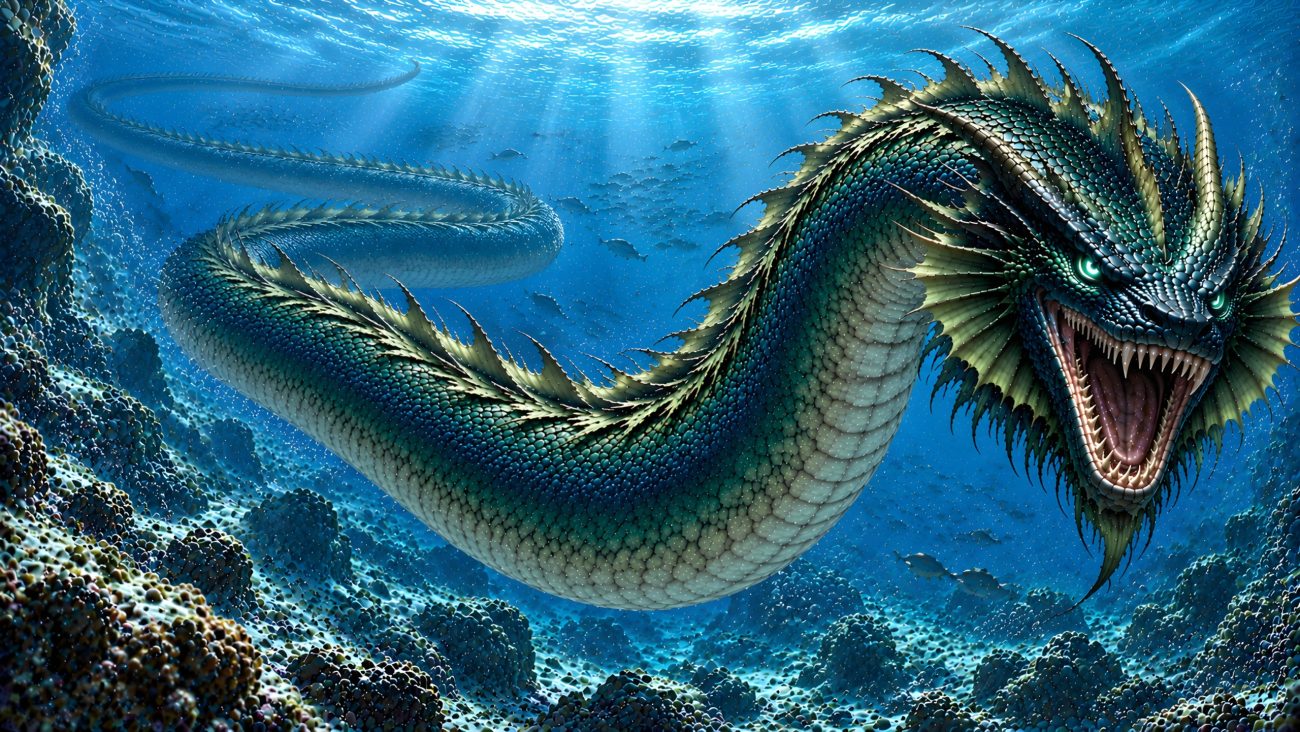
Wani are enormous sea monsters said to dwell in the depths of oceans, seas, and lakes. They possess long, serpentine bodies and fins and can breathe both air and water. Although monstrous in their natural form, wani are capable of transforming themselves into humans, and stories even tell of wani and human beings falling in love.
Wani are regarded as rulers of the oceans and gods of the sea. Far beneath the surface they dwell in magnificent coral palaces, where they maintain a society that mirrors the political world of humans. Their underwater kingdoms contain kings and queens, princes and princesses, courtiers, servants, and other ranks. Among them, Watatsumi, also known as Ryūjin, is the greatest of the sea dragons. He rules the ocean from the magnificent Ryūgū-jō and possesses the tide jewels kanju and manju, with which he controls the ebb and flow of the sea.
The wani appear in some of Japan’s earliest written mythology, particularly the Kojiki and Nihon shoki, although their stories are believed to preserve traditions considerably older than these texts. Their ultimate origins are uncertain, and similarities have been noted between the wani and other great aquatic beings such as the Chinese long and the Indian naga.
The word wani originally appeared in the Kojiki written phonetically using man’yōgana. It was later written with the character 鰐. The word came to encompass sharks and other dangerous sea creatures encountered by sailors and fishermen, perhaps reflecting the way real marine predators could become identified with the enormous serpents of mythology. Over time its meaning expanded to include crocodiles and eventually became associated specifically with crocodiles. Today, wani and the kanji 鰐 normally mean “crocodile,” even though the older mythology describes a very different kind of creature.
One of the greatest stories involving the wani concerns Toyotama-hime, the daughter of Watatsumi. She encountered Hoori, a human hero and grandson of Amaterasu, after he descended into the realm beneath the sea. Hoori had accidentally lost his brother Hoderi’s fishing hook and, unable to find it, eventually discovered the palace of the Dragon King. There he asked Watatsumi for help recovering the lost hook.
With the Dragon King’s assistance, Hoori eventually found the hook. During his stay in the underwater palace, however, he fell in love with Watatsumi’s daughter, Toyotama-hime. The two married and lived together beneath the sea for three years.
Eventually Hoori grew homesick and longed to return to the world above. He and Toyotama-hime therefore returned to the surface together, bringing Hoderi’s lost hook with them. Once back on land, Toyotama-hime became pregnant and prepared to give birth.
She warned Hoori not to look upon her during childbirth. In order to bear the child, she explained, she had to abandon her human appearance and assume her true form. But Hoori could not overcome his curiosity. He secretly looked at his wife as she gave birth and was horrified to discover that the woman he loved had become an enormous wani, cradling their newborn son.
Toyotama-hime was devastated by his betrayal and ashamed that he had witnessed her true nature. Unable to forgive him, she fled back into the sea and never again saw Hoori or the child she had given birth to.
Her sister Tamayori took responsibility for raising the abandoned child. He grew to adulthood and eventually married Tamayori. Their son was Jimmu, who became the first emperor of Japan. Through Toyotama-hime and her wani lineage, the ancient sea-dragon tradition thus became intertwined with the legendary ancestry of Japan’s imperial line.
Sources
“Wani.” Yokai.com: The Japanese Yokai Encyclopedia. Accessed October 3, 2026. https://yokai.com/wani/