Tradition: Japanese mythology
Alternative Names: Nine-Headed Dragon, Kuzuryū Gongen, Kuzuryū Ōkami,
Category: Dragon
The Myth
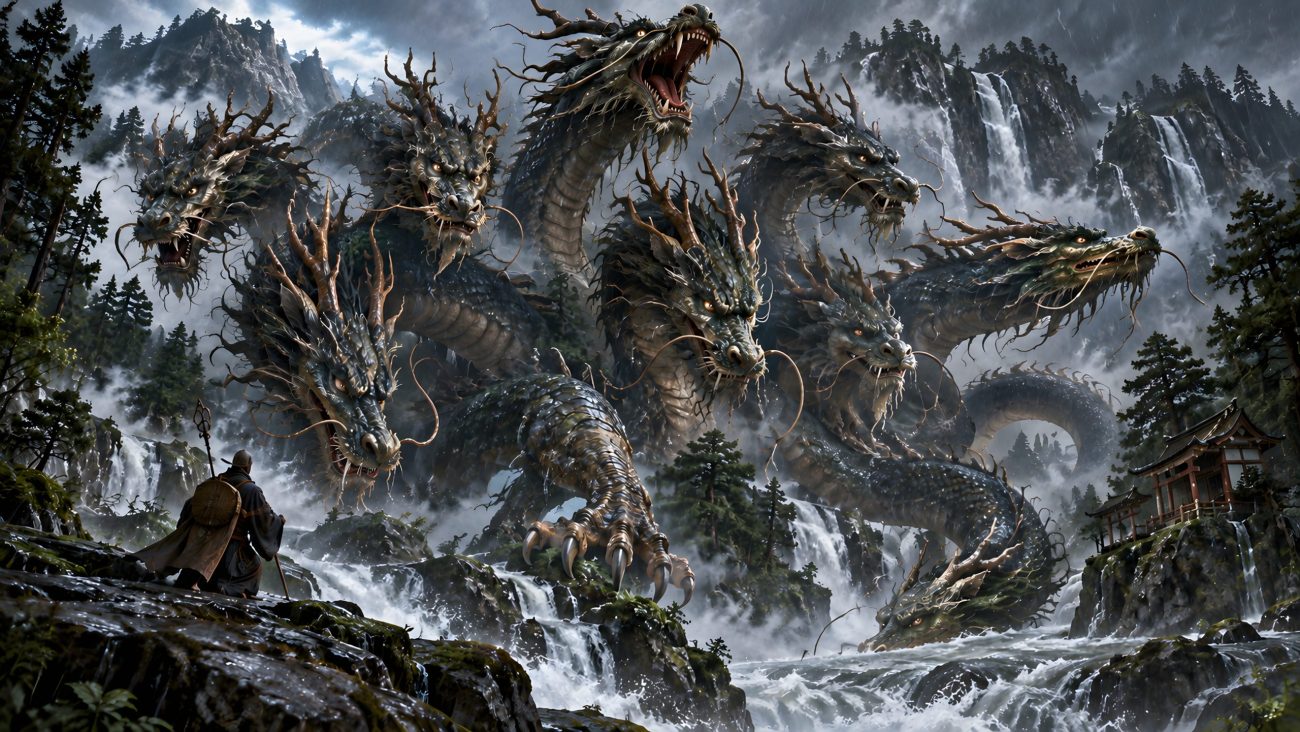
The Nine-Headed Dragon, or Kuzuryū, is a great dragon with nine heads and a single tail. It is especially associated with water, mountains, rain, and sacred places throughout Japan.
At Mount Togakushi in Shinshu, a great dragon with nine heads and one tail was said to dwell when a scholar-ascetic arrived there in search of a place where Buddhism could flourish. The dragon, also described as an oni, had become a harmful presence in the mountain. Through the power and merit of the Lotus Sutra, the ascetic overcame its harmful influence and caused the dragon to repent.
Kuzuryū then vowed to protect Mount Togakushi and urged the ascetic to establish a great temple there. Afterward, the dragon concealed itself by sealing the treasure cave with a huge rock. The cave was the place where the vajra thrown from Mount Iizuna had landed. This act was said to give Mount Togakushi its name, while the ascetic established Kenkōji Temple, later associated with Togakushi Shrine, where Kuzuryū Gongen was enshrined.
Kuzuryū became especially revered as a water god. People prayed to it for rain, and a particular ritual involved taking water from Taneike Pond to Togakushi Shrine and having prayers for rain performed over it. The water was then carried back without allowing it to touch the ground and sprinkled over the rice fields, after which rain was expected to fall.
Kuzuryū was also believed to have a fondness for pears. Offerings of pears were traditionally made to the dragon to relieve toothaches. People suffering from tooth pain could write their names and the location of the pain on pears, pray toward Mount Togakushi from a distance, and then set the pears afloat in a river.
Another legend connects the Nine-Headed Dragon directly with the creation of Mount Togakushi. When Amaterasu Ōmikami hid inside the Heavenly Rock Cave, Tajikarao no Mikoto attempted to open it. He pulled with such force that the rock was thrown down into the lower world, where it became Mount Togakushi. The Nine-Headed Dragon God appeared in response to the sound of the falling rock, and the Kuzuryū of Togakushi was regarded as a temporary manifestation of this Dragon God.
Nine-headed dragons appear in other Japanese legends as well. At Lake Ashi in Hakone, a poisonous dragon once rampaged through the waters until the monk Manmaki subdued it, after which the dragon became a god and was enshrined as Kuzuryū Daimyōjin. In Fukui, a nine-headed dragon is said to have swum along the Kuzuryū River as though carrying the floating statue of Hakusan Gongen. On Mount Onikiri in Chiba, another nine-headed dragon was defeated by Yamato Takeru and subsequently enshrined at Jinnoji Temple.
In Tadami, Fukushima, the name of the Kuguryū district is connected to another legend in which a nine-headed dragon rose from a swamp and ascended into heaven. Across these traditions, the Nine-Headed Dragon appears as a powerful supernatural being of water and mountains, sometimes dangerous and destructive, but capable of repentance and becoming a divine protector.
Sources
Takahashi, Toshihiro. “九頭竜 [くずりゅう] (Kuzuryū).” 新版TYZ 妖怪図鑑 (New TYZ Yokai Encyclopedia). October 21, 2024. https://tyz-yokai.blog.jp/archives/1082950617.html