Tradition: Japanese mythology
Alternative Names: Jikininki, Human-Eating Demon
Category: Demon
The Myth
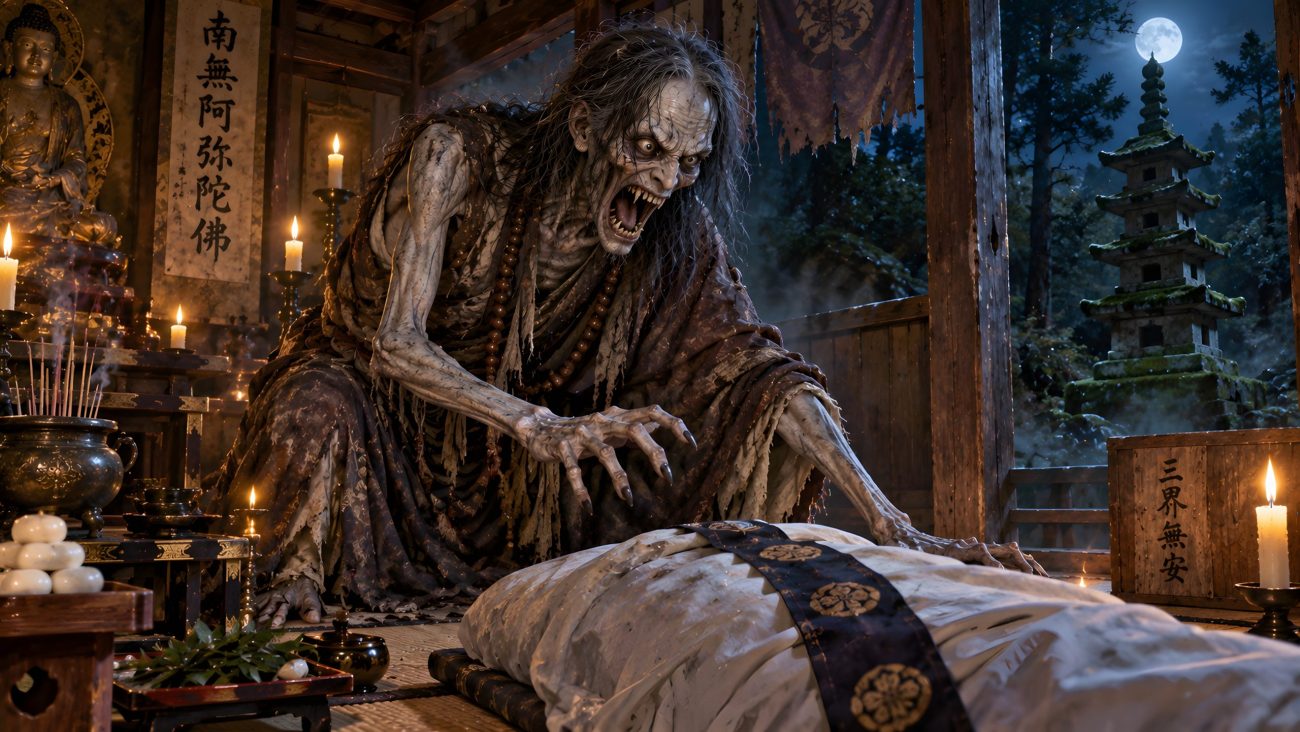
Jikininki is a man-eating demon that feeds upon human corpses and the offerings placed before them. It appears in the story “Jikininki” associated with Lafcadio Hearn’s Kwaidan.
Long ago, Musō Kokushi, the Rinzai Zen monk Musō Soseki, was traveling through Mino Province. As evening approached, he became lost in the mountains and discovered an old hermitage on a hill. He asked the old monk who appeared to live there for lodging, but the monk curtly refused him and instead directed him toward a village in the valley.
Musō traveled to the village and was warmly welcomed into the house of the village headman. He was given a meal in an outbuilding and went to sleep.
Late that night, the young man who had welcomed him came to his room and explained that the village headman had actually died shortly before Musō arrived. The young man was his son. Now that the funeral was over, he intended to leave the village for another settlement, according to the custom that everyone must leave the village on the night of a death. Strange things were believed to happen in houses where a corpse was left alone, and those who violated the custom were said to suffer great misfortune.
Musō was grateful for the hospitality he had received and decided to remain alone in the house until morning so that he could mourn the dead village headman. His words reassured the young man and the villagers, who thanked him before leaving.
Musō sat before the corpse, reciting Buddhist sutras and meditating while he waited for dawn. As the night grew deeper, an unknown creature entered the room. At the same moment, Musō became completely paralyzed and was unable to move.
The creature approached the corpse and devoured everything. It consumed the flesh, bones, and hair of the dead man, then ate the burial shroud and even the offerings that had been placed before the body. After consuming everything, it left the house.
The next morning, the villagers returned. Musō told them about the terrible creature that had entered during the night and devoured the corpse. The villagers recognized it as the same kind of being described in their old stories.
Musō then asked whether the monk living in the hermitage on the hill ever performed funerals for the villagers. The villagers looked at him in confusion. They told him that there was no hermitage on the hill and that they knew of no monk living there. No monk had settled in the area for a very long time.
Musō left the village and returned to the hill to discover the truth. He found the hermitage without difficulty. The old monk welcomed him inside, bowed respectfully, and confessed that Musō had seen him the previous night swallowing the corpse and devouring the offerings.
The monk revealed that he had once been the only monk living in the area. Because of this, the villagers depended upon him whenever someone died and needed Buddhist funeral rites. He became constantly occupied with funerals, and his religious devotion gradually disappeared. Eventually, he began performing Buddhist services merely to obtain food, clothing, and shelter.
After his death, the monk was reborn in the realm of hungry ghosts as a man-eating demon. From then onward, he became a wretched creature that survived by devouring the corpses of the dead in the surrounding area.
The demon begged Musō to perform a Buddhist memorial service for him and save him through prayer. As he pleaded, both the demon and the hermitage suddenly vanished. Musō found himself sitting alone among the tall weeds. Beside him stood only a moss-covered five-tiered pagoda, which appeared to mark the monk’s grave.
Sources
Takahashi, Toshihiro. “食人鬼 [じきにんき] (Jikininki).” 新版TYZ 妖怪図鑑 (New TYZ Yokai Encyclopedia). May 7, 2016. https://tyz-yokai.blog.jp/archives/1056923784.html