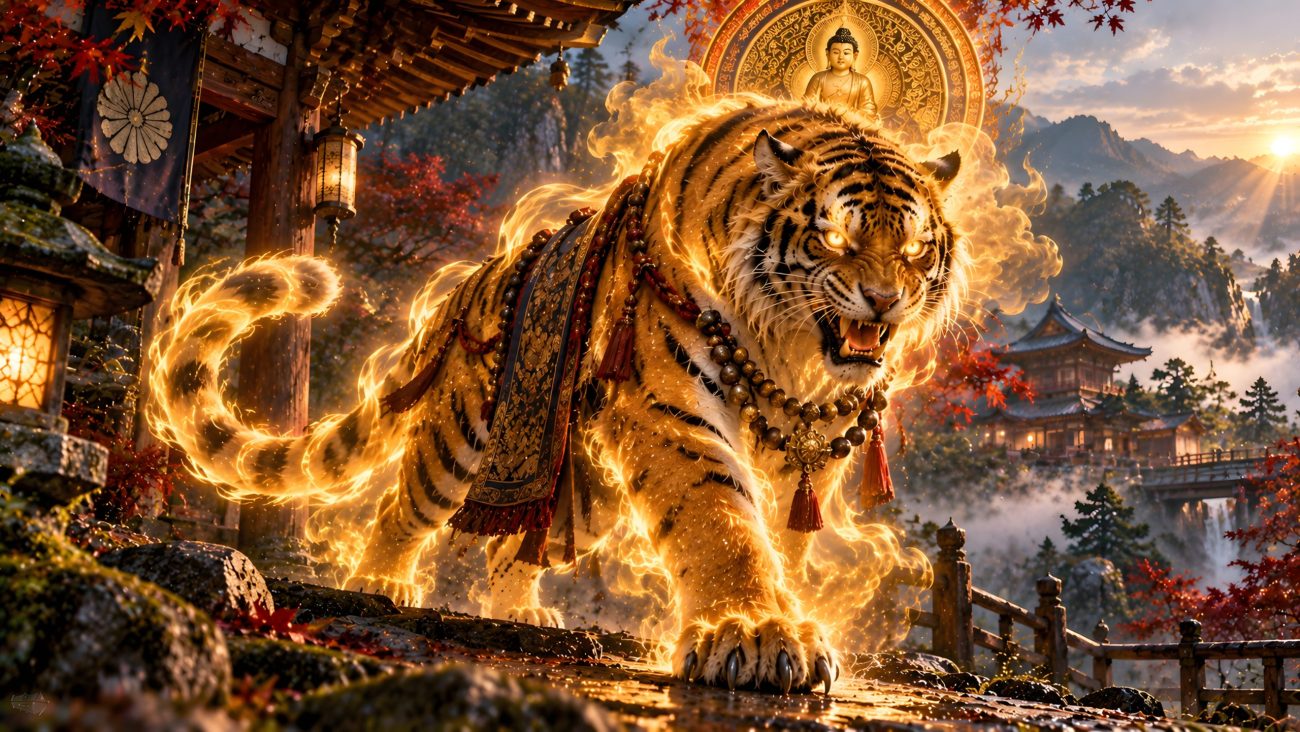
Tradition: Japanese Mythology
Alternative Names: Tiger Yakushi
Category: Tiger
The Myth
Tora Yakushi is the name given to statues of Yakushi Nyorai, the Buddha of Medicine, associated with tigers. At Jōsenji Temple in Suginami, Tokyo, the name is connected to a legend in which Yakushi Nyorai transformed into a tiger to save a person from danger.
According to the temple’s founding legend, the statue, traditionally attributed to the Buddhist monk Gyōki, was originally located near Hōrai-ji Temple in Mikawa Province. During the Eiroku era (1558–1570), a young man living in Shinshiro, Mikawa, was attacked by a wolf. Yakushi Nyorai manifested as a tiger and rescued him.
In gratitude, the young man became a Buddhist monk and came to be known as Shōgan Sonkichi Zenji. He founded Sekiunzan, later transferring the statue from Hōrai-ji to serve as the principal image of the new temple. The name Sekiunzan is said to derive from the event in which a mottled stone grew as though clouds were rising from it before transforming into a tiger.
Jōsenji’s Tora Yakushi became known as a Buddhist figure who protects people from calamities and attracted devoted worshippers from the Edo period onward.
A statue of the tiger that represented Yakushi’s manifestation was also enshrined at the temple. It reportedly remained intact through fires and earthquakes. However, during the Great Kantō Earthquake of 1923, the tiger statue was damaged, seemingly as though it had taken the place of the principal image and the people. A replacement tiger statue was made during the Shōwa era.
According to another local tradition, the tiger statue would wander outside at night and frighten people.
Sources
Tyz-Yokai. (n.d.). Torayakushi. https://tyz-yokai.blog.jp/archives/1080047322.html