Tradition: Japanese Mythology
Alternative Names: 照兜魚
Category: Mermaid
The Myth
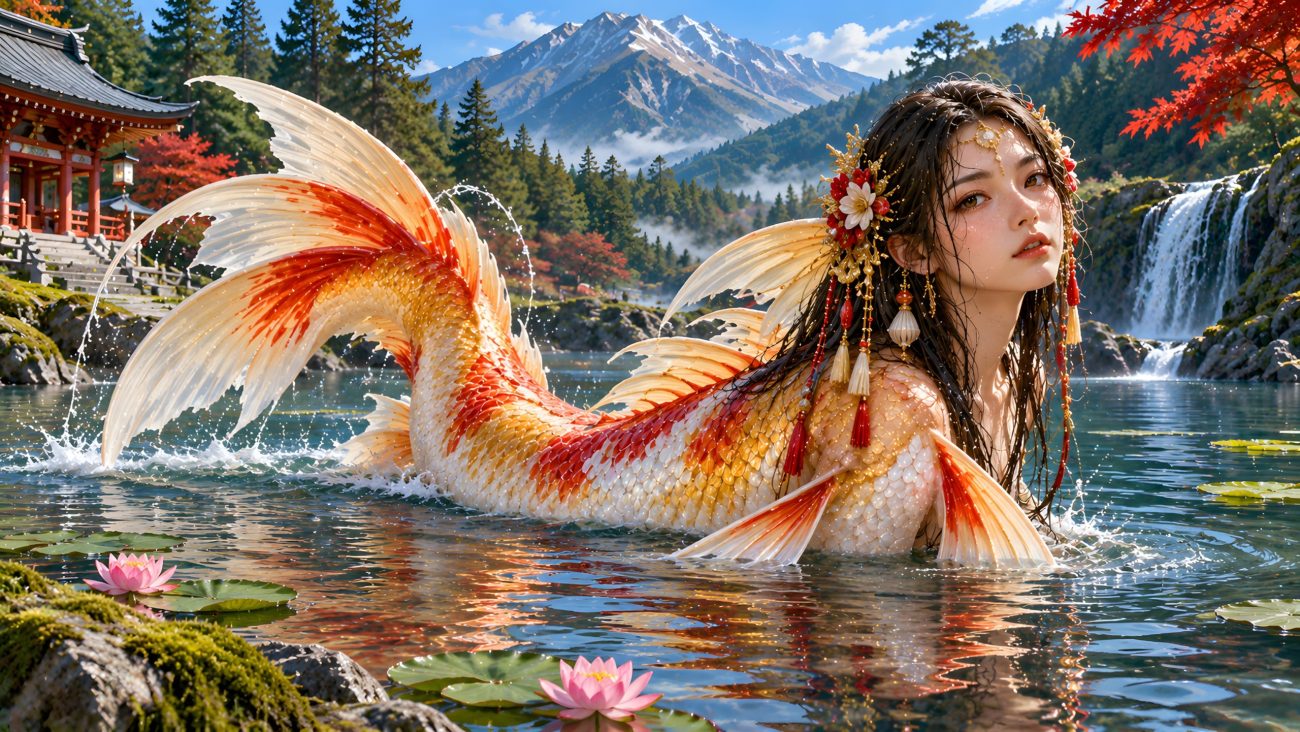
Terutouo is a sacred carp associated with Akamatsu Pond on Mount Daisen in Izumo Province. According to a tale recorded by the British folklorist Richard Gordon Smith, the creature could take human form and lived as a young woman named Chiyoko.
In 1646, a kind-hearted man named Ōtani Jinai lived in Matsue with his wife, Oryō. The couple had been unable to have children for many years and prayed to various deities for help. After hearing that Ōgamiyama Shrine on Mount Daisen was renowned for granting the blessing of children, they climbed the mountain to pray. On their way home, thick fog suddenly surrounded them, and a beautiful young woman appeared to guide Jinai through the mist. Learning that the couple had prayed for a child, she gave them a bottle of sacred water. She explained that the water had been collected as dew from the grass around Akamatsu Pond and offered to Ōgamiyama Shrine on New Year’s Day. She promised that drinking it would grant them a child. Oryō drank the water and immediately felt light-headed, as though she had been drinking alcohol, while sensing that her wish would be fulfilled. When the couple looked again, the mysterious woman had vanished.
The following year, Oryō gave birth to a daughter named Chiyoko, also known as Ochiyo. She grew into a beautiful and intelligent young woman. When she was sixteen, a marriage was arranged between her and a young man named Tamaoki, who was Jinai’s nephew. Tamaoki welcomed the arrangement, but Chiyoko did not love him. Unable to bring herself to reject the match and disappoint her parents, she allowed the engagement to proceed.
Before the wedding, Chiyoko asked to visit Ōgamiyama Shrine to give thanks to the gods. Her parents agreed, and she travelled to the mountain accompanied by her nurse, Osuma. After praying at the shrine, the two began their descent and reached Akamatsu Pond, where Chiyoko’s parents had encountered the mysterious woman years earlier.
Chiyoko gazed across the water and approached the shore. As vapour rose from the pond, she turned to Osuma and thanked her before saying goodbye. She explained that although she had been born into the human world, her human appearance was only temporary. Her true identity was that of a carp living in the region, and her real home was the pond itself. Entrusting Osuma with a letter for her parents, Chiyoko plunged into the water and disappeared.
When Osuma cried out, asking to see her once more, a gigantic golden carp leapt from the pond in a spray of water. Its face was unmistakably Chiyoko’s. Overwhelmed, Osuma knelt and prayed to the creature.
After hearing Osuma’s account and reading Chiyoko’s letter, Jinai and Oryō were heartbroken. In her letter, Chiyoko expressed gratitude to her parents and explained that, as Terutouo, she was a carp and could not marry a human. She also told them that if they wished to see her again, they should call her name beside Akamatsu Pond.
Jinai recognised the story as connected to the sacred carp of Akamatsu Pond, whose existence he had heard about before. He concluded that the deity of Mount Daisen had granted him a child in the form of a carp. In response, he built a shrine dedicated to Terutouo and enshrined Chiyoko’s letter there.
Several days later, Jinai, Oryō, and their relatives visited the pond. Jinai called out “Terutouo!” three times. A tremendous sound rose from beneath the water, seemingly answering his summons, but Chiyoko never appeared. Tamaoki, whose marriage to Chiyoko could no longer take place, was adopted by Jinai and later devoted his life to Shinto.
From that time onward, visitors reportedly developed the custom of calling Terutouo’s name three times beside the pond. The shrine established by Jinai attracted young men and women seeking blessings for successful marriages. Around Mount Daisen, carp also came to be respectfully called Terutouo-san, and the name was reportedly extended to people of high rank and religious officials.
Richard Gordon Smith, who collected Japanese folktales during the Meiji period, included illustrations made by a Japanese artist alongside his account. These depicted a divine woman appearing from the pond and Terutouo as a carp with a human face.
Sources
Japanese folklore blog contributors. (n.d.). Terutou. In TYZ Yokai Blog, from https://tyz-yokai.blog.jp/archives/1077741621.html