Tradition: Norse Mythology
Alternative Names: Tanngiost (modern Anglicised form of Tanngnjóstr)
Category: Sheep
The Myth
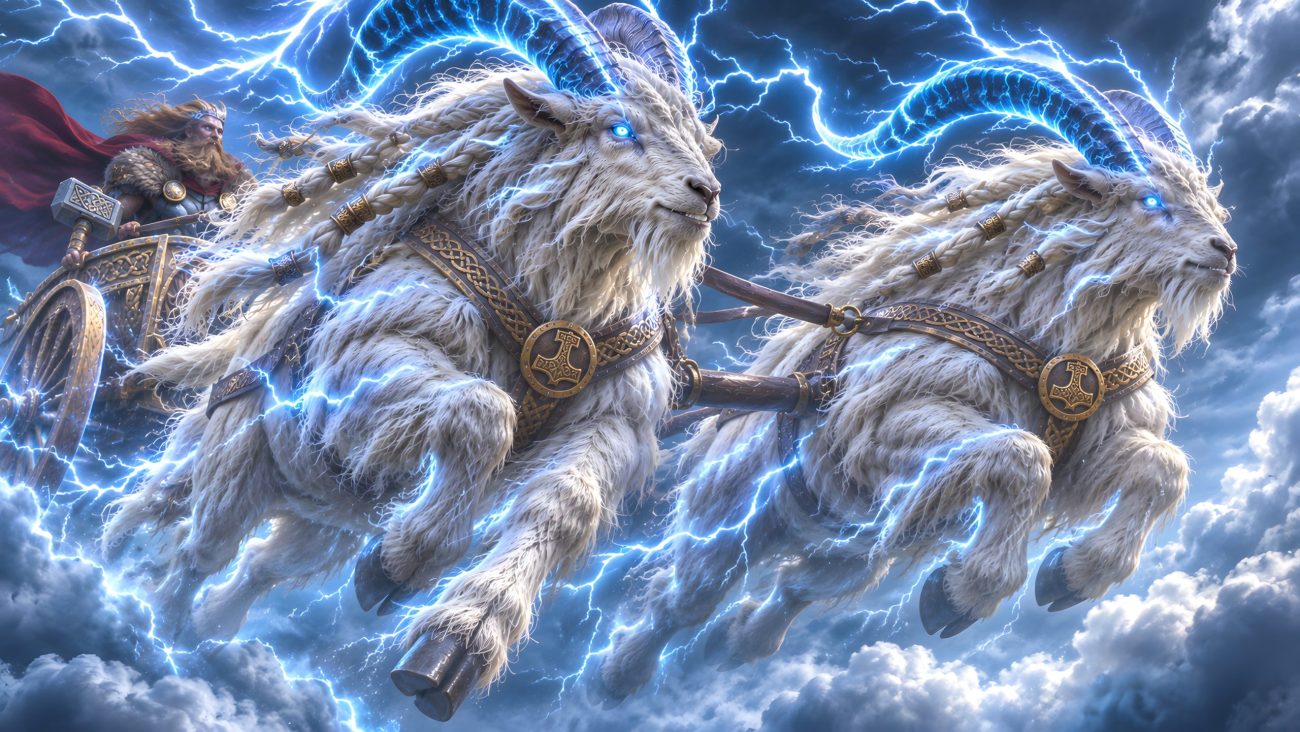
Tanngrisnir and Tanngnjóstr are the two mighty goats that pull the chariot of Thor, the Norse god of thunder. Their names mean approximately “teeth-barer” or “snarler” and “teeth-grinder” or “teeth-gnasher.” They possess a remarkable ability: Thor can slaughter them and eat their meat, only to bring them back to life with his hammer, Mjölnir.
After a meal, their bones must be carefully placed upon their skins. Thor then raises Mjölnir and blesses the remains, restoring both goats to life by the following morning.
One evening, Thor and Loki sought shelter at the home of a poor peasant farmer. Thor slaughtered his goats and shared their meat with the household, but warned everyone not to break or damage the bones. After the meal, the bones were to be placed upon the goatskins so that he could restore the animals the next day.
However, the farmer’s son, Þjálfi, could not resist splitting open one of the goats’ thigh bones to suck out the marrow. The following morning, Thor raised Mjölnir and brought the goats back to life. But when they stood up, one of them was lame in its hind leg. Thor immediately realised that one of the bones had been damaged.
Furious, the thunder god confronted the farmer and his family, frightening them with his anger. Terrified, they begged for mercy and offered all their possessions as compensation. Thor eventually accepted something else instead: the farmer’s children, Þjálfi and Röskva, who became his servants and accompanied him and Loki on their journey to Jötunheimr, the land of the giants.
The two goats also display their tremendous power when pulling Thor’s chariot. In one account, they travel towards Jötunheimr with such force that mountains shatter and the earth appears to burn beneath them. They are described as having splendid horns, befitting the divine animals that carry the thunder god across the heavens.
Their extraordinary ability to return from the dead has parallels with another Norse creature, Sæhrímnir, whose flesh is consumed and restored repeatedly. Their story has also been compared with Scandinavian folk beliefs concerning herring bones and witchcraft.
Sources
Wikipedia contributors. (n.d.). Tanngrisnir and Tanngnjóstr. Wikipedia. https://en.wikipedia.org/wiki/Tanngrisnir_and_Tanngnj%C3%B3str