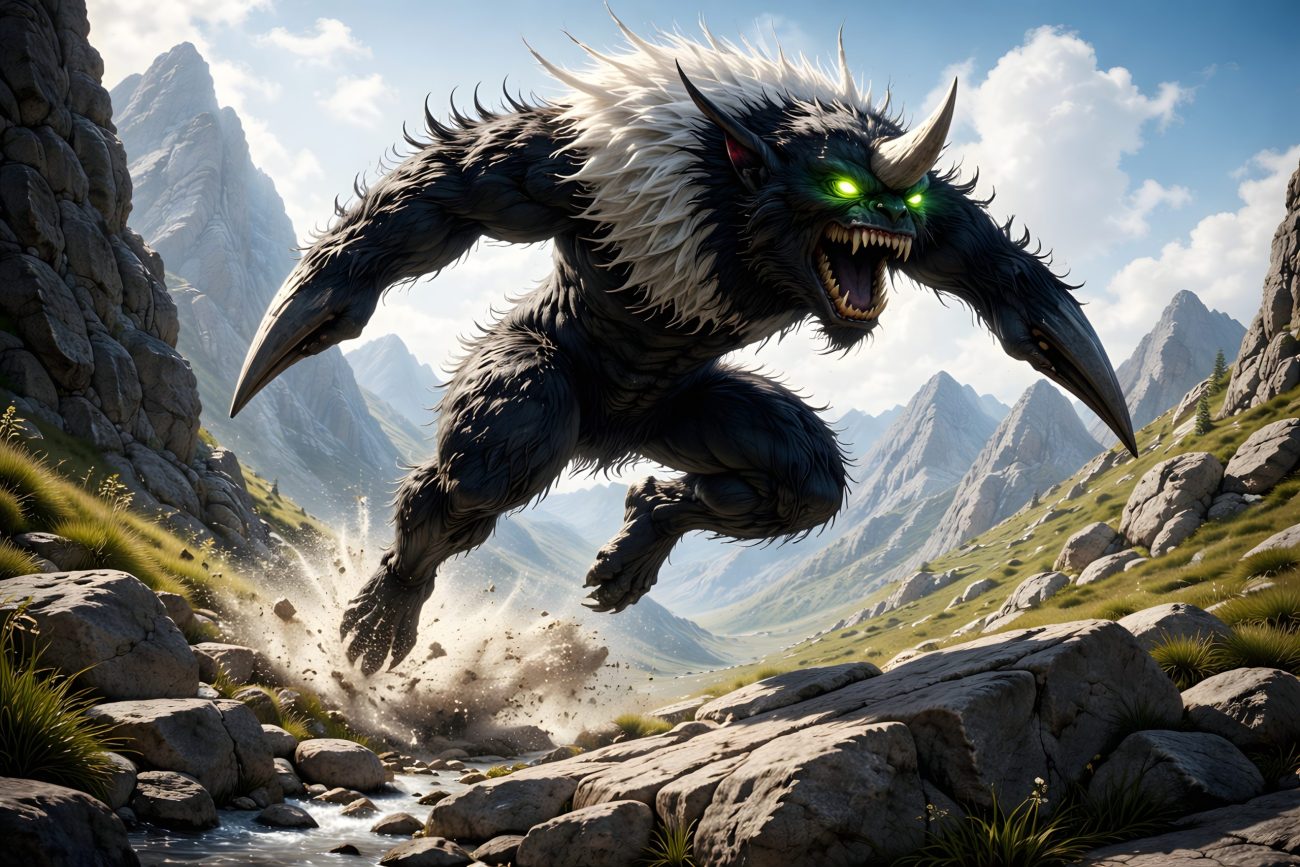
Puigmal

Tradition / Region: Catalan mythology, Spanish Mythology
Alternate Names:
Category: Giant, Mountain dweller


The Myth

In the high mountains above the valley of Ribes there once lived a giant named Puigmal.

He towered above the forests and peaks, a mighty being who watched over the trees and the wild animals. No hunter could loose an arrow without feeling his presence. No woodcutter could strike a trunk without sensing the mountain’s silent warning. Puigmal guarded nature fiercely, defending it from careless human hands.

One day, as he wandered the slopes, he milked a wild doe and made cheese from her milk. He brought this cheese to a human and offered it as a gift. “As long as you do not eat it all,” he said, “it will grow again and again. You will never hunger, and you will not need to hunt the creatures of these mountains.”

The gift was a covenant: live with restraint, and the mountain would provide endlessly.

But the balance between humans and nature is fragile. In time, the giant was turned to stone, his immense body becoming the very mountain that now bears his name—Puigmal. His stony form rises above the valley still, silent and watchful.

They say he remains there as guardian still, the mountain itself standing as his petrified body, overlooking the forests and animals he once defended.


Gallery


Sources

creatures-of-myth.fandom.com contributors. (n.d.). Puigmal. In creatures-of-myth.fandom.com, from https://creatures-of-myth.fandom.com/wiki/Puigmal


Interpretive Lenses

Religious Readings
  • Christian Ascetic Deep Dive
Philosophical Readings
  • Nietzschean Deep Dive
Psychological Readings
  • Jungian Deep Dive
Esoteric Deep Dive
  • Hermetic Deep Dive
Political / Social Readings
  • Marxist Deep Dive
Other
  • How to Invite The Puigmal

Cuegle

Tradition / Region: Cantabrian Mythology, Spanish Mythology
Alternate Names:
Category: Mountain dweller


The Myth

In the mountains and wild lands of Cantabria there is said to roam a dreadful creature known as the cuegle.

Though small in stature, it walks upright like a man. Its skin is black as soot, its beard long and tangled, its hair grey and unkempt. From its body sprout three arms—yet each ends bluntly, without hands or fingers. Upon its head sits a short, stunted horn, and in its face gleam three terrible eyes: one yellow, one red, and one blue. When it opens its mouth, five rows of teeth are revealed, layered deep within like the jaws of some monstrous trap.

Despite its size, the cuegle possesses enormous strength. It prowls at night, attacking travelers and livestock, dragging them down with ferocity. But most feared of all is its hunger for infants. The cuegle creeps silently into homes and steals babies from their cradles, vanishing into the darkness before anyone can stop it.

Families learned that the creature recoils from certain leaves. Oak and holly are hateful to it. So mothers would place fresh sprigs of oak or holly in the cradle beside their child. The sharp scent and sacred greenery drove the cuegle away, protecting the infant from its grasp.

Thus the people of Cantabria guarded their homes with leaves and vigilance, wary of the small, three-eyed horror that stalked the night.


Gallery


Sources

Wikipedia contributors. (n.d.). Zana (mythology). In Wikipedia, The Free Encyclopedia. Retrieved February 13, 2026, from https://en.wikipedia.org/wiki/Cuegle


Interpretive Lenses

Religious Readings
  • Christian Ascetic Deep Dive
Philosophical Readings
  • Nietzschean Deep Dive
Psychological Readings
  • Jungian Deep Dive
Esoteric Deep Dive
  • Hermetic Deep Dive
Political / Social Readings
  • Marxist Deep Dive
Other
  • How to Invite The Cuegle