Hati Hróðvitnisson

Tradition / Region: Norse Mythology
Alternate Names: Hati, Mánagarmr, Moon-Hound, Moon’s Dog
Category: Wolf


The Myth

Hati Hróðvitnisson is one of the monstrous wolf-sons of Fenrir, born of a giantess who dwells in the dark forest of Járnviðr, east of Midgard. From that wild place came many wolves, but Hati became one of the most feared.

While his brother Sköll hunts the Sun across the sky, Hati pursues the Moon. Each night he runs beneath the heavens, chasing the chariot of Máni, never resting, never turning aside. The Moon flees endlessly before him, and the night sky moves in constant motion because of the wolf’s pursuit.

Prophecy says this hunt will not last forever. When Ragnarök arrives and the world begins to break apart, Hati will finally catch his prey. He will seize the Moon and swallow it whole, darkening the sky and casting the world into chaos.

Some tales say that this same wolf, called Mánagarmr, will grow fat on the flesh of the dead before the end of days. When the final battles begin, he will rush across the heavens, staining the sky with blood as the order of the cosmos collapses.

Until that destined hour, Hati runs through every night — the unseen hunter whose shadow follows the Moon.


Gallery


Sources

Wikipedia contributors. (n.d.). Hati Hróðvitnisson. In Wikipedia. Retrieved March 1, 2026, from https://en.wikipedia.org/wiki/Hati_Hr%C3%B3%C3%B0vitnisson


Interpretive Lenses

Religious Readings
  • Christian Ascetic Deep Dive
Philosophical Readings
  • Nietzschean Deep Dive
Psychological Readings
  • Jungian Deep Dive
Esoteric Deep Dive
  • Hermetic Deep Dive
Political / Social Readings
  • Marxist Deep Dive

Sköll

Tradition / Region: Norse Mythology
Alternate Names: Skoll, Skǫll
Category: Wolf, Celestial Beast, Apocalyptic Pursuer


The Myth

Sköll is one of the great wolves born of Fenrir, the monstrous son of Loki. From the beginning of the world, he was set upon a relentless hunt across the sky.

Each day, the goddess Sól drives the chariot of the Sun through the heavens, pulled by shining horses. Behind her races Sköll, a vast and tireless wolf. He runs with jaws open, always gaining, always threatening to catch her. The Sun moves swiftly, but never fast enough to escape him forever.

At night, his brother Hati hunts the Moon, pursuing Máni across the darkness in the same unending chase. Thus the sky is never still, for the wolves are always running.

This pursuit is fated to last until the end of the world. When Ragnarök comes, the order of the cosmos will fail. On that final day, Sköll will at last overtake the Sun and devour her, plunging the world into darkness. His brother will seize the Moon, and the heavens will collapse into chaos as the stars vanish from the sky.

So long as the Sun rises and sets, Sköll still runs — an eternal hunter racing toward the doom of gods and men alike.


Gallery


Sources

Wikipedia contributors. (n.d.). Sköll. In Wikipedia. Retrieved March 1, 2026, from https://en.wikipedia.org/wiki/Sköll


Interpretive Lenses

Religious Readings
  • Christian Ascetic Deep Dive
Philosophical Readings
  • Nietzschean Deep Dive
Psychological Readings
  • Jungian Deep Dive
Esoteric Deep Dive
  • Hermetic Deep Dive
Political / Social Readings
  • Marxist Deep Dive

Fenrir

Tradition / Region: Norse Mythology
Alternate Names: Fenrisúlfr, Hróðvitnir, Vánagandr
Category: Wolf


The Myth

Fenrir is the monstrous wolf born to the trickster god Loki and the giantess Angrboða. He is the brother of the world-serpent Jörmungandr and Hel, ruler of the dead. From the moment of his birth, prophecies foretold that he would bring ruin to the gods.

Because of this, the gods took Fenrir into their own realm and raised him among them, hoping to control his fate. Yet the wolf grew at an unnatural speed, becoming larger and more terrifying with each passing day. Of all the gods, only Týr had the courage to approach him and feed him.

Fearing the prophecy, the gods decided to bind Fenrir before he became unstoppable. They forged a massive chain called Leyding and challenged him to test his strength. Fenrir allowed himself to be bound, but with a single effort he shattered the chain.

They forged a second, stronger fetter called Dromi, and again Fenrir agreed to be bound so his strength might win fame. This too he broke with ease, and the gods grew afraid.

Finally, Odin sent for the dwarfs to create a magical binding. They forged a silken ribbon named Gleipnir, made from impossible things: the sound of a cat’s footsteps, a woman’s beard, the roots of a mountain, the sinews of a bear, the breath of a fish, and the spittle of a bird. Though it looked soft and harmless, it was stronger than any iron.

The gods brought Fenrir to the island Lyngvi and asked him to test this ribbon. Suspicious of trickery, Fenrir demanded a pledge of good faith. He agreed only if one of the gods would place a hand inside his mouth while the fetter was tied.

None dared, except Týr. He stepped forward and placed his right hand between the wolf’s jaws.

When Fenrir struggled, Gleipnir tightened and held him fast. Realizing he had been deceived, Fenrir bit down and tore off Týr’s hand. The gods chained the ribbon to a stone buried deep in the earth and forced a sword into Fenrir’s mouth to hold his jaws open. From his drooling rage flowed the river Ván. There he remained bound, howling, until the end of the world.

At Ragnarök, when the bonds of the world break, Fenrir will finally be freed. He will stride across the land with flames in his eyes, his upper jaw scraping the sky and his lower jaw the earth. In the final battle he will confront Odin himself and swallow the All-Father whole.

But Odin’s son Víðarr will avenge him. With a mighty step he will force Fenrir’s jaws apart and tear the wolf asunder, bringing about the fall of the monster and the turning of the age.


Gallery


Sources

Wikipedia contributors. (n.d.). Fenrir. In Wikipedia. Retrieved March 1, 2026, from https://en.wikipedia.org/wiki/Fenrir


Interpretive Lenses

Religious Readings
  • Christian Ascetic Deep Dive
Philosophical Readings
  • Nietzschean Deep Dive
Psychological Readings
  • Jungian Deep Dive
Esoteric Deep Dive
  • Hermetic Deep Dive
Political / Social Readings
  • Marxist Deep Dive

Garmr

Tradition / Region: Norse Mythology
Alternate Names: Garm
Category: Dog


The Myth

Garmr is the terrifying hound of the Norse underworld, associated with Hel, death, and the final cataclysm of Ragnarök. He is described as a blood-stained guardian who watches over the entrance to the realm of the dead, often said to be bound at the cave Gnipahellir.

In the Poetic Edda, Garmr is named as the greatest of hounds, and his howling is a prophetic sign of the world’s end. In the poem Völuspá, his cry is repeated as a refrain, each time marking another step toward Ragnarök — the breaking of bonds, the rise of chaos, and the coming destruction of the gods.

Another poem, Baldrs draumar, tells how Odin rides to the underworld and encounters a fearsome hell-hound, bloody on its chest and howling at him from afar. Though unnamed in the poem, this dog is often identified as Garmr.

In the Prose Edda, Garmr’s fate is sealed: when Ragnarök arrives, his bonds will snap and he will run free. He will fight the god Týr, and the two will slay one another in the final battle.

Because of his role as a guardian of the dead and his connection to apocalyptic prophecy, Garmr is often compared to other mythic hellhounds such as Cerberus, and in some traditions he is even equated with the monstrous wolf Fenrir.


Gallery


Sources

Wikipedia contributors. (n.d.). Garmr. In Wikipedia, from https://en.wikipedia.org/wiki/Garmr


Interpretive Lenses

Religious Readings
  • Christian Ascetic Deep Dive
Philosophical Readings
  • Nietzschean Deep Dive
Psychological Readings
  • Jungian Deep Dive
Esoteric Deep Dive
  • Hermetic Deep Dive
Political / Social Readings
  • Marxist Deep Dive

Margyg

Tradition / Region: Norse mythology, Greenlandic Mythology
Alternate Names:
Category: Mermaid


The Myth

Sailors in the northern seas told of a strange being that appeared only when storms were near.

It was called the margyg.

Those who saw it said it rose from the sea like a woman from the waist up, but vast and unsettling in form. Its chest was heavy, its arms long, and its hair streamed down wet over its shoulders. Its head and neck resembled those of a human, yet its face was coarse and fearsome, with a wide mouth, heavy cheeks, and a low brow. Its hands were large, and the fingers were joined together by webbing like the feet of seabirds.

Below the waist, it was wholly a fish, covered in scales with fins and a powerful tail.

The margyg was said to appear rarely, and almost always before a great storm. Sailors would spot it rising above the waves, holding a fish in its hands.

If it swam toward a ship, tossing the fish toward the vessel or playing with them as it approached, the crew believed disaster was coming and feared they would not survive the storm.

But if the margyg ate the fish, or threw them away from the ship and turned aside, the sailors took heart. Though the storm might still strike, they believed they would live through it.

For this reason, the margyg was not merely a monster of the sea, but a sign — a creature whose brief appearance foretold the fate of those who sailed beneath the darkening sky.


Gallery


Sources

Bestiary.us contributors. (n.d.). Margjug. In Bestiary.us, from https://www.bestiary.us/margjug/


Interpretive Lenses

Religious Readings
  • Christian Ascetic Deep Dive
Philosophical Readings
  • Nietzschean Deep Dive
Psychological Readings
  • Jungian Deep Dive
Esoteric Deep Dive
  • Hermetic Deep Dive
Political / Social Readings
  • Marxist Deep Dive
Other
  • How to Invite The Margyg

Auðumbla

Tradition / Region: Norwegian mythology
Alternate Names:
Category: Cow


The Myth

In the beginning there was only Ginnungagap, the great empty void stretched between two extremes. To the north lay Niflheim, a realm of ice, mist, and bitter cold. To the south burned Muspelheim, a world of fire and sparks. Where cold met heat, the ice began to melt, and from the dripping rime the first life emerged.

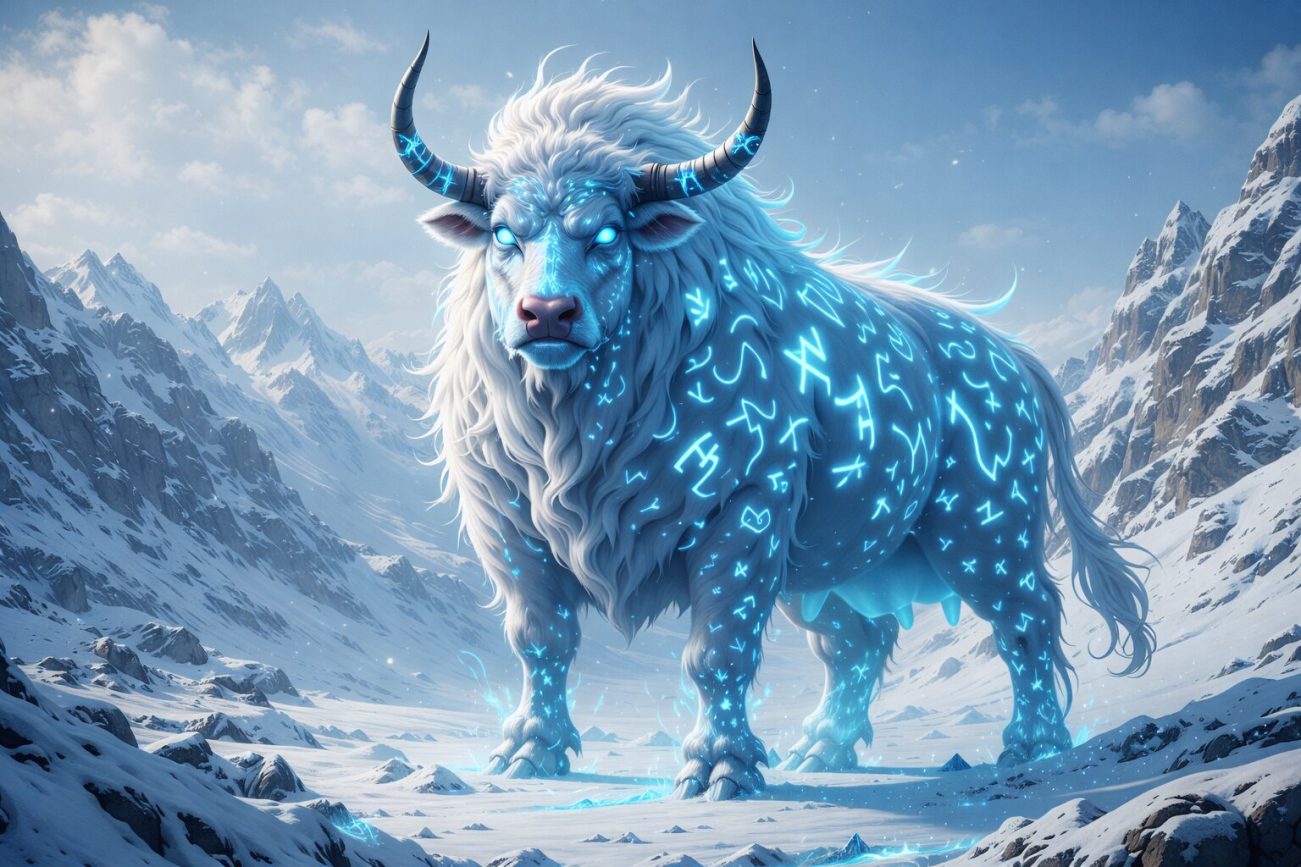
From this mingling was born Ymir, the primordial frost giant, vast and ancient. But Ymir did not survive alone. From the same melting ice came a great cow named Auðumbla.

Auðumbla fed Ymir with the milk that flowed from her four teats, sustaining him in the age before land, sky, or gods existed. While Ymir drank, Auðumbla wandered the void, licking the salt-covered ice stones formed by ancient frost.

As she licked, the ice began to change.

On the first day, a man’s hair appeared within the frozen stone. On the second day, a head emerged. On the third day, the ice released a complete being, alive and whole. His name was Búri.

Búri became the ancestor of the gods. From him came Borr, and from Borr were born Odin, Vili, and Vé. These sons would one day slay Ymir and shape the world from his body, forming earth, sea, sky, and stars.

Thus Auðumbla stands at the dawn of creation. She nourished the first giant and uncovered the first god, bridging chaos and order. Through her milk and her patient licking of ice, the foundations of the cosmos were laid.


Gallery


Sources

Sturluson, S., Nordal, S., & Young, J. (1954). The prose Edda of Snorri Sturluson : tales from the Norse mythology. In University of California Press eBooks. http://ci.nii.ac.jp/ncid/BA79942020

Wikipedia contributors. (2025b, October 6). Auðumbla. Wikipedia. https://en.wikipedia.org/wiki/Au%C3%B0umbla#Name


Interpretive Lenses

Religious Readings
  • Christian Ascetic Deep Dive
Philosophical Readings
  • Nietzschean Deep Dive
Psychological Readings
  • Jungian Deep Dive
Esoteric Deep Dive
  • Hermetic Deep Dive
Political / Social Readings
  • Marxist Deep Dive
Other
  • How to Invite The Auðumbla

Ahuna

Tradition / Region: Norwegian Mythology
Alternate Names: Ahune; Ahunum; Hahune; Hahanie; Swamfisk
Category: Fish


The Myth

In the depths of the sea lives a creature called the Ahuna, feared not for speed or cunning, but for its boundless hunger. Of all fish, it is the most voracious. It eats without pause, consuming fish after fish until its belly swells larger than its own body, stretched and distended beyond what seems possible.

The Ahuna’s body is strange and ill-formed. Its mouth opens directly into its stomach, with no true neck or throat between, as if it were nothing but hunger given flesh. When danger approaches, the creature does not flee. Instead, it curls inward, tucking its head and limbs into its own body like a hedgehog, folding skin and flesh over itself until nothing vulnerable remains. In this state it lies still, waiting for the threat to pass.

But the Ahuna’s appetite never sleeps.

If hunger seizes it while it is curled tight, the monster turns upon itself. Unable to unfold without exposing itself to danger, it gnaws at its own body, devouring its own flesh to satisfy its need. Thus it survives by consuming itself, only to grow hungry again.

Some say the Ahuna bears a beak like a bird and is marked with wavelike stripes; others describe it as a sea-hedgehog, round and coiled, with a twisted tail. Whatever its shape, all agree on its nature: a creature trapped by endless appetite.

In northern waters it is also called the Swamfisk, a rare monster hunted for its fat and oil. Yet even when slain, the Ahuna is remembered as a warning—that hunger without limit devours not only the world, but itself.


Gallery


Sources

A Book of Creatures contributors. (n.d.). Swamfisk. In A Book of Creatures, from https://abookofcreatures.com/2019/04/26/swamfisk/


Interpretive Lenses

Religious Readings
  • Christian Ascetic Deep Dive
Philosophical Readings
  • Nietzschean Deep Dive
Psychological Readings
  • Jungian Deep Dive
Esoteric Deep Dive
  • Hermetic Deep Dive
Political / Social Readings
  • Marxist Deep Dive
Other
  • How to Invite The Ahuna