Dragon of Odainsaker

Tradition: Norse Mythology
Alternative Names: Dragon of Odainsaker
Category: Dragon


The Myth

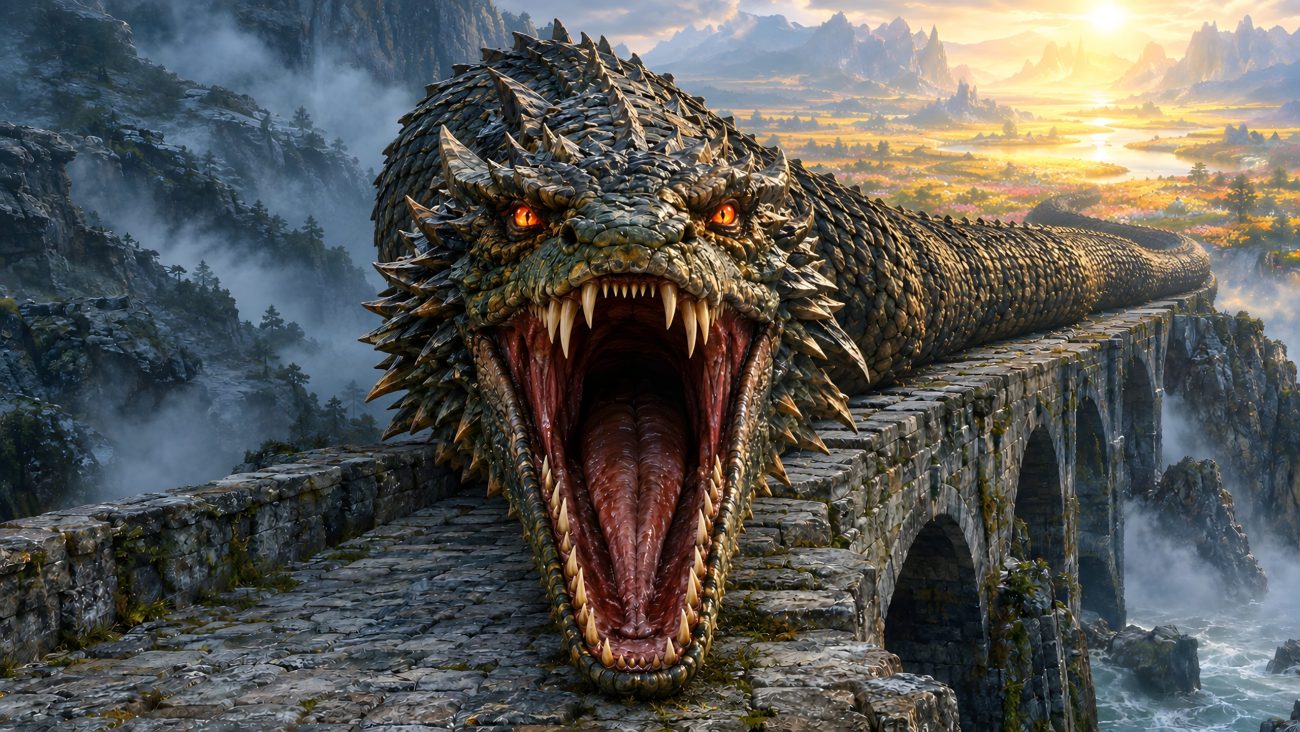
A great dragon lay stretched across the stone bridge leading toward the mysterious land of Odainsaker. It rested there with its jaws opened wide, blocking the only apparent path across the river and guarding the way into the wondrous country beyond.

Erik, a Norwegian prince who had sworn to seek out Odainsaker, eventually reached the bridge after travelling with his Danish companion through distant lands. They had passed through Syria and India and then entered a strange, dark country where the stars could be seen even during the day. At last they came to a river crossed by a vaulted stone bridge. Beyond it lay a beautiful plain filled with sweet fragrance, and Erik believed the river to be the Pison, said to rise in Paradise.

The dragon lying upon the bridge terrified Erik’s Danish companion, who urged him to turn back. He believed that no man could overcome such a beast or pass the bridge. Erik, however, refused to abandon his quest. He seized a weapon and confronted the dragon, determined to reach the land beyond.

The dragon swallowed Erik and his companion whole. Inside the monster they expected to find death, but instead they discovered themselves surrounded by smoke. The smoke soon cleared, and astonishingly they were unharmed. They had somehow passed through the dragon and emerged upon the magnificent plain beyond the bridge.

The land before them was unlike anything they had known. It was bathed in perpetual sunlight, covered with flowers, and crossed by rivers of honey. The air was still except for gentle breezes carrying the fragrance of the flowers, and nothing cast a shadow. The two travellers continued onward until they discovered a strange tower suspended in the air, with no foundation or pillars to support it. There they rested before eventually learning that they had reached Odainsaker, the wondrous land where sickness and old age could not touch those who entered.


Sources

Rydberg, Viktor. Teutonic Mythology: Gods and Goddesses of the Northland. Edited and translated by Rasmus Björn Anderson, with James W. Buel. London, New York, etc.: Norrœna Society, 1906.

Nidhogg

Tradition: Norse mythology
Alternative Names: Níðhǫggr, Níðhöggr, Nidhöggur, Nidhug
Category: Dragon


The Myth

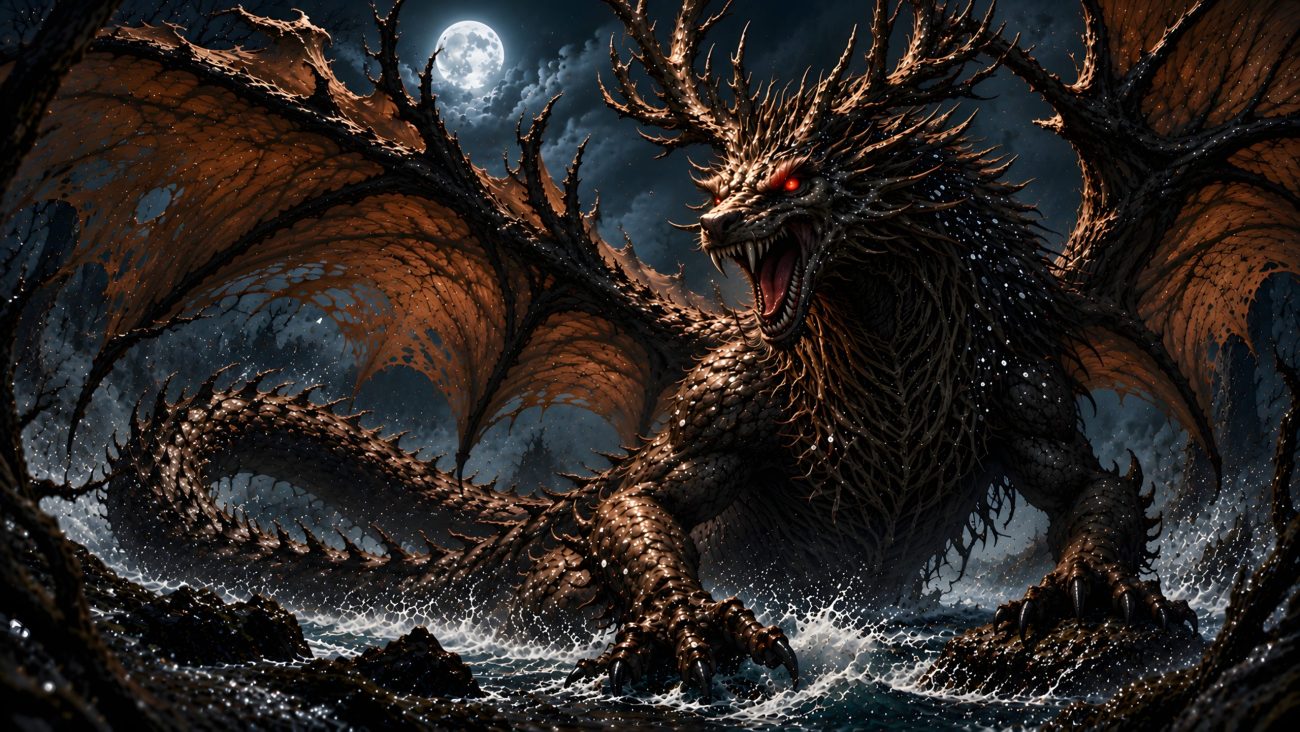
Nidhogg is a terrible dragon or serpent that dwells beneath Yggdrasil, the great World Tree. He gnaws endlessly at one of the tree’s great roots, the root that stretches over Niflheim. Beneath the world tree, he continually tears at its foundations while other creatures inhabit the branches above.

Nidhogg is also associated with the dead and the dark realms beneath the world. In the halls of Náströnd, where the wicked dead suffer, venom falls through the roof and the hall is woven from serpents’ spines. There Nidhogg feeds upon the corpses of those who committed murder, broke oaths, or betrayed those who trusted them. He is described as a creature of malice, a monstrous serpent that consumes the dead.

High above him, an eagle dwells among the branches of Yggdrasil. Between the eagle and Nidhogg runs the squirrel Ratatoskr, carrying hostile and envious words between the two creatures as it travels up and down the World Tree. Thus the great dragon beneath the roots is locked into an ancient struggle with the creature above.

Nidhogg’s most ominous appearance comes at the end of Völuspá. After the events surrounding Ragnarök, a dark dragon comes flying from the direction of Niðafjöll, described as a gleaming serpent carrying the corpses of the dead in its wings. The dragon is Nidhogg, rising from the darkness with the bodies of the dead as the world sinks. The meaning of this final appearance is uncertain, but it is commonly understood as an ominous image connected with Ragnarök.

His name itself is connected with biting or striking, and may evoke malice, darkness, or the act of gnawing below the roots of Yggdrasil. Whatever its precise meaning, Nidhogg’s role is unmistakable: beneath the World Tree waits a monstrous serpent, endlessly gnawing at its roots and feeding upon the dead.


Sources

“Níðhöggr.” Wikipedia: The Free Encyclopedia. Wikimedia Foundation. Accessed October 2, 2026. https://en.wikipedia.org/wiki/Nidhogg


Fáfnir

Tradition: Norse mythology
Alternative Names: Fáfnir, Fafnir, Fáfnisbani
Category: Dragon


The Myth

Fáfnir was originally a dwarf who transformed himself into a great worm-dragon to guard a vast treasure. In his dragon form he was a huge, serpentine creature, described in the oldest accounts as flightless and snake-like. Later traditions give him shoulders, leaving open the possibility of legs or wings.

Fáfnir was the son of Hreiðmarr and the brother of Regin and Ótr. The trouble began when Odin, Loki, and Hœnir accidentally killed Ótr, who had taken the form of an otter. The gods were forced to pay Hreiðmarr a great ransom of gold. Loki obtained the treasure from the dwarf Andvari, including the cursed ring Andvaranaut and the Helm of Terror. Andvari warned that the treasure would bring death to whoever possessed it.

Hreiðmarr refused to share the treasure with his sons. Fáfnir became consumed by greed and killed his own father, taking the entire hoard for himself. He fled into the wilderness and settled at Gnitaheath, where his greed and corruption transformed him into a dragon. There he coiled himself around the treasure and guarded it, becoming increasingly vicious and ill-natured.

Fáfnir’s brother Regin eventually sought revenge and sent his foster son Sigurð to kill the dragon. He gave Sigurð the sword Gram and instructed him to hide in a pit beneath the path Fáfnir used when he went to drink. Sigurð followed the plan. As Fáfnir crawled over the pit, breathing poison before him, Sigurð thrust his sword upward into the dragon’s body, mortally wounding him.

As Fáfnir lay dying, he spoke to Sigurð and questioned him about his name and the reason for his attack. He warned the young warrior that the treasure would eventually bring about his death, just as it had brought destruction to its previous owners. Fáfnir then died from his wound.

Regin returned and asked Sigurð to prepare Fáfnir’s heart for him to eat. While roasting it, Sigurð touched the heart to see whether it was cooked and burned his finger. He instinctively put the finger into his mouth, and Fáfnir’s blood touched his tongue. Suddenly he could understand the speech of birds.

The birds warned Sigurð that Regin intended to betray and kill him so that he could take the treasure for himself. Sigurð listened to their warning, killed Regin, and took the treasure for himself. He loaded the hoard onto his horse Grani, carrying away the cursed wealth that had already destroyed Fáfnir and his family.


Sources

“Fáfnir.” Wikipedia: The Free Encyclopedia. Wikimedia Foundation. Accessed September 20, 2026. https://en.wikipedia.org/wiki/F%C3%A1fnir