Wölfraleh Woman of Beringen

Tradition / Region: Luxembourg Mythology
Alternate Names: Wölfra, Wild Woman of Wölfraleh
Category: Cave dweller, Spinner


The Myth

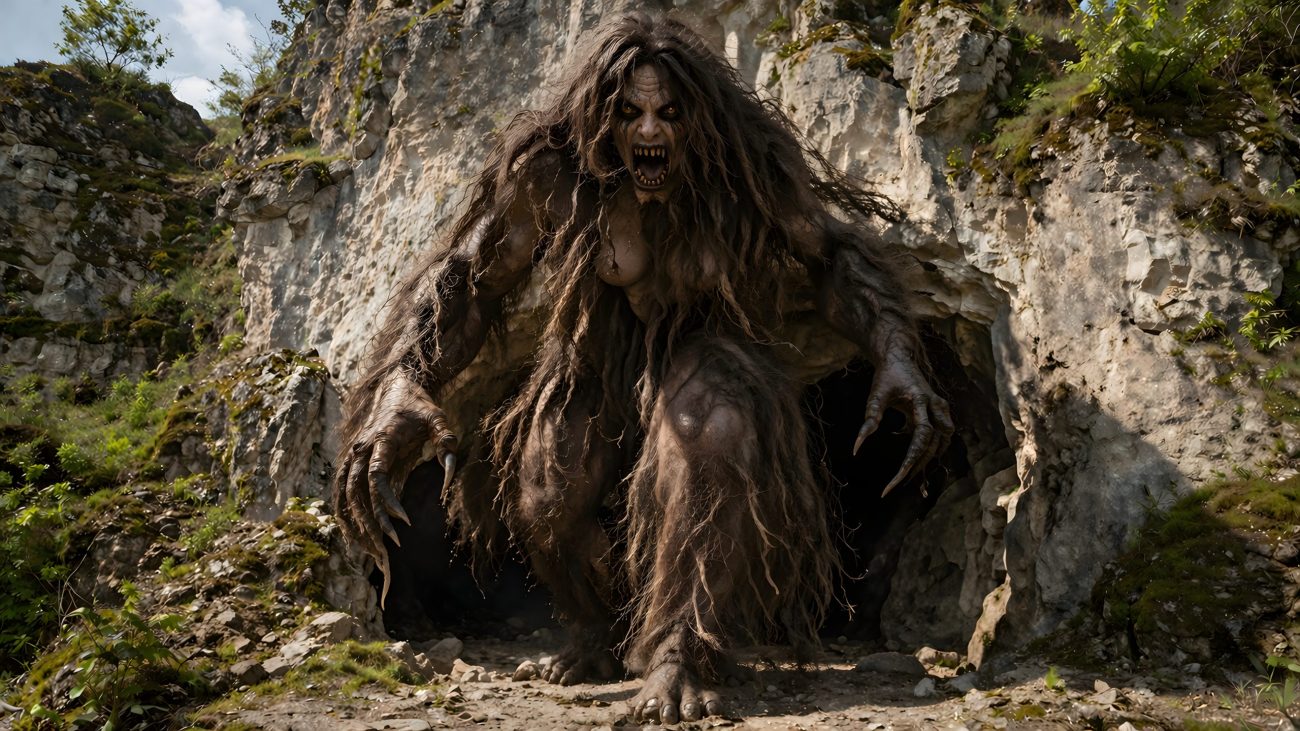
In the Beringer Forest stands a high rock known as Wölfraleh, the Rock of the Wild Woman. It is hollowed out into a roughly square chamber with one side open, and a narrow stairway leads up from below.

According to the old stories, a wild woman once lived there, alone in the stone chamber. Others say that it was not a spirit but a lonely, childless couple who once made their dwelling in the rock, cut off from the rest of the world.

A similar tale is told of another hollow rock near Mersch, where a woman once lived entirely by herself. She did nothing but spin and lived in such isolation that people called her Wölfra, the solitary one.

Thus the rocks of the region were remembered as the homes of a lone woman who lived apart from all others, spinning in her stone dwelling.


Gallery


Sources

sagen.at contributors. (n.d.). Die Wölfraleh bei Beringen. In sagen.at, from https://www.sagen.at/texte/sagen/luxemburg/woelfraleh.html


Interpretive Lenses

Religious Readings
  • Christian Ascetic Deep Dive
Philosophical Readings
  • Nietzschean Deep Dive
Psychological Readings
  • Jungian Deep Dive
Esoteric Deep Dive
  • Hermetic Deep Dive
Political / Social Readings
  • Marxist Deep Dive

Wild Woman of La Sauvage

Tradition / Region: Luxembourg Mythology
Alternate Names: Wild Woman of the Val de la Sauvage Femme
Category: Cave dweller


The Myth

Before the ironworks of La Sauvage were built in the early seventeenth century, the valley was uninhabited and known as the Valley of the Wild Woman. The name came from a fearsome being said to live in a cave in the rock of La Cronnière.

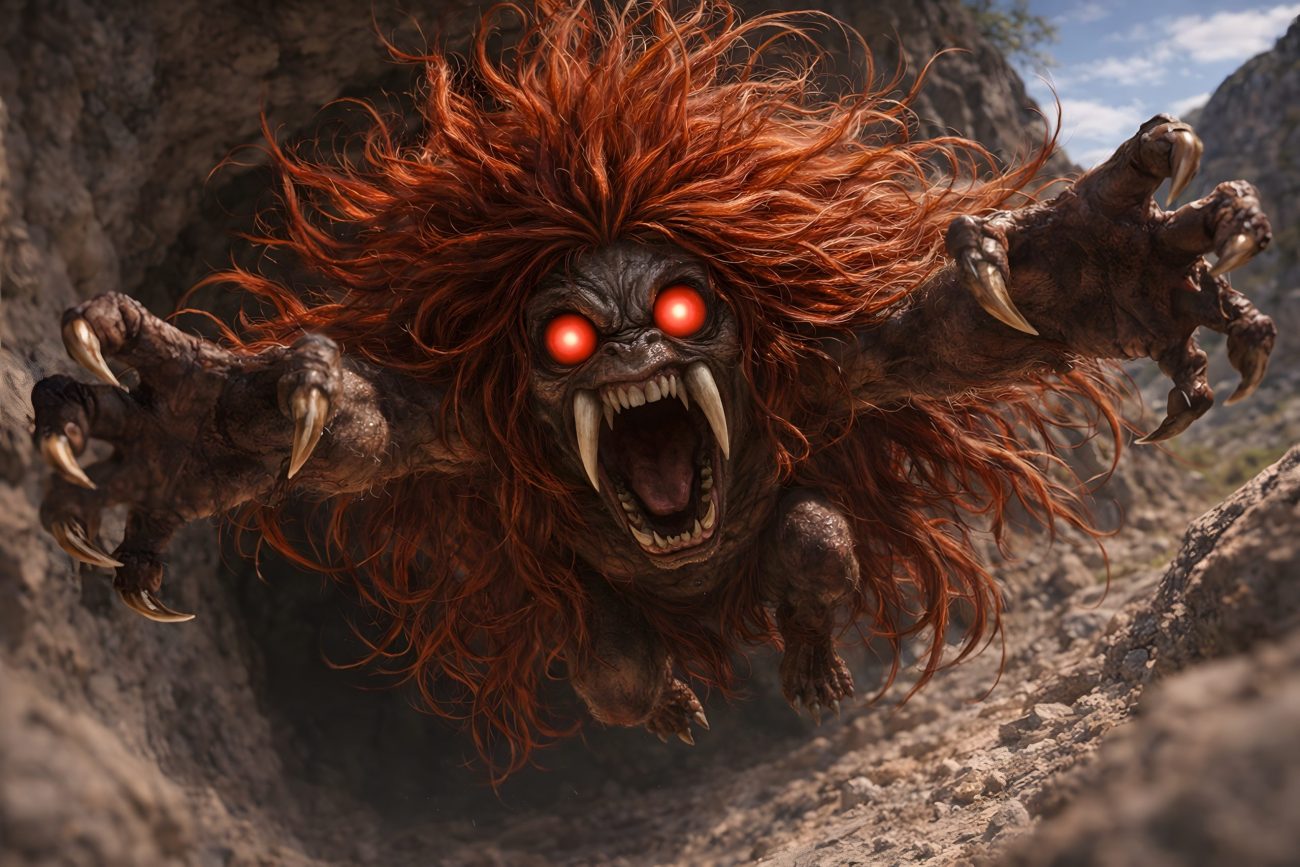
She was said to feed on raw meat. Thick hair covered her entire body and hung down to her feet, serving as her only clothing. Her eyes, red-rimmed and buried deep beneath her hair, glowed like coals. From her wide mouth protruded double rows of teeth, and her voice sounded like the hooting of an owl. Her fingers ended in sharp claws with which she tore apart the game she hunted or the sheep she seized from the fields.

When the wild woman died, the tale says she was refused entry to Hell because she was mistaken for the female of a wild animal. Forced back to the earth, she returned as a dreadful ghost and wandered the valley by night, spreading terror throughout the surrounding region.

At last a pious hermit from the Selomon Forest drove her spirit away across the sea. He did so by invoking Saint Donatus and Our Lady of Luxembourg, and in remembrance of this deliverance, their holy images were placed upon the rock of La Cronnière.


Gallery


Sources

sagen.at contributors. (n.d.). Die wilde Frau zu La Sauvage. In sagen.at, from https://www.sagen.at/texte/sagen/luxemburg/Wilde_Frau_La_Sauvage.html


Interpretive Lenses

Religious Readings
  • Christian Ascetic Deep Dive
Philosophical Readings
  • Nietzschean Deep Dive
Psychological Readings
  • Jungian Deep Dive
Esoteric Deep Dive
  • Hermetic Deep Dive
Political / Social Readings
  • Marxist Deep Dive

Wild Woman of the Wôbâch

Tradition / Region: Luxembourg Mythology
Alternate Names: Wild Woman of Wölfragrond
Category: Cave dweller


The Myth

In the valley of the Wôbâch, a small stream that flows into the Eisch between Simmern and Heckenhof, there once lived a wild woman in a cave. Because of her, the place came to be called Wölfragrond.

She was said to be completely covered in hair from head to foot. By day she hid in her cave, but as soon as night fell she came out and walked along the banks of the Eisch. There she attacked and strangled whatever she could seize, whether human or animal. Because of this, no one dared to pass through the place at night.

At last a knight from Simmer Castle set out to rid the region of the creature. Whether he ambushed her or met her by chance, he took the silver cross from his rosary, hammered it into a ball, and loaded it into his rifle. With this bullet he shot and killed the wild woman, and the valley was freed from her terror.


Gallery


Sources

sagen.at contributors. (n.d.). Die wilde Frau in der Wôbâch. In sagen.at, from https://www.sagen.at/texte/sagen/luxemburg/Wilde_Frau_Wobach.html


Interpretive Lenses

Religious Readings
  • Christian Ascetic Deep Dive
Philosophical Readings
  • Nietzschean Deep Dive
Psychological Readings
  • Jungian Deep Dive
Esoteric Deep Dive
  • Hermetic Deep Dive
Political / Social Readings
  • Marxist Deep Dive

Gnome of Dondelange

Tradition / Region: Luxembourg Mythology
Alternate Names: Dondelange Gnomes, Fäsch Gnomes, Family of Frau Holle
Category: Gnome, Cave dweller


The Myth

In a place called Fäsch near Dondelange, there stands a high rock that contains a large cave. This cave was said to have once been the dwelling of a family of gnomes, whose mother was known as Frau Holle.

One day, a farmer named Michel Wagner was plowing a field not far from the rock. Around ten o’clock he stopped to rest and smoke his pipe. As he sat there, he heard voices coming from within the rock, calling out: “Bake me a Pflamb! Me too, a Pflamb! Me too, a Pflamb!”

Amused, the farmer called back jokingly, “Me too, a Pflamb!”

When he returned to his work and later in the afternoon prepared to leave, he found that a fine cake was hanging from his plow. It was said to be so delicious that even the best confectioner of the time could not have baked a better one.


Gallery


Sources

sagen.at contributors. (n.d.). Die Wichtelcher zu Dondelingen. In sagen.at, from https://www.sagen.at/texte/sagen/luxemburg/Wichtlein_Dondelingen.html


Interpretive Lenses

Religious Readings
  • Christian Ascetic Deep Dive
Philosophical Readings
  • Nietzschean Deep Dive
Psychological Readings
  • Jungian Deep Dive
Esoteric Deep Dive
  • Hermetic Deep Dive
Political / Social Readings
  • Marxist Deep Dive
Other
  • How to Invite The Gnome of Dondelange

Wahlhausen Gnome

Tradition / Region: Luxembourg Mythology
Alternate Names: Wichtelcher of op dem Heidenhäuschen
Category: Gnome, Cave dweller


The Myth

Near Wahlhausen, on a mountain whose foot meets the Ur River, there is a place known as op dem Heidenhäuschen. Long ago, people believed this hill was not solid earth alone, but hollowed beneath by an underground dwelling.

Within that hidden space lived very small people, the Wichtelcher. They were said to inhabit rooms beneath the soil, sheltered from sight, living quietly below the fields. The place where they lived now lies under cultivated land, ploughed and walked upon, yet never entirely at rest.

Old villagers remembered that stone walls were once uncovered in the ground there—traces of something built, then buried again by time and soil. Even in more recent years, the land showed signs of what lay below. While people were working the rock nearby and paused to eat, the ground suddenly sank beneath them, dropping about the depth of a shoe, as if the earth itself had given way into a hollow space.

Such moments were taken as reminders that the Wichtelcher had not been a story alone. Though unseen, their former homes were believed to remain beneath the hill, fragile and empty now, but still capable of shifting the ground above. The place kept its quiet reputation, a reminder that beneath ordinary fields, the Little Ones were once said to live.


Gallery


Sources

SAGEN.at contributors. (n.d.). Wichtlein (Wahlhausen). In SAGEN.at, from https://www.sagen.at/texte/sagen/luxemburg/Wichtlein_Wahlhausen.html


Interpretive Lenses

Religious Readings
  • Christian Ascetic Deep Dive
Philosophical Readings
  • Nietzschean Deep Dive
Psychological Readings
  • Jungian Deep Dive
Esoteric Deep Dive
  • Hermetic Deep Dive
Political / Social Readings
  • Marxist Deep Dive
Other
  • How to Invite The Wahlhausen Gnome