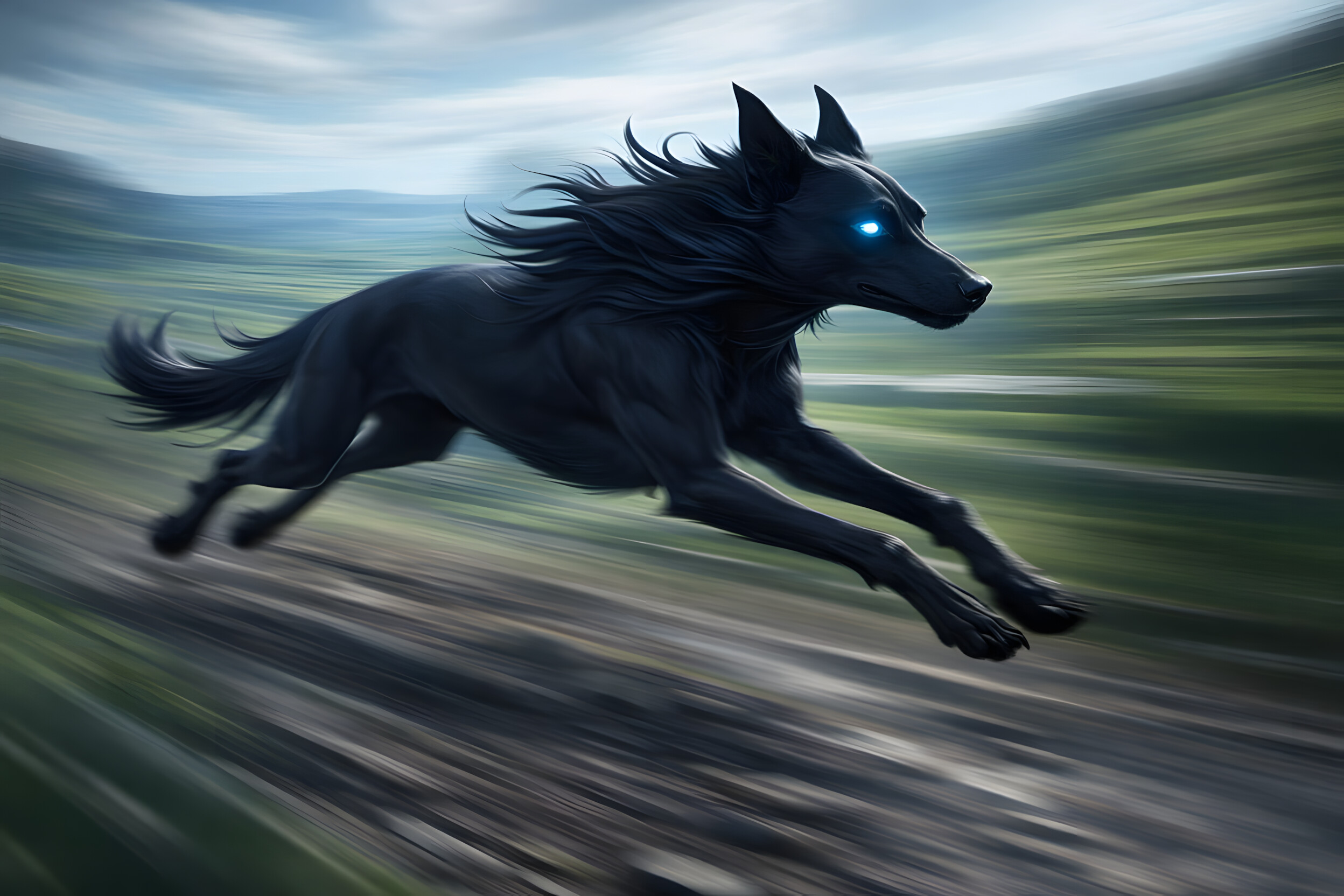
Failinis

Tradition / Region: Irish Mythology
Alternate Names: Shalinnis, Salinnis, Fer Mac
Category: Dog


The Myth

Failinis was a marvelous hound belonging to Lugh Lámhfhada of the Tuatha Dé Danann. The dog was one of the great treasures demanded as reparation from the sons of Tuireann after they killed Lugh’s father, Cian.

The hound originally came from the distant land of Iruaid, where it belonged either to a king or a royal smith. From there it passed into the hands of the sons of Tuireann, who were forced to surrender it to Lugh as part of their punishment.

Failinis was no ordinary dog. It was invincible in battle and could catch any beast it pursued, whether on land or in water. It held mastery over animals and was said to hunt everything from deer to fish. It possessed wondrous magic as well: whenever it bathed in running water, the water turned into wine or mead. In some tellings, it could even disgorge drink, gold, or silver from its mouth.

By day, the hound was immense and powerful, strong enough to overcome many warriors. By night it was like a bolt of fire, blazing and swift. Some tales describe it as beautifully colored, others as patterned in many hues — white, black, blue, and more.

In later stories of the Fenian Cycle, the same hound appears again, now in the hands of three foreign warriors from Iruaid who arrive in Ireland. They use the dog’s magic to create strong drink and defend themselves against spies. When warriors attempt to watch them in secret, the hound raises a supernatural wind with its tail that strips their weapons away. At its masters’ command it breathes upon the slain, reducing their bodies to dust so that nothing remains.

In some versions, the foreign warriors eventually lose the hound as compensation to the Fianna led by Fionn mac Cumhaill. In another telling they swear never to take the dog alive from Ireland, so they kill it and carry away its hide instead.

Thus Failinis is remembered as one of the great mythic hounds of Ireland — a creature of battle, magic, wealth, and loyalty, tied to heroes, kings, and warriors across multiple cycles of legend.


Gallery


Sources

Wikipedia contributors. (n.d.). Failinis. In Wikipedia, from https://en.wikipedia.org/wiki/Failinis


Interpretive Lenses

Religious Readings
  • Christian Ascetic Deep Dive
Philosophical Readings
  • Nietzschean Deep Dive
Psychological Readings
  • Jungian Deep Dive
Esoteric Deep Dive
  • Hermetic Deep Dive
Political / Social Readings
  • Marxist Deep Dive

Dobhar-chú

Tradition / Region: Irish Mythology
Alternate Names: King Otter, Dobharcu, Dorraghow, Anchu
Category: Dog, Lake dweller


The Myth

The Dobhar-chú is a feared creature of lakes and rivers in Irish tradition, remembered as a monstrous water hound.

It is said to resemble a great otter but with the strength and build of a dog. Far larger than any natural animal, it could grow many times the size of a normal otter. Some tales describe it with a pale coat marked by darker patches, while others say its fur appears dark from the waters it inhabits. Its body is powerful, with strong limbs and a long tail, and it moves easily both on land and in water.

The creature is believed to dwell in deep lakes and hidden waters, rarely seen but greatly feared by those who live nearby. Stories of it were passed down mostly by word of mouth, and many people believed it to be a dangerous predator of both livestock and humans.

One well-known tale tells of a woman who went to the lakeshore to wash clothes. When she did not return, her husband went to search for her and found her dead by the water. Lying beside her was the great beast itself, resting near its kill.

The man hurried home, armed himself, and returned to face the creature. After a struggle he managed to kill it. But as the beast died, it gave out a piercing cry. From the lake rose another of its kind, drawn by the call. The second monster pursued him, and after a fierce fight he killed that one as well.

The place where the woman died was long remembered, and a stone marking her grave was said to bear the image of a great dog-like animal, keeping alive the memory of the water hound.

Thus the Dobhar-chú was remembered as the king of the waters — a great lake beast shaped like a hound, feared along lonely shores and whispered about in stories of the deep.


Gallery


Sources

Wikipedia contributors. (n.d.). Dobhar-chú. In Wikipedia, from https://en.wikipedia.org/wiki/Dobhar-ch%C3%BA


Interpretive Lenses

Religious Readings
  • Christian Ascetic Deep Dive
Philosophical Readings
  • Nietzschean Deep Dive
Psychological Readings
  • Jungian Deep Dive
Esoteric Deep Dive
  • Hermetic Deep Dive
Political / Social Readings
  • Marxist Deep Dive

Bran and Sceólang

Tradition / Region: Irish Mythology
Alternate Names:
Category: Dog


The Myth

Bran and Sceólang were the two great hounds of the hero Fionn mac Cumhaill, leader of the Fianna.

They were no ordinary dogs. Both were said to be mostly white, with striking colors marking their bodies — purple upon their flanks, a crimson tail, and blue feet. They were enormous, standing as high as Fionn’s shoulder, and were famed for their speed, loyalty, and intelligence.

Their birth was itself strange. Their mother, Uirne, sister to Fionn’s own mother, had been transformed into a dog while pregnant. In that form she gave birth to the twins. Afterward she was restored to her human shape, but the two children remained hounds. Because of this, Bran and Sceólang were not only companions to Fionn, but also his kin.

The two dogs accompanied Fionn throughout many of his adventures and hunts. Bran in particular was said to remain always at his master’s side. In later stories it was told that the two hounds grew up together and were inseparable.

They were the first to find Fionn’s son Oisín when the boy wandered alone in the wilderness, discovering him naked in the forest and bringing him back to the world of men.

Yet the end of the two hounds came in sorrow.

Sceólang died during a hunt in the place later called Thrush Glen. There she chased a strange doe that was half black and half white, pursuing it until she met her death.

Bran’s end came later. In a moment of anger or impulse, Fionn struck his beloved hound. Whether from grief, injury, or the breaking of their bond, Bran afterward chose to cast himself into the water and drown.

So the two great hounds of the Fianna passed from the world, remembered not only as hunting dogs, but as companions of heroes and creatures whose lives were bound by blood and fate to the family of Fionn himself.


Gallery


Sources

Wikipedia contributors. (n.d.). Bran and Sceólang. In Wikipedia, from https://en.wikipedia.org/wiki/Bran_and_Sce%C3%B3lang


Interpretive Lenses

Religious Readings
  • Christian Ascetic Deep Dive
Philosophical Readings
  • Nietzschean Deep Dive
Psychological Readings
  • Jungian Deep Dive
Esoteric Deep Dive
  • Hermetic Deep Dive
Political / Social Readings
  • Marxist Deep Dive

Adhnúall

Tradition / Region: Irish mythology, Celtic Mythology
Alternate Names: Adnual
Category: Dog


The Myth

Adhnúall, whose name means “Sweet of Sound,” was one of the hunting dogs of Fionn mac Cumhaill, leader of the Fianna. Unlike the more famous hounds, Adhnúall was remembered not for ferocity alone, but for a voice so beautiful and sorrowful that it could stir the heart.

Once, the dog was stolen by Arthur, the son of the king of Britain. The Fianna pursued the matter and reclaimed Adhnúall, restoring him to Fionn. From that time on, the hound remained closely bound to his master’s fate.

It was said that Adhnúall played a quiet but decisive role in love as well as in the hunt. Through the dog’s presence and guidance, Sadhbh was led into Fionn’s heart, beginning a bond that would shape both their lives.

In later days, a great battle was fought in Leinster, and many of the Fianna were slain. The loss weighed heavily upon Adhnúall. Stricken with grief, the hound ran the full circuit of Ireland three times, as though seeking every fallen companion and every memory of the Fianna.

When his strength was spent, Adhnúall returned to the battlefield. He went to a hill where three warriors of the Fianna and their lovers lay buried together. There, he lifted his head and gave three long howls, each filled with sorrow and farewell. When the last cry faded, Adhnúall lay down and died of grief.

Thus ended the life of the sweet-voiced hound, whose loyalty bound him to love, loss, and the fate of the Fianna themselves.


Gallery


Sources

Wikipedia contributors. (n.d.). Adhnúall. In Wikipedia, The Free Encyclopedia, from https://en.wikipedia.org/wiki/Adhn%C3%BAall


Interpretive Lenses

Religious Readings
  • Christian Ascetic Deep Dive
Philosophical Readings
  • Nietzschean Deep Dive
Psychological Readings
  • Jungian Deep Dive
Esoteric Deep Dive
  • Hermetic Deep Dive
Political / Social Readings
  • Marxist Deep Dive
Other
  • How to Invite The Adhnúall