Fairy Cow

Tradition / Region: Irish Mythology
Alternate Names:
Category: Cow


The Myth

In Ireland it was often said that the fairy folk kept herds of magical cattle and sometimes shared their bounty with humans. These fairy cows were usually hornless, often red or speckled, and known for their endless milk and for bearing calves year after year.

One winter in County Donegal, a poor family with many children faced starvation. One stormy night they heard the lowing of a cow outside their home. When they went out, they found a red-speckled cow standing quietly at their door. They brought her into their barn, and the very next day she calved and gave rich, plentiful milk.

The family searched to see if the animal belonged to anyone, but no one claimed her. For years she stayed with them, producing calves and filling their vessels with milk, keeping the household alive.

One day, however, the father found her grazing in a newly sown field. In anger he lifted his staff to strike her, forgetting the blessing she had been. At once the cow gathered her calves and vanished, and neither she nor her offspring were ever seen again.

Other tales told of fairy cattle that seemed to die suddenly. People believed that in such cases the fairies had taken the real animal and left behind a piece of enchanted wood shaped like a cow. Because of this, it was thought unwise to eat meat from a beast that had died strangely, for it might belong to the fairy world.

By the sea, it was also said that undersea folk kept their own herds, which grazed on the ocean’s growth and sometimes appeared to human eyes as seals.

Thus the fairy cow was remembered as a creature of otherworldly kindness, one that could bring life and plenty, yet would vanish the moment gratitude gave way to anger.


Gallery


Sources

Monaghan, P. (2004). The Encyclopedia of Celtic Mythology and Folklore. Facts on File, p. 170.


Interpretive Lenses

Religious Readings
  • Christian Ascetic Deep Dive
Philosophical Readings
  • Nietzschean Deep Dive
Psychological Readings
  • Jungian Deep Dive
Esoteric Deep Dive
  • Hermetic Deep Dive
Political / Social Readings
  • Marxist Deep Dive

Dun Cow of Saint Ciarán

Tradition / Region: Irish Mythology
Alternate Names:
Category: Cow


The Myth

When Saint Ciarán went to study at Clonard, he carried little with him. Instead of wealth or fine possessions, he brought only a dun-colored cow as his offering.

Though the animal seemed humble, it proved a great blessing. Wherever Ciarán stayed, the cow gave milk in abundance, enough to sustain not only him but the scholars and clergy around him. Its supply never failed, and it became known as a gift that supported the holy community.

After Ciarán’s death, the memory of the cow remained strong. It was said that when the animal died, its hide was preserved and made into parchment. From that hide came the pages of a great book known as the Book of the Dun Cow, on which were written many ancient stories, lives of saints, and heroic tales of Ireland.

In this way, the cow of Saint Ciarán was remembered as a creature that first nourished the living with its milk and later preserved the words and history of the land, carrying them forward through time.


Gallery


Sources

Wikipedia contributors. (n.d.). Ciarán of Clonmacnoise. In Wikipedia, The Free Encyclopedia, from https://en.wikipedia.org/wiki/Ciar%C3%A1n_of_Clonmacnoise


Interpretive Lenses

Religious Readings
  • Christian Ascetic Deep Dive
Philosophical Readings
  • Nietzschean Deep Dive
Psychological Readings
  • Jungian Deep Dive
Esoteric Deep Dive
  • Hermetic Deep Dive
Political / Social Readings
  • Marxist Deep Dive

Dun Cow

Tradition / Region: Irish Mythology
Alternate Names: The Great Dun Cow; Y Fuch Frech; Y Fuwch Laethwen Lefrith
Category: Cow


The Myth

In the lands of Ireland and Britain there wandered a great and wondrous animal known as the Dun Cow. She was immense in size and known for her generosity, for she gave milk freely to anyone who asked. Her bounty seemed without end, and people came from far and wide to receive her gift.

In some tellings, she bore two mighty long-horned oxen, who later became famous for their strength and deeds. Yet though the cow gave willingly, not all treated her with respect. In certain stories, greedy people tried to take more than was fair, milking her without care or gratitude. Because of such acts, she was eventually killed, and in some places her enormous bones were said to remain as proof of her size and wonder.

Another tale speaks of a Dun Cow that belonged to a holy man in Ireland. After the cow died, her hide was preserved and turned into vellum. From this hide came the pages of a great book that held many ancient stories of Ireland. In this way, even after death, the cow continued to give, for her body became the keeper of the land’s tales and memories.

Thus the Dun Cow was remembered as a creature of abundance and marvel, whose generosity fed both people and legend, and whose gift endured even after her life had ended.


Gallery


Sources

Monaghan, P. (2004). The Encyclopedia of Celtic Mythology and Folklore. Facts on File, p. 141.


Interpretive Lenses

Religious Readings
  • Christian Ascetic Deep Dive
Philosophical Readings
  • Nietzschean Deep Dive
Psychological Readings
  • Jungian Deep Dive
Esoteric Deep Dive
  • Hermetic Deep Dive
Political / Social Readings
  • Marxist Deep Dive

Donn Cuailnge and Finnbennach

Tradition / Region: Irish Mythology
Alternate Names:
Category: Cow

The Myth

In ancient Ireland there lived two mighty bulls whose strength was said to surpass that of all other cattle. One was Finnbennach, owned by the queen of Connacht, admired throughout the land for his size and power. The other was Donn Cuailnge, the great bull of Ulster, the only beast believed capable of matching him.

Their rivalry became the heart of a great conflict. When the rulers of Connacht sought to possess Donn Cuailnge, the attempt set off the struggle remembered as the great cattle raid of Cooley. Warriors marched and kingdoms clashed, for the possession of the bull was seen as a matter of honor and power.

Whenever the two bulls met, their battles were terrible to behold. They charged with thunderous force, locking horns while their hooves tore the ground apart. Hills and fields were scarred by their fights, and men watched in awe as the land seemed to shake beneath them.

At last, in their final encounter, Donn Cuailnge overcame Finnbennach and slew him. Yet the victory cost him dearly, for he too was left wounded from the struggle.

Thus the two bulls passed into legend, remembered as creatures whose strength stirred war among kings and whose clashes were counted among the greatest marvels of Ireland.

Gallery

Gallery

Drag and drop images, upload, or choose from your library.UploadMedia Library

Sources

Monaghan, P. (2004). The Encyclopedia of Celtic Mythology and Folklore. p. 135.

Interpretive Lenses

Religious Readings
  • Christian Ascetic Deep Dive
Philosophical Readings
  • Nietzschean Deep Dive
Psychological Readings
  • Jungian Deep Dive
Esoteric Deep Dive
  • Hermetic Deep Dive
Political / Social Readings

Bó Find

Tradition / Region: Irish mythology
Alternate Names:
Category: Cow


The Myth

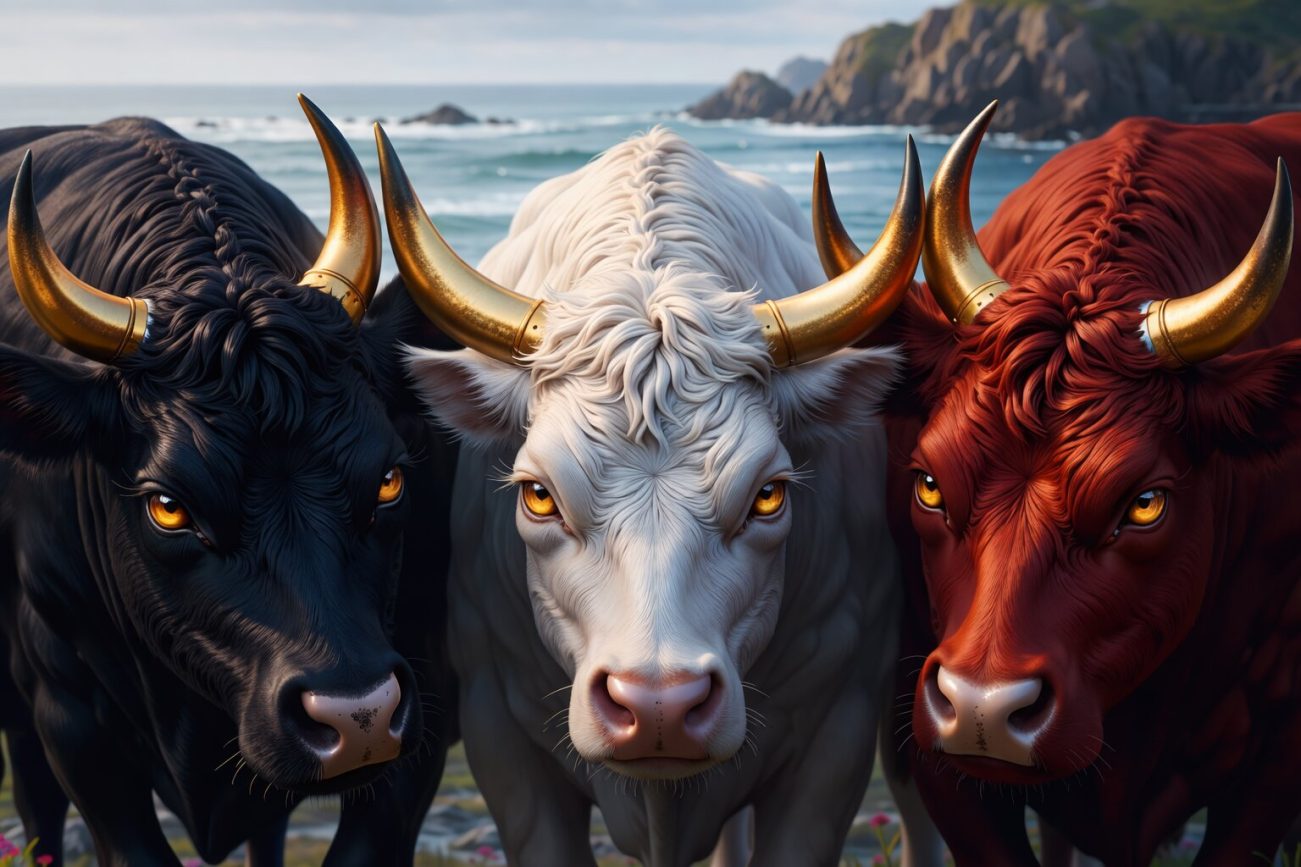
In the earliest age of Ireland, before grass grew or herds roamed, the island lay empty and barren. From the western sea came three cows, rising from the waves as if born from the ocean itself. They were sisters: Bó Find, white as light; Bó Ruadh, red as flame; and Bó Dhu, black as night.

When they reached the shore, the sisters parted ways. Bó Ruadh turned north, and Bó Dhu went south. Bó Find alone walked inland, toward the heart of the island. Wherever the three cows traveled, the land behind them changed. The empty ground became fertile, cattle appeared where none had existed, and life followed in their wake. By their passage, Ireland was transformed from a lifeless place into one that could sustain its people.

Bó Find journeyed on until she reached the center of the island. There she gave birth to two calves, one male and one female. From these twins descended all the cattle of Ireland, and through them the island gained abundance and nourishment.

The memory of Bó Find did not fade. Her path was said to remain marked upon the land itself, preserved in place-names that carried the word . In this way, the people remembered that the life of Ireland flowed from a white cow who walked ashore from the western sea and filled the empty land with living herds.


Gallery


Sources

Monaghan, P. (2004). The Encyclopedia of Celtic Mythology and Folklore. Facts on File, p. 52.


Interpretive Lenses

Religious Readings
  • Christian Ascetic Deep Dive
Philosophical Readings
  • Nietzschean Deep Dive
Psychological Readings
  • Jungian Deep Dive
Esoteric Deep Dive
  • Hermetic Deep Dive
Political / Social Readings
  • Marxist Deep Dive
Other
  • How to Invite The Bó Find