
Redeemed Hand

Tradition: Czech Mythology
Alternative Names: The Hand in the Cellar
Category: Ghost


The Myth

The Redeemed Hand is a mysterious supernatural apparition said to haunt the cellar of an inn on Saueben Hill, above the ruins of Bayreck Castle in the Bohemian Forest. Long ago, the innkeepers employed a maid who was once sent down into the cellar to fetch potatoes. There, she encountered a terrifying sight: a disembodied hand hanging in the darkness, holding a bag. A strange voice repeatedly whispered, “Take it, take it!” Frightened, the maid fled from the cellar, trembling with fear.

The maid told her father, who lived in a dilapidated cottage in the village of Dörrstein. He accompanied her back to the cellar, carrying a torch to illuminate the darkness. The mysterious hand and the bag appeared again before the maid, and the pleading voice once more urged her to take it. Her father, however, could see nothing unusual, even as he waved his torch around the cellar. Finally, the maid overcame her fear and took the bag from the hand.

As soon as she seized it, the voice sighed, “God bless you!” The disembodied hand immediately vanished, and the cellar became quiet. Inside the bag was a fortune in Swedish gold. The maid and her father used the treasure to purchase a beautiful farm in Austria. By accepting the mysterious bag, the maid had apparently fulfilled the spirit’s wish and released the hand from its supernatural burden, allowing it to disappear at last.


Sources

“Die erlöste Hand.” In Hans Watzlik, Böhmerwald-Sagen. Budweis: Böhmerwalder Dorfbücher, 1921, Heft 5. Reproduced by SAGEN.at. https://www.sagen.at/texte/sagen/tschechien/watzlik/erloestehand.html

Stilzel

Tradition: Czech Mythology
Alternative Names:
Category: Ghost


The Myth

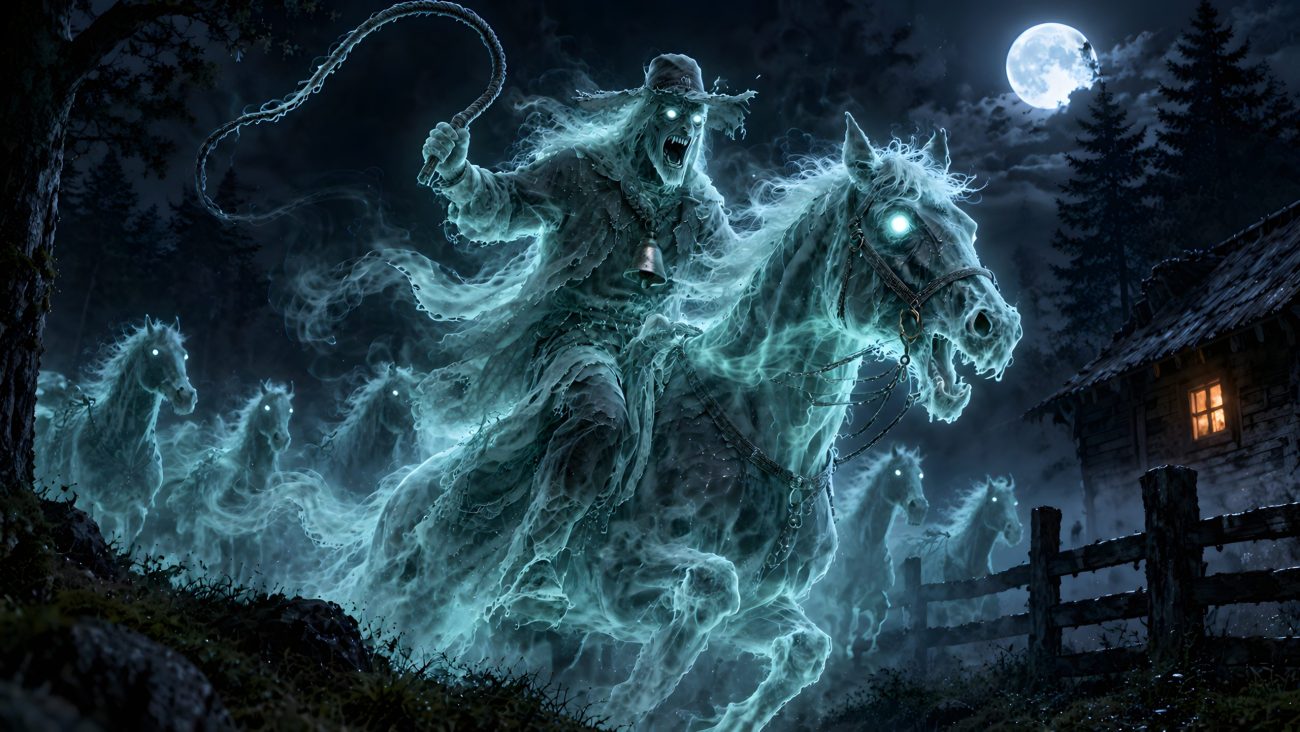
Stilzel was once a horse herder who worked for the farmers of Heuhof, near the Bavarian border. His difficult task was to drive a hundred horses into the forest pastures. One day, before returning home, he counted the herd to make sure none had wandered off into the vast woods. However, no matter how many times he counted, he could only account for ninety-nine horses because he kept forgetting which horse he was riding. Enraged by his failure, Stilzel cursed and swore so blasphemously that the stones seemed to fly toward the sky and the forest trees trembled. Finally, he stood upon his horse and hanged himself from a pine branch using his own whip.

After his death, Stilzel became a mischievous and terrifying spirit who haunts the forest at night. He cracks his whip and bellows like an entire herd of cattle, frightening border guards into believing that smugglers are driving livestock across the border into Bavaria. The guards rush out, hoping to catch the smugglers, only to become trapped in deep mud up to their forks. From somewhere nearby, Stilzel laughs like the devil at their misfortune. Wanderers who hear the forest roar are warned never to look behind them, for Stilzel may leap onto their backs and force them to carry him until they are exhausted, their chests heaving and their knees buckling.

Despite his frightening nature, Stilzel sometimes helps people who recognize his presence. Once, a farmer from Bärnlohe found that his wagon would not move, even though it carried no logs and his oxen could not pull it forward. Realizing that Stilzel was secretly pressing his fist against the wagon, the farmer shouted at the spirit to get off and help push. Immediately, the wagon became light and rolled forward as if moving by itself.

Stilzel is also associated with the Saumühle, an old mill between Flöß and Heuhof where he once herded horses. According to the legend, the supernatural herdsman carried the entire mill there himself on his back. His stories portray him as a powerful, unpredictable spirit who delights in frightening travellers and tricking those who enter his forest, but who can also be persuaded to lend a helping hand.


Sources

“Stilzel.” In Hans Watzlik, Böhmerwald-Sagen. Budweis: Böhmerwalder Dorfbücher, 1921, Heft 5. Reproduced by SAGEN.at. https://www.sagen.at/texte/sagen/tschechien/watzlik/stilzel.html


Weihizer

Tradition: Czech Mythology
Alternative Names: The Weihizer
Category: Ghost


The Myth

The Weihizer is the ghost of a wealthy but dishonest innkeeper who once lived in Neukirchen in the Bohemian Forest. He cheated his customers by pouring only as much drink as he could fit his unusually long thumb into the jug. Through this trick, he accumulated an enormous fortune. One day, he challenged his servant Girgel to cut as much straw from dawn until dusk as the innkeeper possessed money. If Girgel succeeded, he would receive ten guilders; if he failed, he would have to pay the innkeeper the same amount. Girgel worked tirelessly and produced a huge pile of straw, but the innkeeper’s mountain of money was even larger. The poor servant lost his ten guilders, which the wealthy man simply tossed onto his enormous pile of silver.

The innkeeper was said to possess supernatural abilities, including the power to be in two places at once. When the hay was being brought in, he could be seen in the meadow and inside the barn simultaneously. As he grew old, he tried to ease his conscience for the harm he had inflicted on the poor. He ordered a gigantic bell to be cast, so wide that eight couples could dance beneath it. Yet the bell could not save him, because not a single honest penny had been used to pay for it.

After his death, the innkeeper could not rest in his grave. As punishment for his dishonesty, he was condemned to raise mysterious fires and sit on the cellar stairs. Before the Angelus bell rang, he was forbidden to harm anyone. Afterward, however, his ghost tormented those who came to fetch beer. The beer would not flow from the barrel because the innkeeper sat upon it, holding his purse. At night, cattle often cried out in terror, and farmhands who rushed outside discovered the stable doors standing open while the cows trembled and staggered around the yard.

One night, a travelling priest stopped at the inn, but nobody dared fetch him beer from the cellar. The priest descended himself to banish the ghost, making the sign of the cross three times. The ritual failed, and the Weihizer leapt from the barrel and struck the priest on the head with his purse, knocking him down. Desperate to rid themselves of the troublesome spirit, the people summoned the Bishop of Regensburg. The bishop finally took the ghost away to the wilderness of Switzerland, ending its haunting of the inn.


Sources

“Der Weihizer.” In Hans Watzlik, Böhmerwald-Sagen. Budweis: Böhmerwalder Dorfbücher, 1921, Heft 5. Reproduced by SAGEN.at. https://www.sagen.at/texte/sagen/tschechien/watzlik/weihizer.html