Tradition / Region: Cuban Mythology
Alternate Names: Jigües, Chichiricúes
Category: Gnome
The Myth
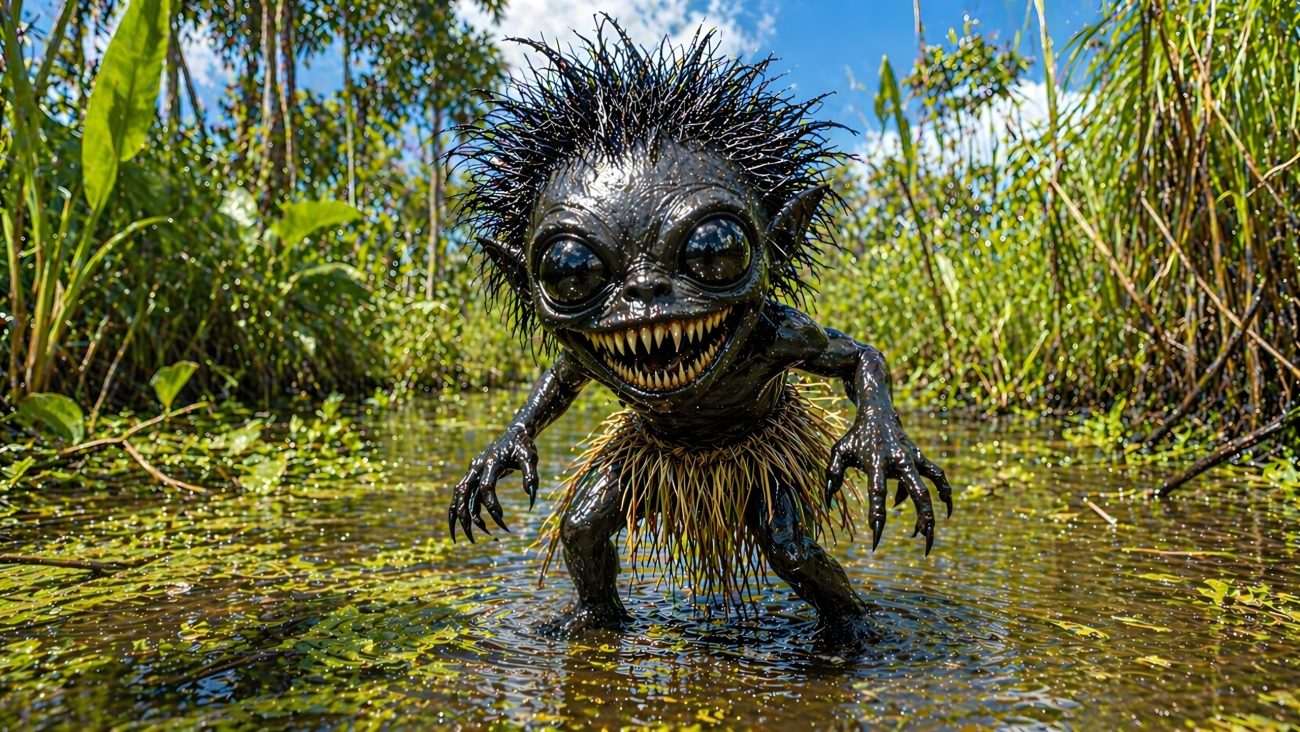
The Güijes are small, elusive beings said to inhabit rivers, lagoons, and deep freshwater pools in Cuba, particularly in places where dense vegetation casts heavy shadows over the water. They belong to hidden, overgrown environments—areas where the natural world feels thick, quiet, and slightly oppressive.
They are typically described as short, dark-skinned humanoids with long, tangled hair. Some accounts portray them as almost childlike in form, while others depict them as more grotesque, hairy, or animal-like. They are usually naked or loosely covered with leaves, blending seamlessly into their surroundings.
Güijes are rarely seen clearly. Their presence is instead suggested through disturbances: rippling water, sudden splashes, or the eerie feeling of being watched. They appear most often at dusk or during the night, when visibility fades and the boundary between the human world and the unseen weakens.
Their behavior is primarily mischievous. They are known for playing tricks on humans, especially those alone near rivers or forests. Children bathing in rivers were often warned about them, as Güijes were said to secretly join their play, only revealing themselves at the last moment—causing panic and driving everyone away from the water.
In some encounters, they attempt to lure people closer to dangerous areas—deeper water, thick brush, or isolated spots—creating confusion rather than outright violence. Victims are typically left frightened, disoriented, or humiliated, but not killed. Their role is that of a tormentor or trickster rather than a predator.
With time, the myth evolved through cultural blending. Indigenous Cuban beliefs merged with African traditions, giving rise to closely related beings known as Chichiricúes. These are similarly small, dark spirits associated with rivers and forests, sometimes described as more intrusive or unsettling. They are often imagined appearing in pairs and harassing travelers at night, especially those caught alone.
Certain rituals are said to summon or attract them—offering cigars, performing repeated movements around sacred trees at midnight, or invoking them through specific group actions. This suggests they are not merely passive spirits, but entities that can be intentionally engaged.
Despite their unsettling nature, Güijes are not purely malevolent. They exist in a space between playful and malicious—embodying the unpredictability of wild, untamed environments. As forests disappeared and rivers became more exposed, stories claim that Güijes also faded, as if tied directly to the presence of dense, living nature.
Sources
MITOLOGIA POPULAR CUBANA contributors. (2012, March 26). Mitologia popular cubana. Archived from the original on March 26, 2010
Wikipedia contributors. (n.d.). Güijes. In Wikipedia, from https://en.wikipedia.org/wiki/G%C3%BCijes