
Passadinha

Tradition / Region: Cape Verde Mythology
Alternative names: Passadinha, Little Blue Bird
Category: Bird


The Myth

Passadinha is a mysterious little blue bird from Cape Verde folklore, remembered for its bright red mouth, mocking intelligence, and connection to the downfall of Lob the Wolf. Though physically small and seemingly harmless, Passadinha acts as a supernatural trickster figure that humiliates greedy or foolish characters. In the tales, the bird is often associated with the sky, unreachable places, and deceptive appearances. Its red mouth is sometimes mistaken for meat by the starving Lob, emphasizing the bird’s strange, almost magical nature.

In one story, Lob learns from his clever nephew Tobinh’ about an enchanted fig tree that obeys spoken commands. By saying special words, the tree bends down to the ground, allowing someone to climb aboard before rising high into the air. Lob uses the tree to gorge himself on fruit, but in his greed he forgets the command needed to descend.

Instead of bringing him back to earth, the tree continues rising higher and higher until it reaches heaven itself.

There Lob encounters God, who gives him pieces of leather to wash so a drum can be made for him. But Lob is so hungry and gluttonous that he repeatedly eats the leather instead. Eventually God sends an angel to watch him, and a drum is finally completed. Lob is lowered back toward earth hanging from a string attached to heaven itself. God instructs him to beat the drum once he safely reaches the ground so the string can be cut.

As Lob descends through the sky, he sees Passadinha flying nearby. The bird carries something red in its mouth which Lob mistakes for meat. Desperate with hunger, he begs the bird for food.

Passadinha refuses unless Lob plays the heavenly drum.

Lob knows that if he beats the drum too early, God will cut the string and he will fall to his death. But his greed overwhelms him once again. Hoping to survive the fall, he shouts for Tobinh’ to prepare mattresses and hay below.

Instead, Tobinh’ gathers knives, razors, broken glass, pins, and every sharp object he can find.

Lob finally plays the drum.

God cuts the string.

Lob crashes down onto the deadly trap below and is killed.

In the tale, Passadinha functions as more than an ordinary bird. It acts almost like a sky-spirit or supernatural tester whose presence exposes greed, impatience, and foolishness. Small, mocking, and untouchable, the bird represents cunning intelligence triumphing over brute appetite — a recurring theme throughout Cape Verdean Lob stories.


Sources

Parsons, E. C. (1923). Folk-lore from the Cape Verde Islands. Part I. Cambridge, MA & New York: American Folk-Lore Society.

Aunt Ganga

Tradition / Region: Cape Verde Mythology
Alternative names: Ganga
Category: Bird


The Myth

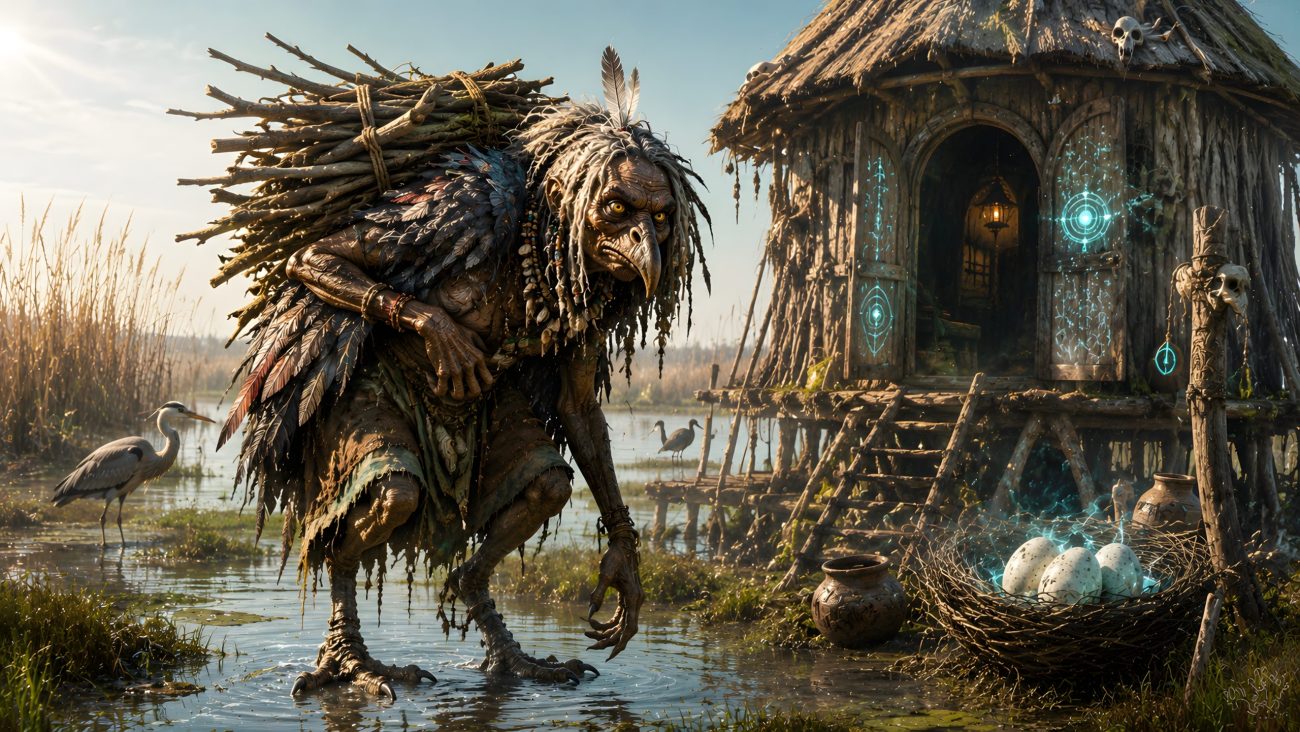
Aunt Ganga is a strange and frightening being from Cape Verde folklore, associated with a water-fowl but portrayed more like a supernatural old woman or monstrous bird spirit. She lives alone in an isolated house protected by a magical talking door that opens only with secret words. She is connected with huge stores of eggs, bundles of firewood, ashes, and dark magical power. In the tale, she appears as an elderly female figure with immense strength and an intimidating presence, carrying enormous loads of wood through the wilderness by herself. Though not described in precise physical detail, she is imagined as something between a giant bird and an old crone: harsh, dangerous, solitary, and feared.

In the story, Lob the Wolf becomes jealous after noticing how fat and healthy his clever nephew has grown. The nephew finally reveals that he has secretly been stealing eggs from Aunt Ganga’s hidden house, but he warns Lob that she is extremely dangerous and unlucky visitors do not survive encounters with her.

Lob insists on going anyway.

Before entering the house, the nephew teaches Lob the magical words needed to open the enchanted door:

“Door toboc tobac!”

But he deliberately gives Lob the wrong phrase for leaving the house, ensuring he will become trapped inside once Aunt Ganga returns.

Inside the house, Lob becomes consumed by greed. He devours enormous numbers of Aunt Ganga’s eggs while continuing to eat even after his nephew warns him she is approaching. Outside, the nephew watches Aunt Ganga returning through the landscape carrying a huge bundle of gathered wood. As she approaches, songs are exchanged between Lob trapped inside the house, the mocking nephew outside, and Aunt Ganga herself advancing toward the door.

When Aunt Ganga reaches the house, Lob mistakenly repeats the false password and the magical door refuses to open. Suspicious, Aunt Ganga commands the door repeatedly until it finally bursts open on its own.

Lob hides beneath the bed while Aunt Ganga calmly enters, prepares coffee, and lies down to rest. But when she breaks wind, Lob insults her from beneath the bed, calling her filthy. Realizing something is hiding in the room, Aunt Ganga searches until she discovers him.

Lob leaps upward and clings desperately to a roof beam while Aunt Ganga savagely beats him. Eventually exhausted, he falls into a pile of ashes where he hides in silence.

When the nephew later arrives, Aunt Ganga explains that Lob somehow disappeared. The nephew tricks Lob into exposing himself by claiming that members of Lob’s kind never die without breaking wind.

Hearing this, Lob foolishly breaks wind loudly from inside the ashes, revealing his hiding place.

Aunt Ganga immediately kills him.

In the tale, Aunt Ganga functions as a supernatural guardian of hidden food and secret places. She punishes greed, intrusion, and gluttony, while her magical house and enchanted door give her the qualities of a witch, ogress, or spirit-being rather than an ordinary woman.


Sources

Parsons, E. C. (1923). Folk-lore from the Cape Verde Islands. Part I. Cambridge, MA & New York: American Folk-Lore Society.