Tradition / Region: Madagascar Mythology
Alternative names: Kinbly
Category: Zombie
The Myth
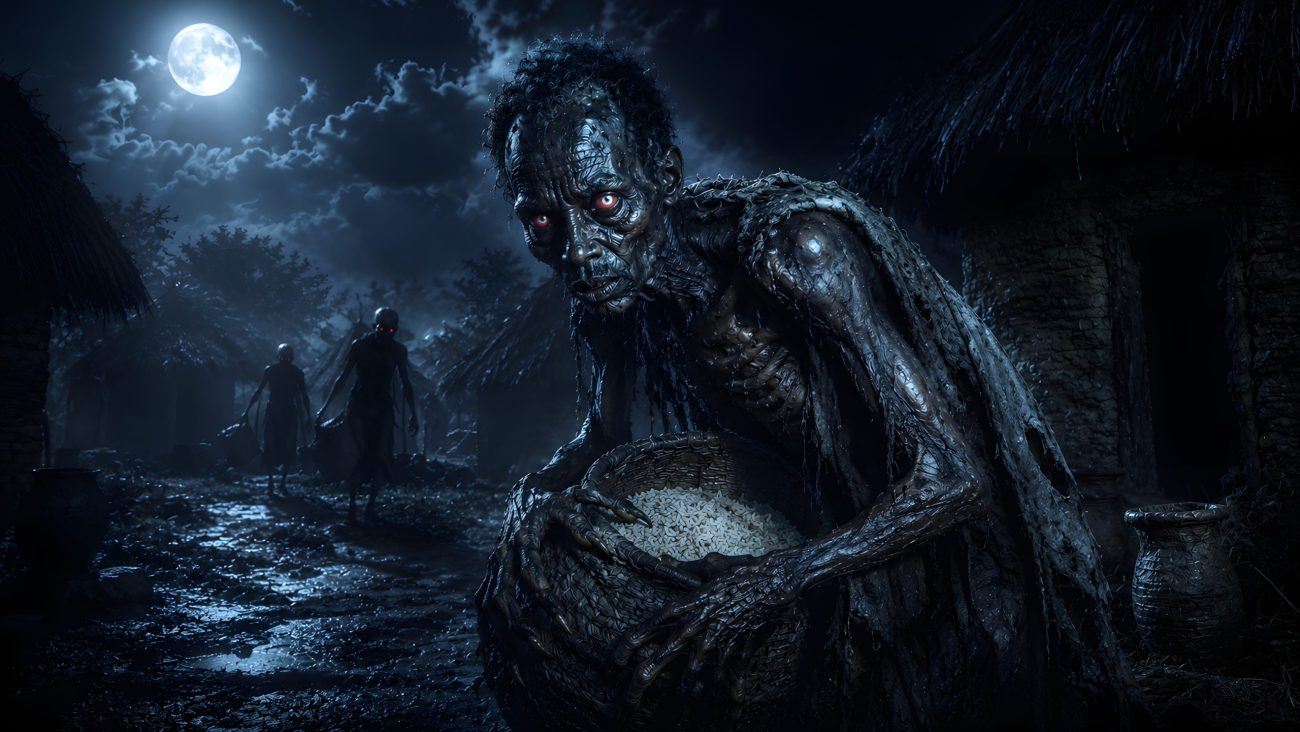
The Kinoly is a corpse-like being from Malagasy folklore said to emerge from the dead after burial. It still resembles a human, but only partially. Its eyes are unnaturally red, its fingernails become long and claw-like, and its stomach and intestines have decayed away entirely. Despite this horrific appearance, the rest of the body remains disturbingly human. The Kinoly wanders at night stealing food from the living, especially rice, and is feared as a restless creature trapped between life and death.
According to the belief, certain dead people transform into Kinoly after burial. Their relatives leave them in the tomb until the stomach and bowels decay. Once this has happened, the grave is opened so the being may leave. From then onward it roams the countryside like a nocturnal scavenger.
Stories about the Kinoly often emphasize its strange weakness. Although constantly stealing rice and food, it can barely carry anything. One tale tells of a man who secretly watched two Kinoly — a male and female — attempting to steal rice together. The male lifted the sack onto his shoulder and immediately cried out in agony from the weight. The female then tried carrying it on her head but also collapsed beneath the burden. Even in undeath they were frail and miserable creatures.
Another story tells of a traveler who unexpectedly encountered a Kinoly face to face. The man was horrified by the creature’s glowing red eyes and its long nails. When he questioned the being about its appearance, the Kinoly answered calmly before suddenly attacking and tearing into him.
Among the Betsileo people, becoming a Kinoly was considered tragic rather than glorious. It was viewed as a terrible fate both for the dead person and for their family. The creature represented corruption after death, endless hunger, and the fear that the dead might not remain peacefully in their graves.
Sources
Sibree, J. (1896). Madagascar before the conquest: The island, the country, and the people, with chapters on travel and topography, folk-lore, strange customs and superstitions, the animal life of the island, and mission work and progress among the inhabitants. New York: Macmillan; London: T. F. Unwin.