Tradition: Japanese Mythology
Alternative Names: Mud Monster
Category: House dweller
The Myth
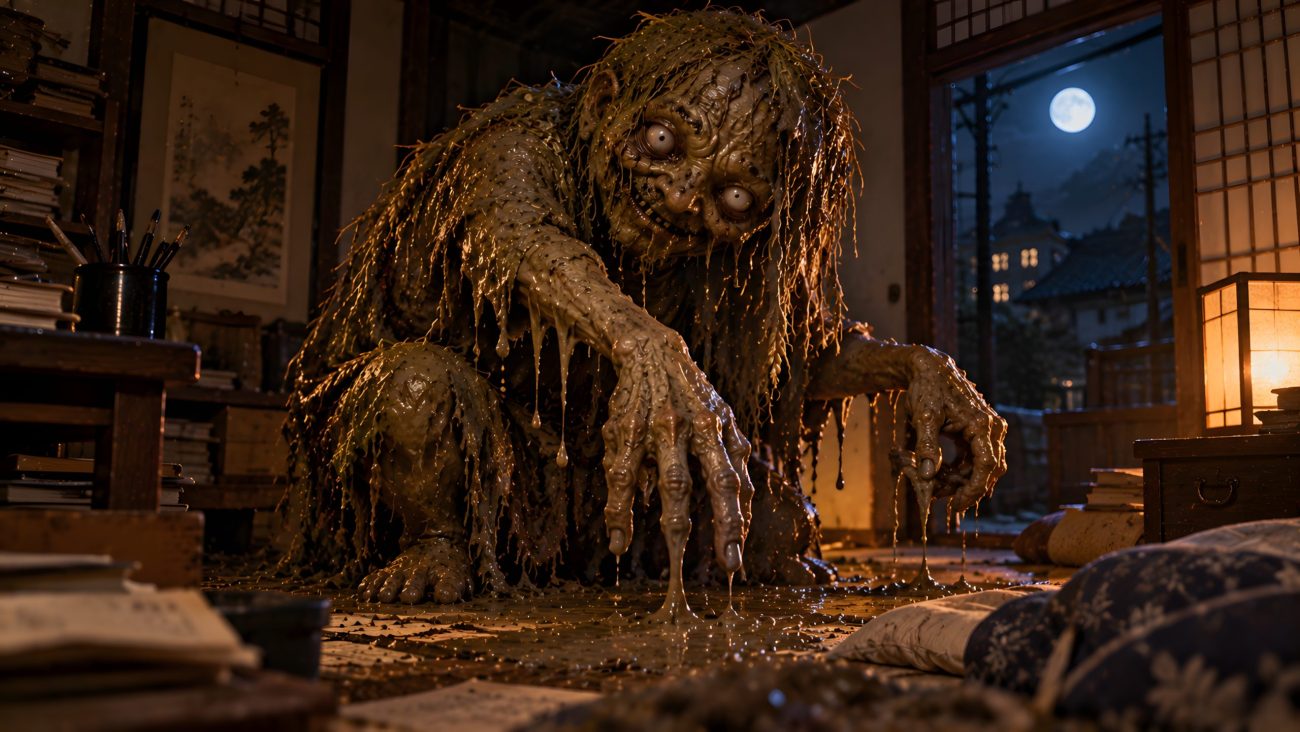
Dorotabo is a mud-covered humanoid monster described in a modern Japanese ghost story featured in Shin Mimibukuro, a collection of contemporary supernatural accounts by Hirokatsu Kihara and Ichiro Nakayama, published in 1998. In the story, a woman working for a publishing company in Kanda Jimbocho is warned by her editor-in-chief not to work through the night. When she asks why, he answers simply: “It’s Dorotabo.”
According to the story, people who sleep in the building are repeatedly awakened by a terrible stench. Beside their pillows stands a human-shaped figure with a body covered in mud, or one that appears to be made entirely of mud. The creature’s presence is accompanied by an overpowering foul smell that makes the encounter deeply unpleasant.
Those who attempt to touch Dorotabo discover that its body behaves unnaturally. When a person puts a hand into the muddy figure, the hand becomes sucked into its body. Even after pulling free, the person finds that the terrible smell remains. By the time they look around again, the creature has disappeared, leaving only its lingering odour as evidence of its presence. The account states that most of the male employees working at the company at the time had witnessed the phenomenon, and that they had long called the creature Dorotabo.
The name comes from an older Japanese yokai associated with rice fields. The artist Toriyama Sekien depicted this figure in Konjaku Hyakki Shūi, a collection of supernatural beings. The source describes Sekien’s Dorotabo as a creature he likely created through metaphor and wordplay. During the Shōwa period, it appeared frequently in yokai manga and children’s books, becoming a relatively familiar figure in Japanese supernatural folklore.
The mud-covered humanoid in the modern ghost story resembles Sekien’s yokai, which likely explains why the name Dorotabo was applied to it. The two accounts belong to different contexts: one concerns a yokai associated with rice fields and artistic representations of supernatural creatures, while the other describes a frightening apparition haunting an office building at night. In both, the name evokes a muddy, uncanny presence, but the modern story particularly emphasises its foul smell, disturbing physical nature, and ability to vanish without a trace.
Sources
“Dorotabō.” 新版TYZ 妖怪図鑑 (New TYZ Yokai Encyclopedia). https://tyz-yokai.blog.jp/archives/1074589168.html