Tradition: Scythian Mythology, Russian Mythology, Ukranian Mythology
Alternative Names: Tarandos, Tarandus, Parandrus, Parandros, Aeternae, Analopos, Antalope, Antholops, Aptaleon, Aptolos, Pantolops
Category: Deer
The Myth
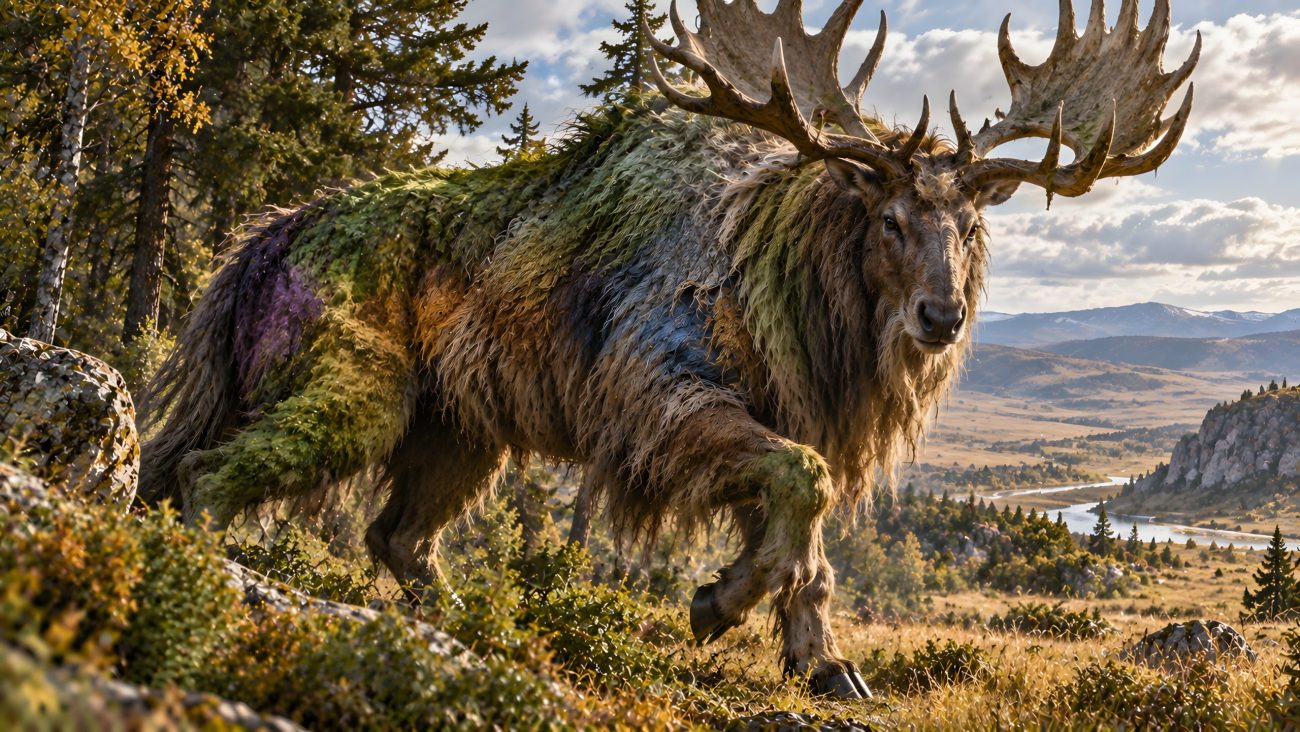
The Tarand is a rare and extraordinary beast said to resemble a large deer or moose. It is described as being about the size of an ox, with a head resembling that of a deer and large, branched antlers. It has cloven hooves, long hair like that of a bear, and an exceptionally tough hide that was said to be strong enough to make shields and breastplates.
Its most remarkable ability is its power to change the color of both its skin and hair. The Tarand can take on the color of whatever surrounds it, becoming the same color as trees, shrubs, plants, flowers, grass, rocks, or the ground. This ability makes it extremely difficult to detect and capture.
The creature was said to inhabit Scythia, particularly among the Scythians called the Geloni. When frightened, it would retreat into its surroundings and take on their colors. When it returned to its natural coloration, it was said to resemble an ass.
Aristotle described the Tarand as an exceptionally rare animal whose hair changed color according to the place in which it stood. He compared its ability to the color-changing skin of the chameleon and polypus, but considered the Tarand remarkable because the transformation affected its hair as well. He described it as being as large as an ox, with the head of a deer.
Pliny the Elder gave a more detailed account. He described the Tarand as an ox-sized creature with a large stag-like head and branched horns, cloven hooves, and deep hair like that of a bear. Its hide was so tough that the Scythians supposedly used it to make protective armor. When the animal hid, its body and hair could imitate the colors of the surrounding trees, plants, flowers, and landscape.
Aelian likewise described the Tarand as a creature from Scythia whose back and size resembled those of a bull. The animal could transform itself completely, hair included, into an astonishing variety of colors. The Scythians were said to cover their shields with its hide and consider it an effective protection against spears.
The Tarand later entered medieval bestiary tradition under forms such as Parandrus. It continued to be described as an animal capable of changing its entire appearance according to its surroundings.
The creature also appeared in later European literature. In François Rabelais’s Pantagruel, the Tarand is described as a bull-sized animal with a stag’s head, branched horns, cloven feet, long bear-like hair, and skin almost as hard as steel armor. Rabelais emphasized that not only the creature’s skin but also its hair could change color according to the objects around it. He even described it changing colors voluntarily according to its fear and emotions.
The Tarand was also said to be unusually tractable when domesticated, despite its rarity and strange abilities. Through these ancient and medieval accounts, it became one of the most remarkable legendary animals associated with the far north and the mysterious natural world beyond the Mediterranean.
Sources
“Tarand (animal).” Wikipedia: The Free Encyclopedia. Wikimedia Foundation. Accessed September 5, 2026. https://en.wikipedia.org/wiki/Tarand_(animal)