Tradition / Region: Japanese Mythology
Alternative names: Traveler’s Horse
Category: Horse
The Myth
The Tabibitoma is a folktale told in several regions of Japan, including Kyushu and the San’in region.
The story tells of two close friends, one the son of a wealthy family and the other from a poor household. Although their backgrounds differed, they set out together on a journey. When night fell, they found lodging in a stranger’s house.
During the night, the poor boy secretly watched the woman of the house behaving strangely beside the hearth. After raking the ashes, she sowed rice seeds into them. The rice instantly grew to maturity, and she harvested it to make dumplings.
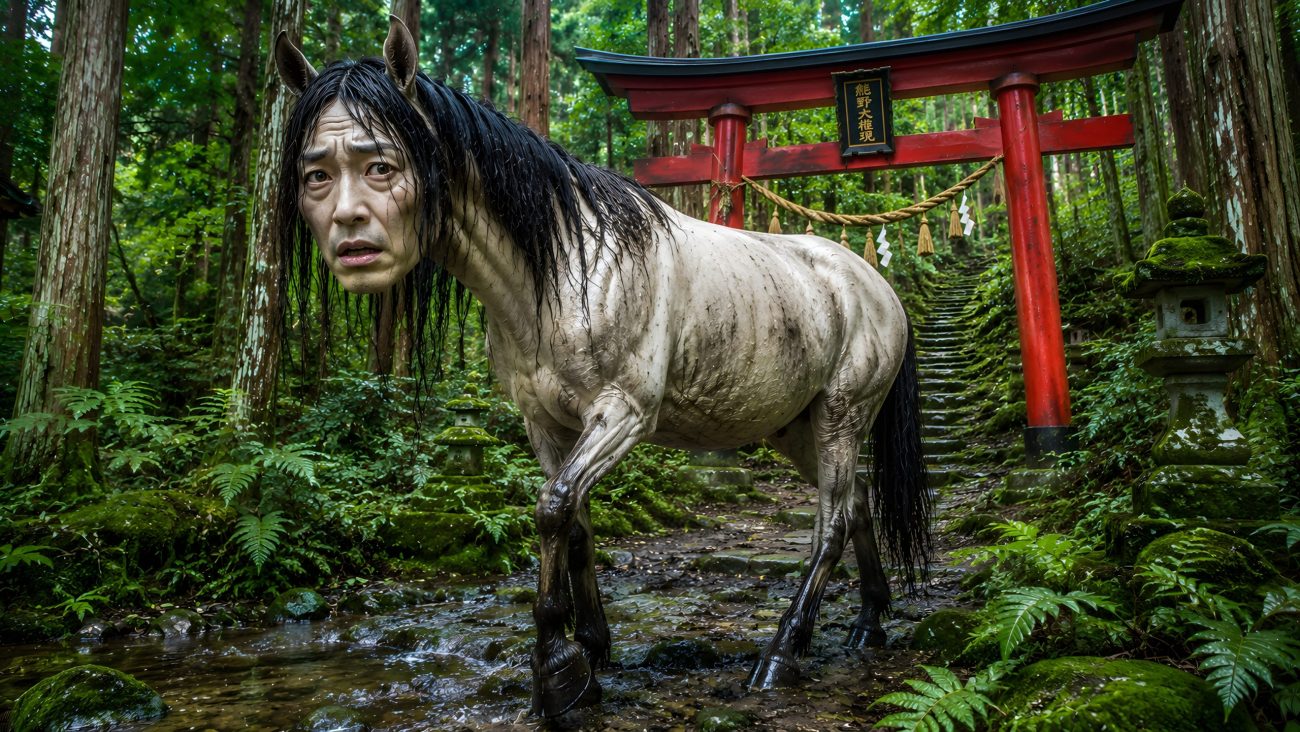
The following morning, the travelers were served the dumplings. Despite his friend’s warnings not to eat them, the wealthy boy tasted one. The moment he swallowed it, he was transformed into a horse.
The woman placed a bridle on the transformed boy and led him away to work as a horse, while the poor traveler escaped. Along the road he met an old man, who listened to his story and revealed that an eggplant tree bearing seven eggplants facing east could reverse the enchantment. If one of those eggplants were fed to the horse, it would become human again.
After searching for several days, the poor boy finally found the magical tree. He returned to the house, where his friend had become weak and emaciated from hard labor in the fields. He forced the seven eggplants into the horse’s mouth, and the spell was immediately broken.
The two friends returned home and told their families what had happened. Deeply moved by the poor boy’s loyalty and courage, the wealthy boy’s father bestowed his fortune upon him. The two friends then lived happily together for the rest of their lives.
Sources
TYZ. (n.d.). 旅人馬 (Tabibitoma). In 新版TYZ 妖怪図鑑. Retrieved June 29, 2026, from https://tyz-yokai.blog.jp/archives/1010655044.html