Tradition / Region: Chinese Mythology
Alternative names: Qi Gui (棋鬼), Chi Gui (痴鬼, “Obsessed Ghost”)
Category: Ghost
The Myth
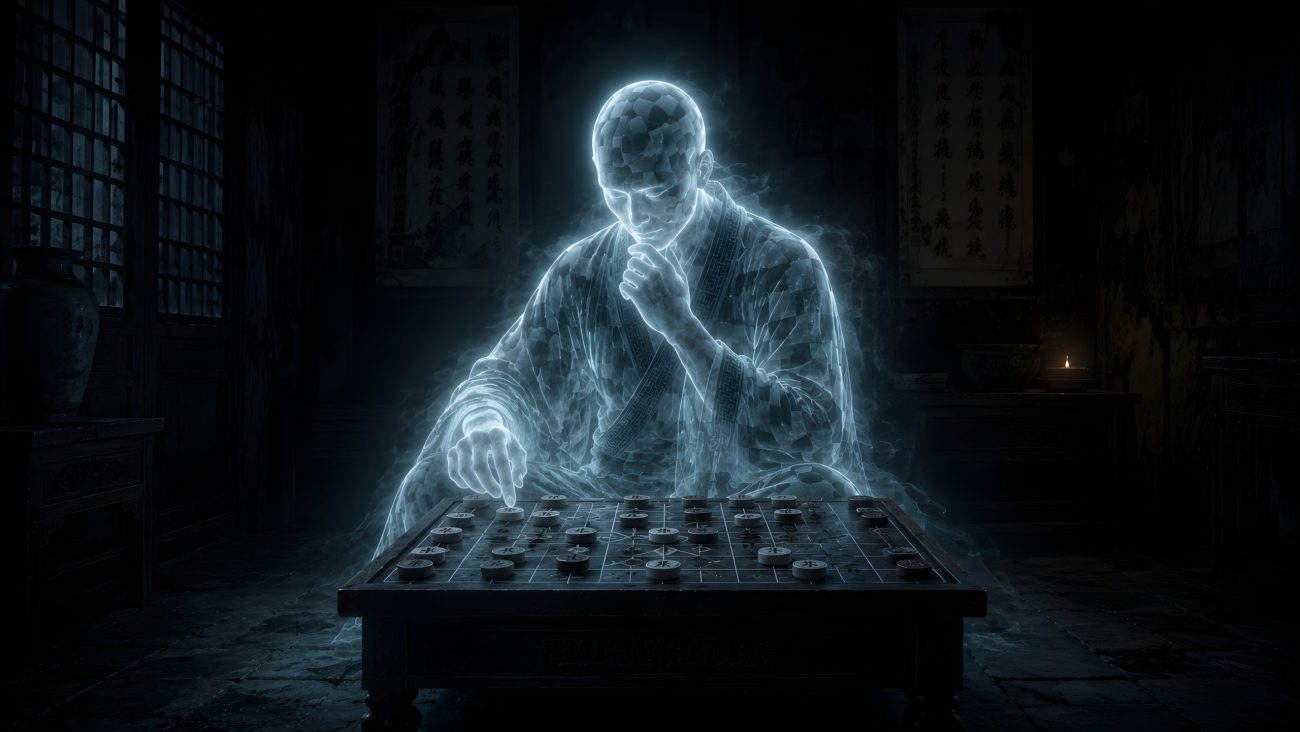
The Chess Ghost appears as the restless spirit of a person so utterly consumed by the game of Go (Weiqi) that even death could not break the obsession. It resembles an ordinary human ghost, forever seeking opponents and wandering wherever games of strategy are played. Though incorporeal, its mind remains entirely fixed upon the board, unable to think of anything except the next move.
According to Chinese legend, the Chess Ghost was once a man whose overwhelming passion for the game caused him to squander his wealth and neglect his family until his life fell into ruin. After death, he was condemned to the realm of the Hungry Ghosts as punishment for allowing obsession to consume his existence.
Even in the afterlife, however, he could not abandon his addiction. Rather than seeking redemption or preparing for reincarnation, he spent his time searching endlessly for games of Go. When the moment finally came for his soul to be reborn, he ignored the opportunity because he was too absorbed in a match. Having missed his chance, he remained trapped as a wandering ghost.
The most famous account appears in Strange Tales from a Chinese Studio (Liaozhai Zhiyi), where the Chess Ghost continues to haunt the living, driven not by hatred or revenge but by an irresistible desire to play. Other classical works similarly portray the spirit as caring little about its earthly life and focusing instead on its endless existence after death, forever captivated by the game that destroyed it.
Thus the Chess Ghost is remembered as a supernatural warning against obsession—a spirit whose love of strategy became so consuming that it sacrificed wealth, family, salvation, and even the possibility of rebirth, remaining forever bound to an unfinished game.
Sources
Wikipedia contributors. (n.d.). 棋鬼. In 維基百科,自由的百科全書. Retrieved June 27, 2026, from https://zh.wikipedia.org/wiki/%E6%A3%8B%E9%AC%BC