Tradition: Japanese Mythology
Alternative Names: 帷子辻, Katabira Crossroads, The Corpse of Danrin Empress
Category: Skeleton
The Myth
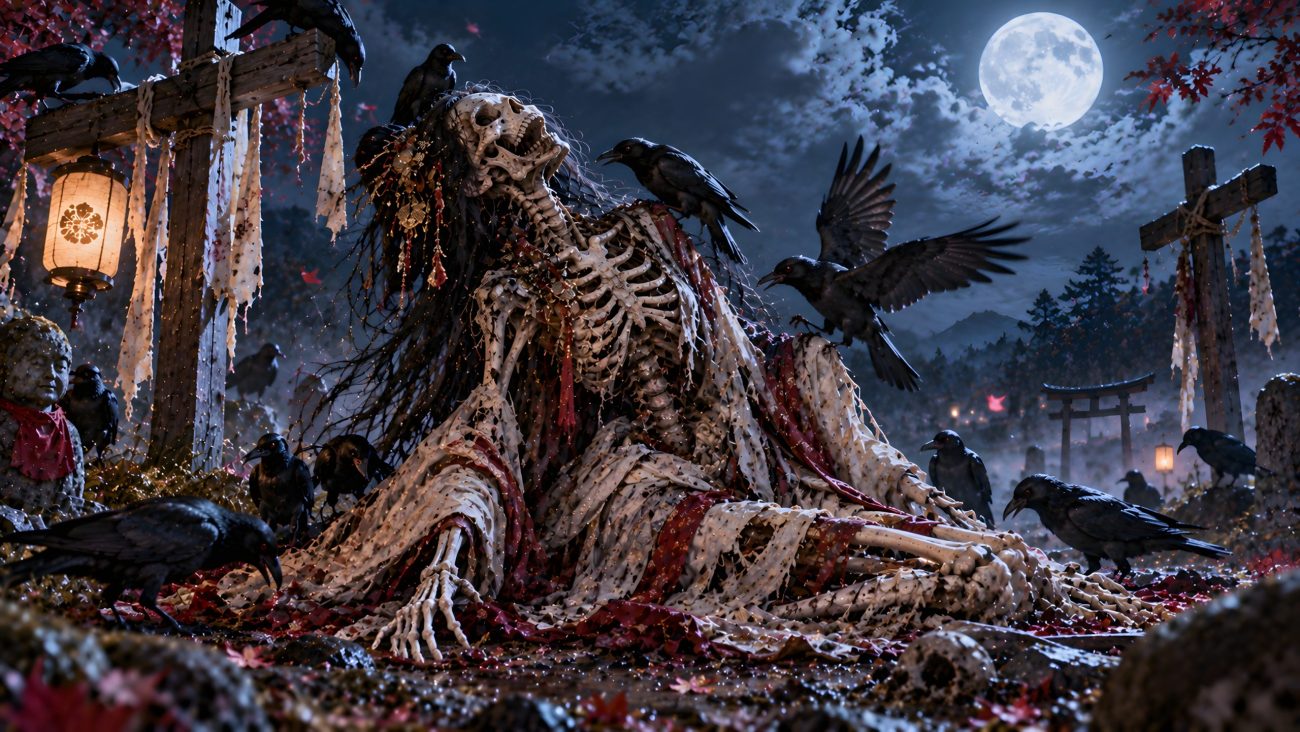
Katabira-ga-tsuji is a haunted crossroads in Kyoto associated with the decaying corpse of a beautiful empress. The legend concerns Tachibana no Kachiko (786–850), the wife of Emperor Saga, who became known as the Danrin Empress because of her devotion to Buddhism.
Renowned for her extraordinary beauty, the empress supposedly made a remarkable request before her death. She ordered that her body should not be buried, but left exposed in the wilderness to decay naturally. She wished for those captivated by physical beauty to witness her body transform over forty-nine days, from a beautiful corpse into bones and dust. Through this sight, she hoped to teach the impermanence of the human body and guide people towards Buddhist understanding.
The empress’s wish is associated with kusōzu, Buddhist paintings depicting the nine stages of a corpse’s decomposition. These images remind viewers that physical beauty and worldly attachments are temporary. At Katabira-ga-tsuji, a woman’s exposed corpse is depicted surrounded by crows waiting to feed upon it.
The apparition of a dead woman being devoured by dogs and crows was said to remain visible at the crossroads long after the empress’s death. The haunting may also reflect the historical practice of leaving unburied bodies at the site. The legend connects the horror of an exposed corpse with the Buddhist teaching that beauty, life, and the human body are all subject to decay.
Sources
新版TYZ. (n.d.). Katabira. https://tyz-yokai.blog.jp/archives/1074775491.html