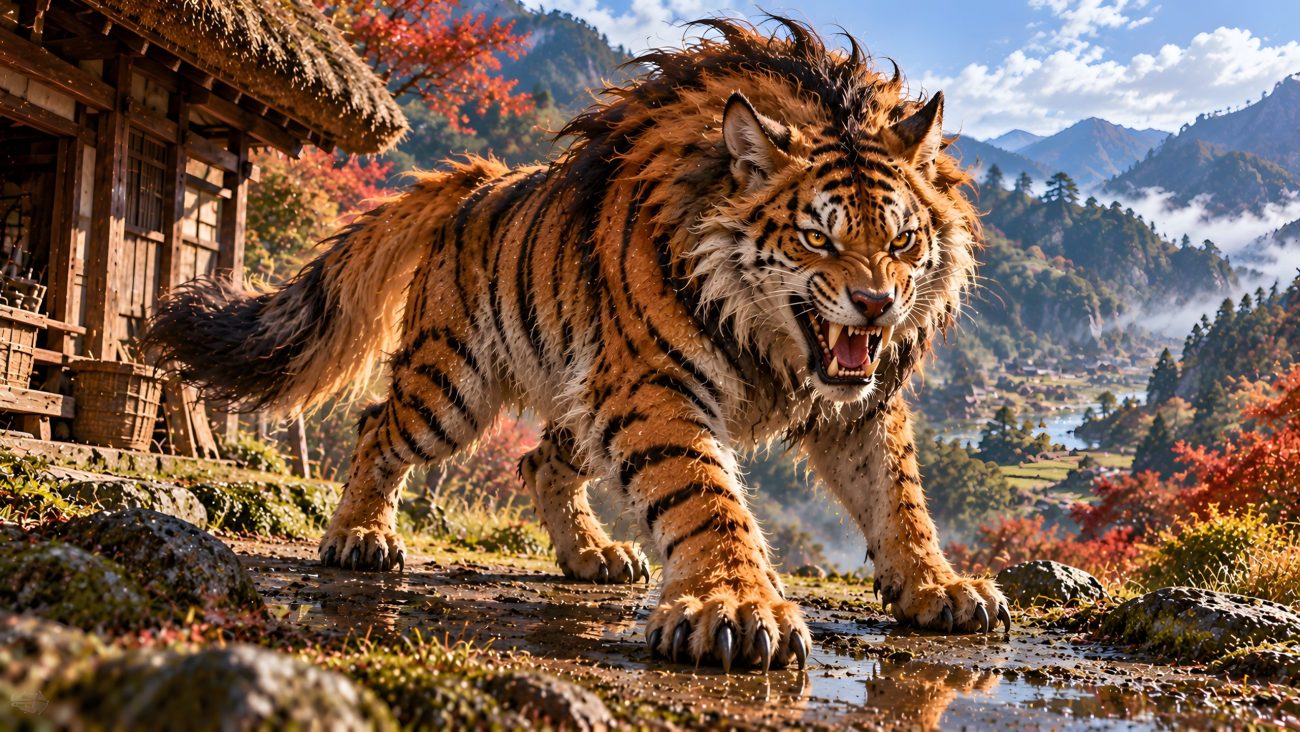
Tradition: Japanese Mythology
Alternative Names: Toraōka, Shishiōkami (Lion-Wolf)
Category: Tiger, Wolf
The Myth
Toraōkami is a fictional beast appearing in some Japanese folktales, particularly in versions of Furuya no Mori (“The Leaky Old House”). Its name combines the Japanese words for tiger and wolf. However, storytellers did not always agree on whether it was a single creature or simply a reference to tigers and wolves together.
In one version from Okishiro, Chizu Town, Tottori Prefecture, an impoverished elderly couple lived in a dilapidated house in the mountains. Whenever it rained, water leaked through the roof. One day, the old man told his wife that although people feared tigers and wolves, the leaking roof was far more frightening to them.
At that moment, a Toraōkami was hiding near their doorway, intending to eat the couple. Hearing the old man’s words, the beast became frightened. It wondered what kind of terrifying creature this “leak” could be if even the elderly couple feared it more than the strongest beasts in the world.
As the Toraōkami tried to flee, it encountered a cattle thief. The thief mistook the beast for a cow and pursued it. The Toraōkami, in turn, mistook the pursuing thief for the terrifying “leak” and ran away as fast as it could.
Thanks to the misunderstanding, the elderly couple escaped being eaten by the beast and avoided the cattle thief as well.
Stories featuring a creature called Toraōkami have been recorded in Japan’s San’in region. However, there was no consistent understanding of what the creature actually looked like or whether it was a distinct animal at all. In one account collected in Saji Village, Tottori Prefecture, the storyteller admitted uncertainty about whether the name referred to a single creature or simply a tiger and a wolf combined. A related story from the Oki Islands in Shimane Prefecture features a creature called Shishiōkami.
Sources
Tyz-Yokai. (n.d.). Tora-okami. https://tyz-yokai.blog.jp/archives/1080079401.html