Tradition / Region: Japanese Mythology
Alternate Names: Stone Crab; Crab Stone; Finger-Eyed Stone Crab
Category: Mountain dweller, Crab
The Myth
The tale of Ishigani begins not with a named monster, but with a series of unsettling events that followed a reckless act. In Bingo Province, a sixteen-year-old samurai youth named Inō Heitarō took part in a test of courage on Mount Hikuma together with his neighbor, Mitsui Gonpachi. After that night, strange disturbances began to plague Heitarō’s home, as if something unseen had followed him back from the mountain.
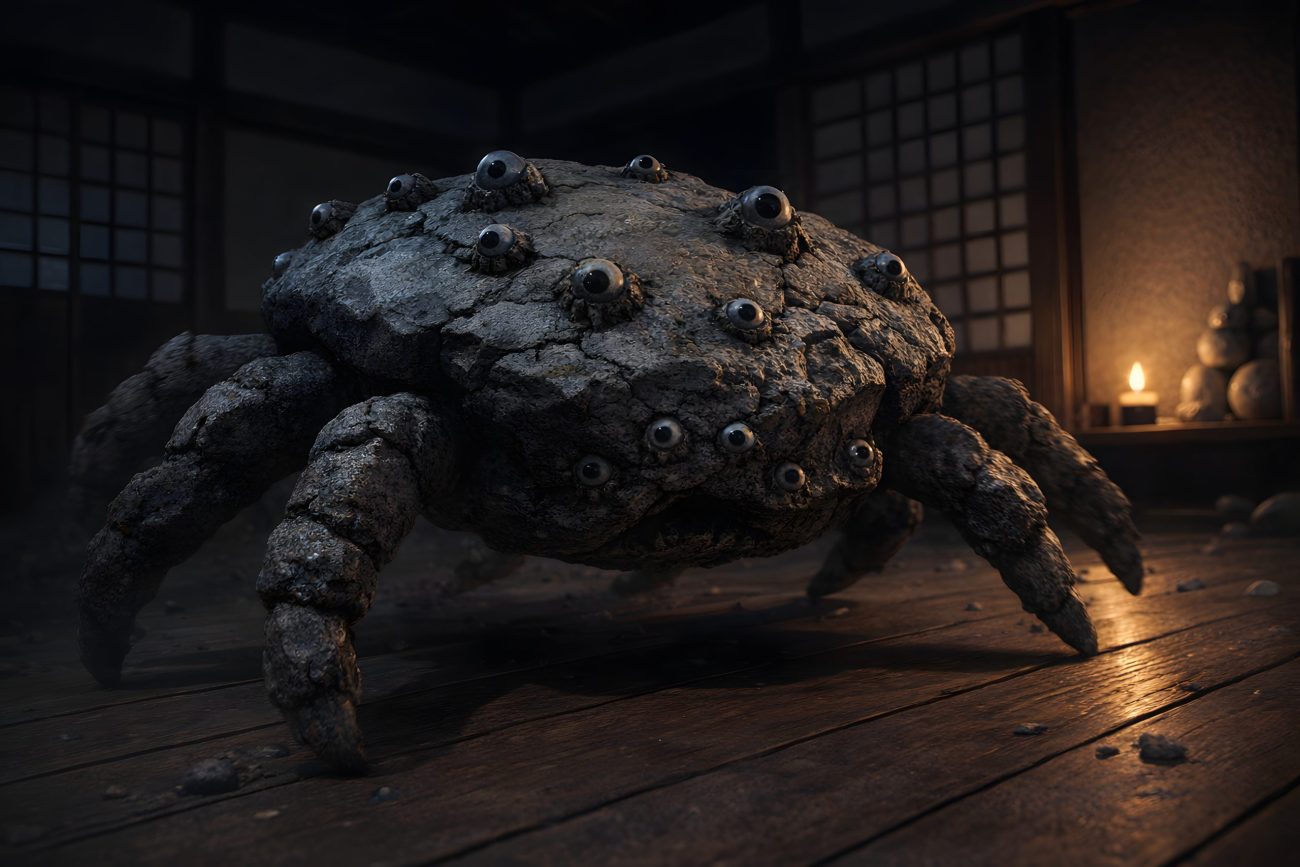
On the night of July fifth, while Heitarō and Gonpachi were talking inside the house, a heavy stone suddenly burst into the room. It was no ordinary rock. Before their eyes, it sprouted thick, finger-like legs and began to crawl across the floor with disturbing speed. From its surface glared eyes like those of a crab, fixed upon the young men with hostile intent. The creature’s movement was vigorous and purposeful, as though the stone itself had been given will and malice.
Gonpachi drew his sword, ready to strike the crawling stone, but Heitarō stopped him. Whether from fear, restraint, or a sense that violence would only worsen matters, no blow was struck. The stone creature continued its threatening display before vanishing, leaving the house shaken and the boys helpless.
When morning came, the terror seemed to have passed. In the kitchen lay a large stone, inert and ordinary once more. It was recognized as a familiar object from the neighborhood—either a car-stopper stone or a heavy stone used for pressing pickles. Whatever force had animated it during the night had withdrawn, leaving behind only the mundane shell of what had briefly become something monstrous.
The creature itself was never given a fixed name in the original account. Later retellings and illustrations began to call it Ishigani, likening it to a crab formed of stone. In picture scrolls and books, it is often shown as a rock covered in many eyes, scuttling forward on thick, finger-like limbs; in other depictions, it has only two bulging eyes, making its crab-like nature more pronounced.
Ishigani stands as a reminder of a common theme in Japanese folklore: that ordinary objects can be temporarily possessed or transformed by unseen forces. What appears lifeless by day may awaken by night, not as a true beast, but as a manifestation of fear, consequence, or something disturbed beyond human understanding.
Gallery
Sources
TYZ-Yokai Blog contributors. (n.d.). 石蟹 (Ishigani). In TYZ-Yokai Blog, from https://tyz-yokai.blog.jp/archives/1052490476.html
Interpretive Lenses
Religious Readings
- Christian Ascetic Deep Dive
Philosophical Readings
- Nietzschean Deep Dive
Psychological Readings
- Jungian Deep Dive
Esoteric Deep Dive
- Hermetic Deep Dive
Political / Social Readings
- Marxist Deep Dive
Other
- How to Invite The Ishigani