Tradition: Russian Mythology, Belarusian Mythology
Alternative Names: Kikimora, Shishimora, Shishimora, Kikhimora, Veshtchytsia, Kykmora, Shishimora
Category: House dweller
The Myth
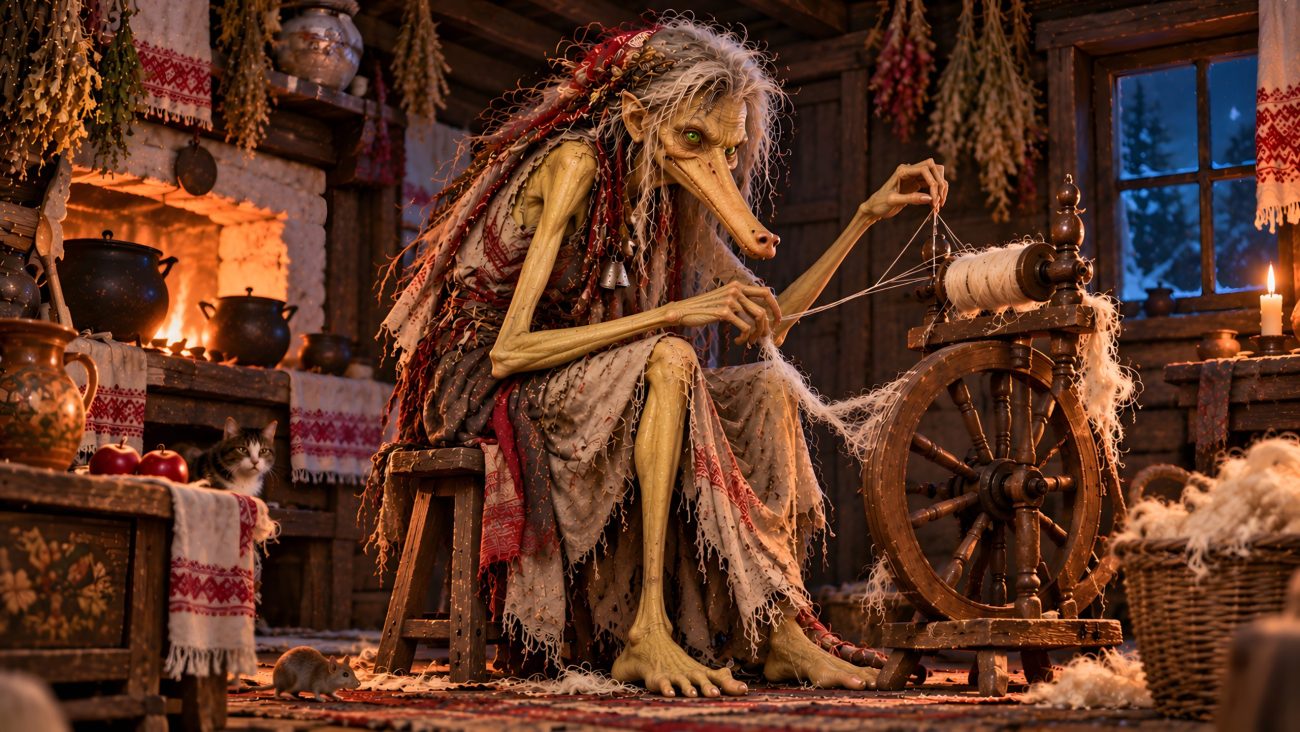
Kikimora is a female household spirit in Slavic folklore, most commonly described as a small, ugly, crooked old woman with a long nose, long skinny arms, and a hunched body. She has a comic yet frightening appearance, with unkempt grey hair and tattered clothing. Some accounts describe her as so small and thin that she can be blown away by the wind. Other traditions portray her as a young woman with a long braid, a peasant woman wearing a married woman’s headdress, or even an animal such as a pig, dog, hare, or duck. She is often associated with the darkest corners of a house, particularly behind the stove or in the cellar.
Kikimora is believed to originate from the souls of people who died before baptism, children who were cursed by their mothers, or infants who were killed before they could be baptised. Some traditions also claim that she can be sent into a house by an evil spirit or deliberately placed there by builders or craftsmen seeking revenge for poor payment. In such cases, a small doll made of wood chips and rags is hidden beneath a beam or between logs in a corner of the building. Once the Kikimora takes up residence, the household may experience constant disturbances and misfortune.
The spirit is notorious for causing disorder during the night. She throws and breaks objects, disturbs sleep, bangs on pots, makes walls and furniture creak, and produces strange noises such as squeals, cries, and whistles. She may throw pillows, scatter belongings, or make the house seem haunted until its occupants are forced to leave. In some stories, she appears as an invisible presence whose voice can be heard even when nobody can see her. Her arrival is considered a sign that a house has become unclean or troubled, and her disturbances can make it almost impossible to live there peacefully.
Kikimora also torments livestock. She may ride horses through the night until they are exhausted, braid their manes, or cause them to become restless. In northern Russian folklore, she is said to shear sheep or pluck their wool, leaving them bald despite the owner’s efforts to stop her. Some accounts describe her tormenting animals until the farmer gives up and moves away. Her mischief can therefore threaten both the comfort of a household and its livelihood.
Despite her destructive nature, Kikimora is not always entirely harmful. In some traditions, she helps with household chores, bakes bread, looks after children, and assists with livestock. She is particularly associated with spinning and weaving. At night, she sits near a spinning wheel, twisting thread and working at the spindle. However, she is easily offended, and her help may become a source of trouble if the household fails to show proper respect. She can tangle wool, spoil spinning, or leave unfinished work behind. A common saying warns that a girl will not receive a shirt from a Kikimora because the spirit never finishes her work properly.
Kikimora’s spinning can also carry ominous meanings. If she is seen spinning in the front corner of a house, it may foretell the death of a member of the household. Her presence is associated with the boundary between ordinary domestic life and the supernatural world. In some regions, she is believed to appear openly only at Christmas or on the night before Christmas, when the inhabitants of the afterlife can enter the world of the living. Other accounts describe her as becoming more docile after Epiphany.
People used various methods to protect their homes and animals from Kikimora. A stone talisman known as a chicken god, often a stone with a natural hole, could be hung near the roost to protect hens. Sharpened sticks were used to guard livestock, while salt was placed on belts to prevent the spirit from harming horses. To drive her away, people might sweep the stove and corners of the house while reciting a charm, or fumigate the home with a burning palm branch. Another remedy involved placing hair in the house or washing pots and jugs with water infused with fern. If Kikimora had been deliberately introduced through sorcery, some accounts claimed that the object used to send her had to be found and destroyed.
Kikimora is one of the most ambivalent figures in Slavic household folklore. She may assist with domestic work and care for animals, but she can also torment families, damage property, and drive people from their homes. Her association with spinning, nighttime disturbances, and the spirits of the unbaptised connects her to anxieties about household order, unfinished work, and the uncertain boundary between the living and the dead.
Sources
“Kikimora.” New Bestiary (Bestiary.us). https://www.bestiary.us/kikimora