Tradition: German Mythology
Alternative Names: Drâk, Dråk, Drakel, Fürdrak, Drake, Drache, Plon
Category: Goblin
The Myth
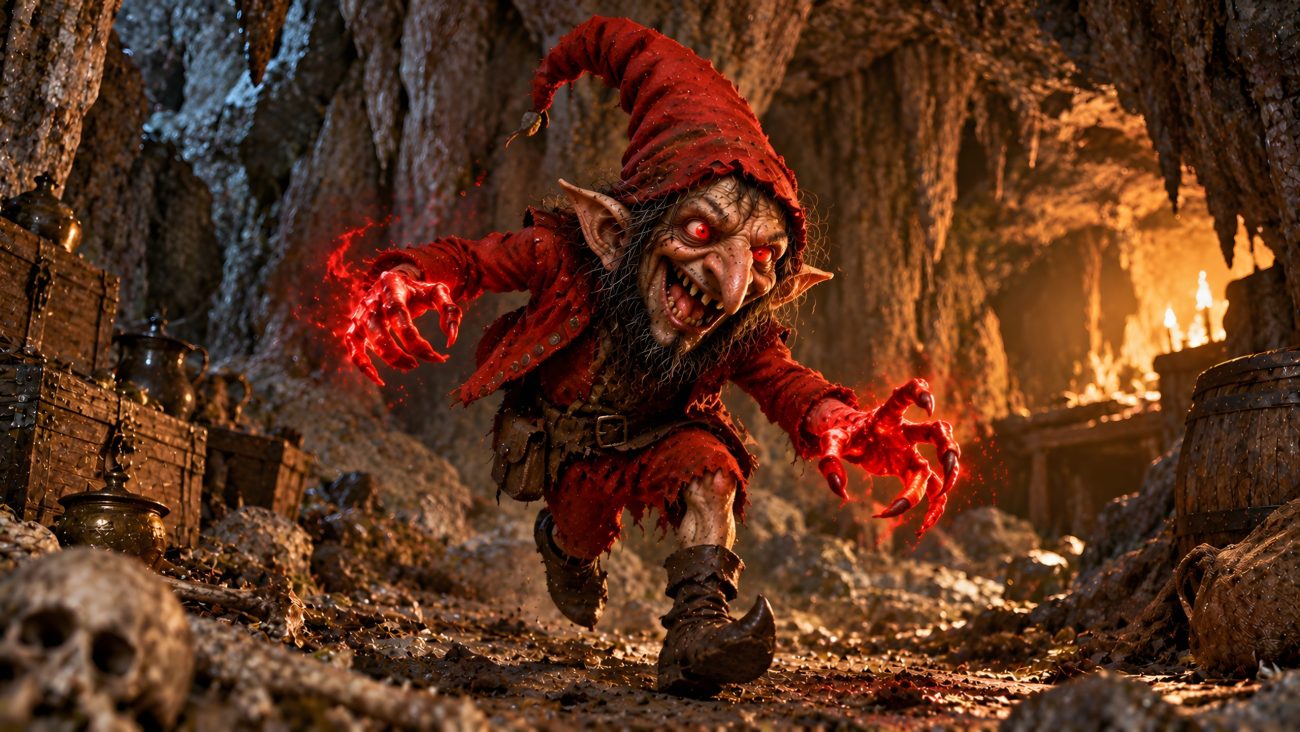
The Drak is a shape-shifting household spirit that most often appears as an animal, although it can also take the form of a small humanoid figure. When humanoid, it may resemble a little man wearing a red cap and red jacket. Animal forms are far more common and include black or dark-brown cats, kittens, black chickens, roosters, hens, partridges, gray hawks, owls, jackdaws, calves, hares, snakes, and even black ants. Some accounts describe it as a wet chicken, a fiery red snake without wings, or a three-legged or burning hare. A particular form, the Drachenhuhn, or dragon chicken, can lay thalers or silver eggs, sometimes producing two silver eggs in a single day.
The Drak’s appearance often changes between day and night. During the day, it may appear as an ordinary animal, while at night it can assume the form of a Kobold or reveal itself as a fiery apparition. It is frequently seen flying through the darkness as a shooting star, meteor, will-o’-the-wisp, or flash of lightning. Other reported forms include a pillar of fire, a glowing ball with a fiery tail, a burning broom, a fiery lump, a flaming sack of grain, and a blazing pole resembling a haystack. Some manifestations combine animal features with fire, such as a fiery cat or chicken, a snake with a glowing tail, or a being with an enormous fiery head and a long, dark-blue tail. The Drak is also associated with a foul, infernal smell of sulfur.
Wherever the Drak flies, fires may break out and everything in its path may burn. Its appearance is therefore regarded as an omen of a destructive firestorm. The spirit can also turn against the person it serves: if its owner mistreats it, the Drak may burn down the owner’s house. Its fiery nature is reflected in several regional names referring to shooting stars, long or short tails, and glowing trails of fire.
The Drak is often identified with the German Kobold or the devil, and these beings may also be used as alternative names for it. Despite sometimes being called a Drache, meaning dragon, it has little in common with the conventional reptilian monster. In Lusatian folklore, a related being called the Plon is said to possess seven heads. Together, these traditions portray the Drak as an unpredictable supernatural creature that can bring wealth through unusual eggs, serve as a household spirit, or appear in the night sky as a dangerous harbinger of fire.
Sources
“Drak (mythology).” Wikipedia: The Free Encyclopedia. Wikimedia Foundation. Accessed October 17, 2026. https://en.wikipedia.org/wiki/Drak_%28mythology%29#Nomenclature