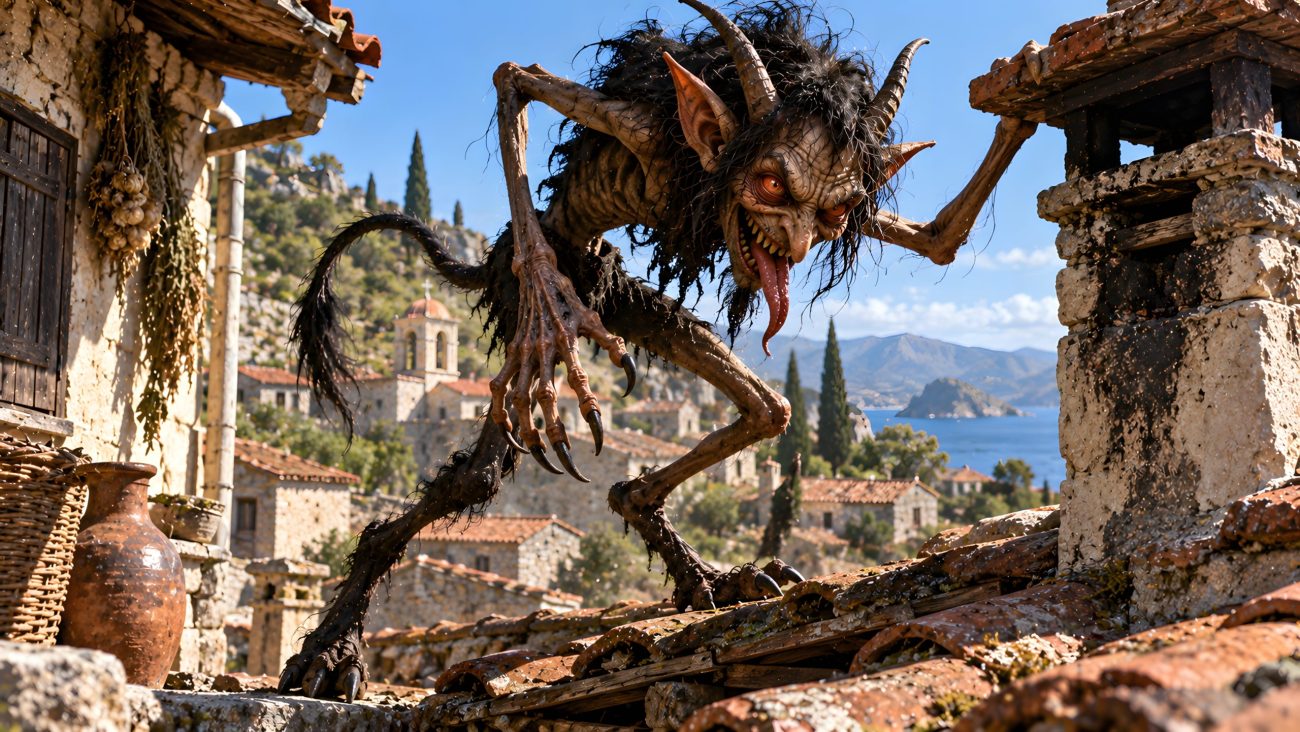
Tradition: Greek Mythology
Alternative Names: Kallikantzaros, Kalikantzaroi, Skalikántzaros
Category: Goblin
The Myth
The Kallikantzaroi are mischievous and frightening supernatural creatures in Greek folklore, believed to emerge from underground during the twelve days of Christmas, from Christmas Day until Epiphany on 6 January. Their appearance varies between regions, but they are commonly described as ugly, black, hairy goblins with horns, burning red eyes, and long black tails. Other accounts portray them with goat-like or donkey-like ears, animal limbs, cloven hooves, protruding tongues, and distorted features. They may be enormous or diminutive, and some traditions describe them as one-eyed, blind, lame, knock-kneed, or reverse-footed. They are generally depicted as male and are sometimes associated with the lustful, animalistic nature of satyrs.
According to a widespread legend, the Kallikantzaroi spend the rest of the year underground, attempting to saw through the trunk of the great tree that supports the Earth. They hope to bring the tree down and destroy the world. Just as they are about to finish their work, however, Christmas arrives, allowing them to emerge onto the surface. They abandon their task and spend the twelve days tormenting humanity. They enter houses through chimneys, urinate on fireplaces, contaminate food and drink, spoil milk, break furniture, devour Christmas pork, and play cruel pranks on people. When Epiphany arrives, the sun begins moving again and the creatures must return underground. They discover that the world tree has healed itself during their absence, forcing them to begin sawing once more. This cycle is believed to repeat every year.
Regional traditions describe the Kallikantzaroi in different ways. In older folklore from Chios, they were said to roam during the Christmas season and attack people with their sharp claws. They might sit on a victim and ask, “Tow or lead?” A person who answered “tow,” meaning a clump of hemp fibre, would be spared, while someone who answered “lead” would be crushed under their enormous weight and beaten. One method of distracting them was to leave a sieve outside. The creatures would attempt to count its holes but could never pronounce the number three, which was considered sacred, and so they repeatedly began counting from one. Another version involved leaving tangled hemp for them to count until the cock crowed and dawn destroyed them.
In some traditions, the Kallikantzaroi are believed to originate from human beings. On Zakynthos, a child conceived by a sinful woman on Christmas Eve was said to become a skalikántzaros in adulthood, gaining the ability to transform into one during the Christmas season. Other communities believed that children born at particular times could become these creatures unless protective measures were taken. In other parts of Greece, however, the Kallikantzaroi are regarded as a separate race of demons rather than transformed humans. They are said to feed on frogs, worms, snakes, and other small creatures, with pork considered a particular delicacy.
People traditionally used a variety of methods to keep the Kallikantzaroi away from their homes. Desserts and honey cakes could be left out to distract or appease them, while households in some regions offered particular foods on New Year’s Eve or Epiphany. Keeping a fire burning in the fireplace was believed to prevent them from entering through the chimney. Other protective measures included burning a Yule log throughout the twelve days, throwing salt or old shoes into the fire, burning incense, marking doors with a black cross on Christmas Eve, and hanging a pig’s lower jaw near the entrance or chimney. These customs reflect the widespread belief that the Kallikantzaroi could be held at bay until Epiphany forced them to return to the underworld.
Sources
“Kallikantzaros.” Wikipedia: The Free Encyclopedia. Wikimedia Foundation. Accessed October 17, 2026. https://en.wikipedia.org/wiki/Kallikantzaros#Greek_folklore