Tradition: German Mythology
Alternative Names: Biersal, Bieresal, Bierasal, Beer Donkey
Category: Goblin, Horse
The Myth
The Bieresel, whose name means “beer donkey” in German, is a type of kobold or household spirit found in German folklore. It is particularly associated with taverns, breweries, beer cellars, and other places where beer is stored or consumed. One of the earliest detailed descriptions appears in Johann Georg Schmidt’s Die gestriegelte Rockenphilosophie, first published in 1705, which describes the Bieresel as a devil or kobold that takes the form of a donkey and drinks beer at night. The name was also recorded as an insult in Bürgel in 1597.
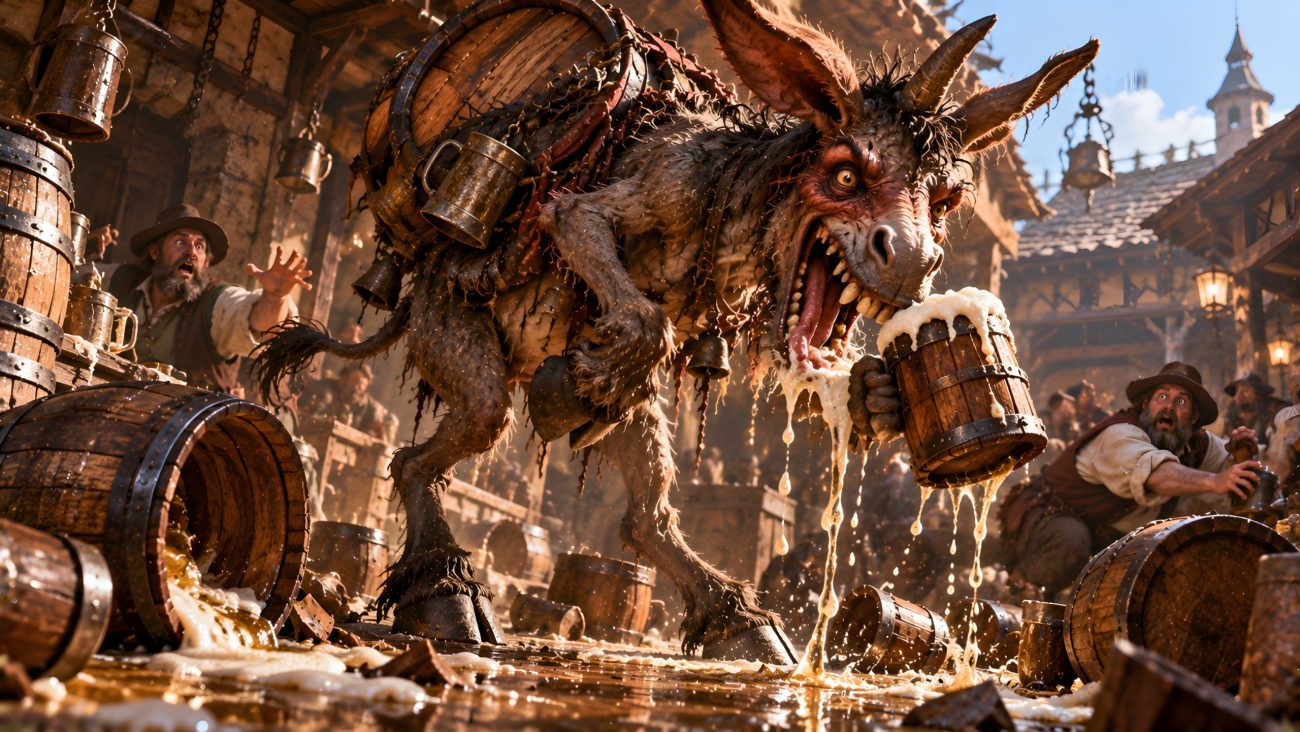
The Bieresel has several different appearances depending on the region. It is often described as a donkey-like creature with three or four legs, or as a spirit with donkey legs. In some traditions, it resembles a gray ox with a thick red human head and enormous horns. Other accounts describe a donkey-headed, hoofed creature that causes disturbances in farmhouses and taverns. These varied descriptions reflect the Bieresel’s changing character across German-speaking regions.
In Ruhla and Steinbach in Thuringia, the Bieresel is said to roam the streets in search of beer drinkers. It particularly targets people returning home late after drinking at a tavern, leaping onto their backs and forcing them to carry it all the way to their front doors. This behaviour, known as aufhocken, is also associated with other supernatural beings in German folklore. In the Vogtland, however, the Bieresel is described as a less threatening figure that enters pubs and mingles with drinkers without causing significant harm. Its name is even used to describe a child who laughs particularly loudly.
In other traditions, the Bieresel performs useful household tasks. In Grochwitz, Saxony, it is said to bring beer into houses and carry out domestic chores like other kobolds. Its only expected reward is a glass of beer each evening. If this payment is withheld, it becomes destructive, breaking objects and causing trouble. Similar beliefs describe a Bieresel living in a cellar beneath a barn near Grimma, where it would not tolerate anyone staying overnight.
The Bieresel can also be a more dangerous spirit. In former German-speaking Bohemia, unscrupulous tavern keepers were sometimes said to transform into Bieresels, which haunted inns and caused violent disturbances. One tale describes a servant found dead with a broken neck after apparently confronting the creature, while a girl who encountered it suffered a swollen face and fever before recovering. Other stories tell of the Bieresel throwing maids from their beds, breaking milk vessels, and following people home from taverns. At a haunted mill known as the Katzenmühle, a nightly offering of beer was made to the spirit until a travelling bear-handler drove it away after a confrontation.
Related accounts of the Biersal portray it as a brewery spirit that cleans bottles, beer steins, casks, and kegs in exchange for its own portion of beer. When properly rewarded, it may serve as a useful helper; when neglected, it steals or hides tools, damages equipment, and causes general disorder. Across these traditions, the Bieresel embodies the unpredictable nature of household spirits: it can be a helpful worker, a troublesome prankster, or a dangerous presence, depending on how it is treated.
Sources
“Bieresel.” Wikipedia: The Free Encyclopedia. Wikimedia Foundation. Accessed October 17, 2026. https://en.wikipedia.org/wiki/Bieresel