Tradition: Basque Mythology, Spanish Mythology
Alternative Names: Jentil, Jentilak, Jentilgo, Jentilarri (Giant Stones)
Category: Giant
The Myth
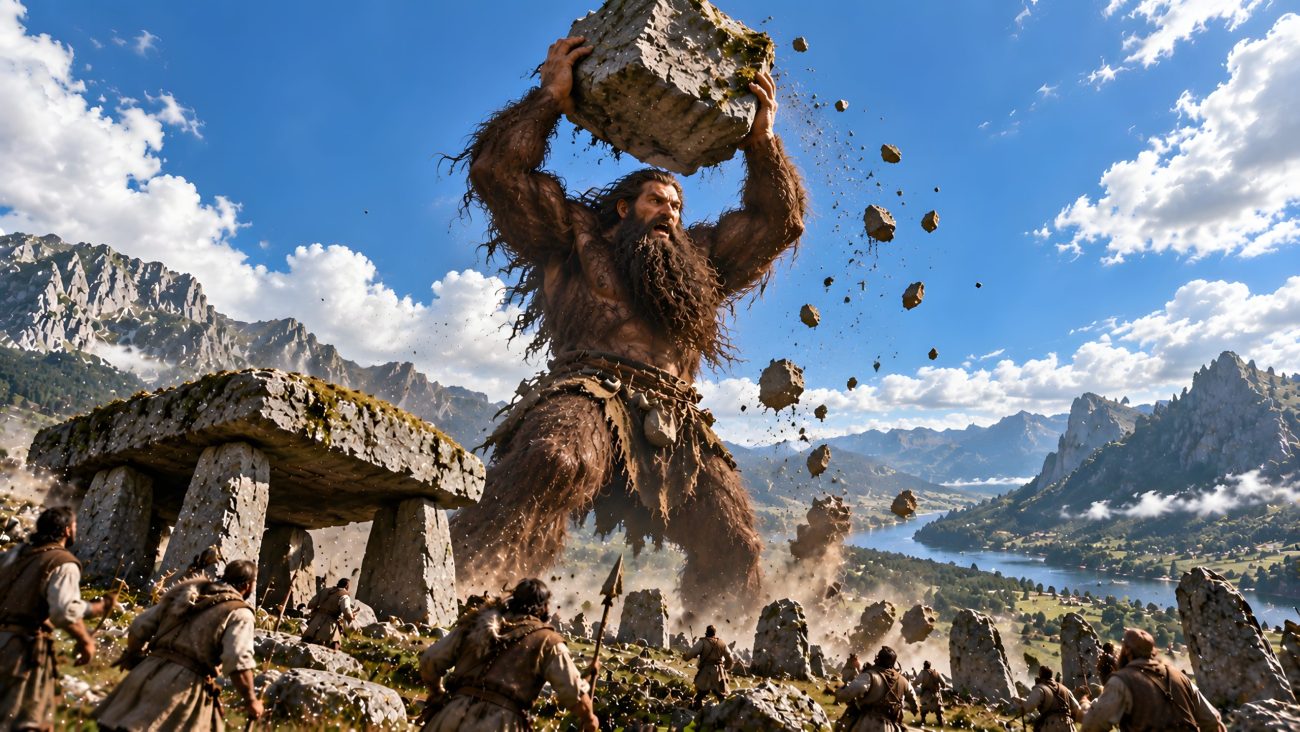
The Jentilak are a race of giants in Basque mythology who were believed to have lived alongside the Basque people in ancient times. They were exceptionally tall and covered in hair, so enormous that they could walk through the sea and throw massive rocks from one mountain to another. Their legendary strength was used to explain the presence of ancient stone monuments, megaliths, and isolated boulders scattered throughout the Basque Country. Some traditions also attributed the origins of Basque pelota, the traditional ball game, to the giants’ stone-throwing contests.
The Jentilak were regarded as builders and inventors who shaped the ancient world. They were credited with constructing Neolithic monuments such as dolmens, as well as inventing metallurgy and the saw. They were also said to have been the first to cultivate wheat and to have taught humans how to farm. Despite these achievements, the giants preferred to remain in the mountains rather than move into the valleys and adopt new ways of life.
Some legends associate the Jentilak with historical battles. One tradition claims that they helped defeat Roland and the Frankish army at the Battle of Roncevaux by hurling enormous rocks at the enemy. Their immense strength and connection with ancient stone structures made them central figures in explanations of the landscape and the distant past.
According to one tradition, the age of the Jentilak ended when a luminous cloud, possibly a star, appeared in the sky, heralding the birth of Christ, whom they called Kixmi. The giants understood this portent as a sign that their era had come to an end. They disappeared beneath the earth under a dolmen in the Arratzaren valley in Navarre. Other versions say that they threw themselves from a mountain. Only Olentzero remained, a giant associated with Christmas who survives in Basque tradition as a figure represented by straw dolls.
The Jentilak’s legacy remains visible in Basque place names and local traditions. Many ancient structures are associated with them: dolmens are called jentilarri or jentiletxe, stone circles known as harrespil are called jentilbaratz, and caves may be known as jentilzulo or jentilkoba. These names preserve the memory of the giants as the legendary builders of ancient monuments and as inhabitants of a world that existed before the Christian era.
Sources
“Jentil.” Wikipedia: The Free Encyclopedia. Wikimedia Foundation. Accessed October 16, 2026. https://en.wikipedia.org/wiki/Jentil