Tradition: Japanese Mythology
Alternative Names: Wanyuudo, Wanyūdō, Katawaguruma
Category: Flame
The Myth
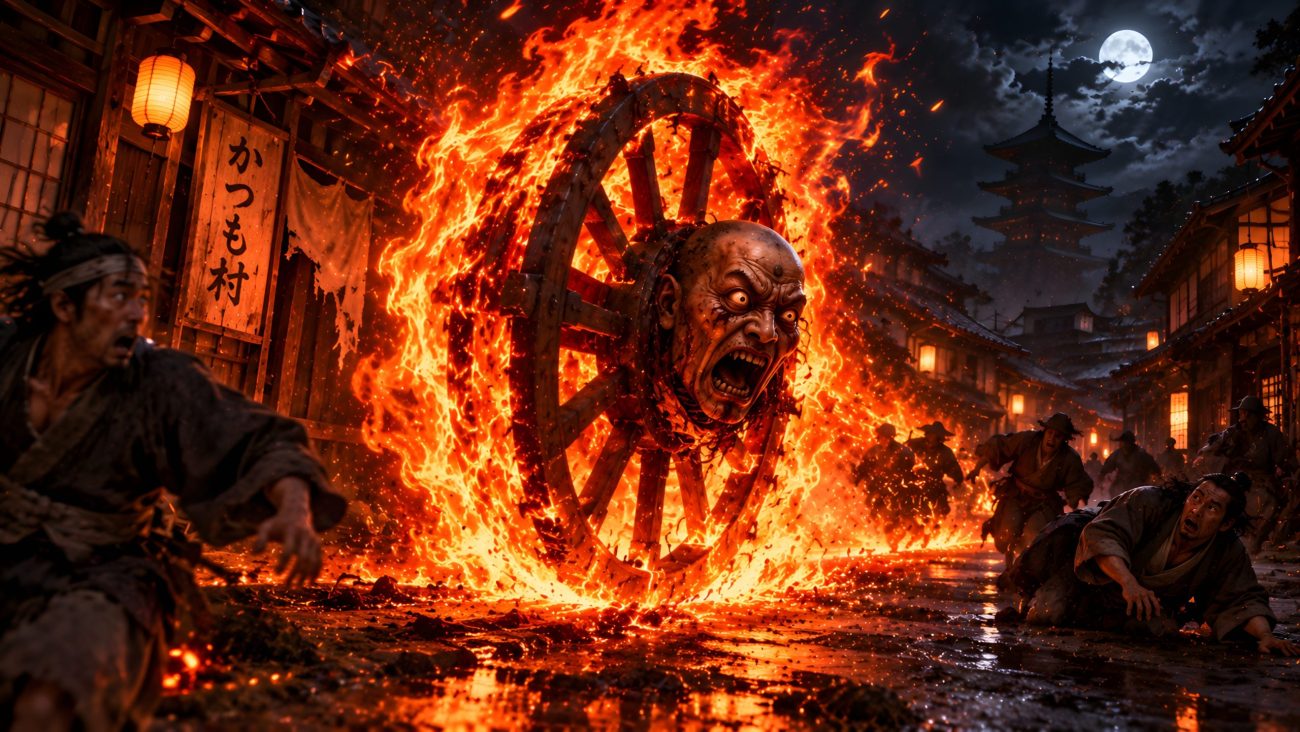
Wanyūdō is a terrifying yōkai from Japanese folklore, depicted as a human head attached to the hub of a gigantic wheel engulfed in flames. The face is often described as that of a bald Buddhist monk, while the burning wheel rolls endlessly through the streets. According to Toriyama Sekien’s Konjaku Gazu Zoku Hyakki, the creature travels in circles on its single fiery wheel, and anyone who sees it risks losing their soul. A traditional protection against Wanyūdō is to place a sign on the door of one’s home bearing the words “This is the village of Katsumo,” which is said to discourage the creature from approaching.
Wanyūdō is closely associated with another supernatural being called Katawaguruma, or the One-Wheeled Cart. In earlier tales, including Shokoku Hyakumonogatari, Katawaguruma haunted Higashinotoin Street in Kyoto and was depicted with a human face attached to the centre of a burning wheel. Some versions portray a woman riding upon the fiery cart. Toriyama Sekien appears to have developed Wanyūdō using Katawaguruma as a model, illustrating the two creatures consecutively in his compendium as a possible pair.
The name Katsumo has a literary origin connected to an ancient Chinese anecdote about Zengzi, a disciple of Confucius renowned for his filial piety. Zengzi refused to enter a village whose name could be interpreted as “overcoming one’s mother,” considering it an expression of disrespect toward one’s parents. This story became part of a proverb about rejecting wrongdoing, alongside an anecdote in which Confucius refused to drink from a spring associated with theft. In the Wanyūdō legend, the reference to Katsumo transforms this moral tradition into a supernatural ward against a fearsome spirit.
Sources
Hans Watzlik. “Jungferblitz.” In Böhmerwald-Sagen. Budweis: Böhmerwalder Dorfbücher, 1921, Heft 5. Reproduced by SAGEN.at. https://www.sagen.at/texte/sagen/tschechien/watzlik/jungferblitz.html