Tradition: Inca and Aymara mythology, Peruvian Mythology
Alternative Names: Katari, Yana Amaru, Yuraq Amaru
Category: Dragon
The Myth
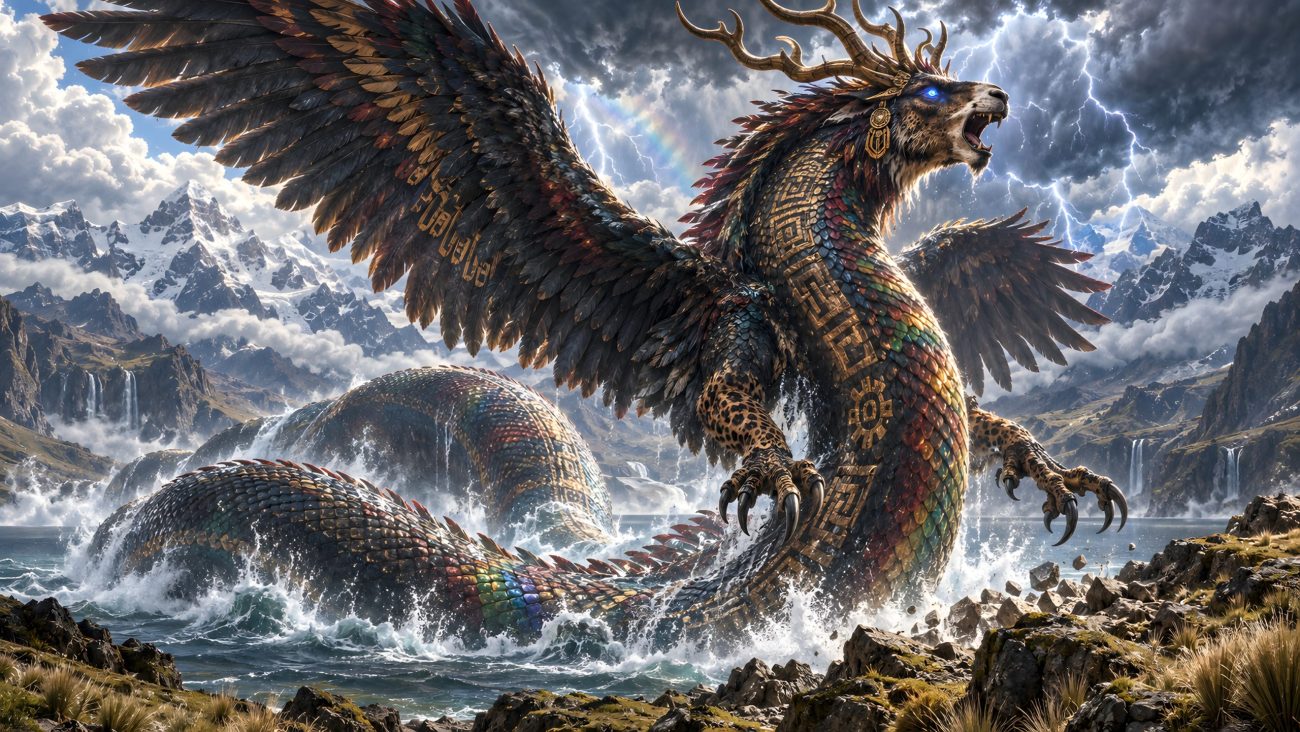
Amaru is a gigantic cosmic serpent, sometimes described as a dragon, whose enormous body remains serpentine even when it takes on features of other animals. It may have two heads, or the head of a bird or puma, and some depictions give it bird-like feet and wings. Other traditions describe it with a reddish snout, crystalline eyes, llama-like head, taruka horns, and a fish’s tail. Its immense body is covered in scales, and it is closely associated with the waters beneath the earth, lakes, rivers, mountains, storms, rain, hail, and the sky.
The Amaru dwells in the depths of lakes and rivers and in the subterranean world, moving between the earthly and spiritual realms. Its winding body connects the earth and sky, while its scales are said to contain all things: living beings, their lives, their realities, and even their dreams. It can bring rain and vital waters to the land, but it can also unleash storms, hail, earthquakes, and destruction.
One great legend tells how the Huanca people once lived in caves because terrible beasts around a great lake prevented them from reaching its waters. They begged the god Wiracocha for help, and he called upon Tulumanya, the first rainbow. With a great roar, Tulumanya brought forth a colossal serpent called Yana Amaru, the Dark Amaru. It had the head of a guanaco, the wings and claws of an eagle, the legs of a jaguar, and a gigantic scaled serpent’s body ending in the tail of an anaconda.
Yana Amaru was sent to destroy the beasts threatening the people, but the creature soon became a monster itself. It began attacking humans and other creatures for pleasure and took possession of the lake. The desperate Huancas once again called upon Wiracocha, who created another Amaru to oppose it. This second serpent had brilliant silver scales and was known as Yuraq Amaru, the White Amaru.
The two gigantic serpents fought one another, but their battle only brought greater destruction. Neither could defeat the other, and their struggle seemed endless. Finally, Wiracocha sent Illapa, the lightning, and Wayra, the wind, against them.
The Amarus attacked the two divine powers and, finding themselves overwhelmed, attempted to escape. They fled toward a lagoon, but Illapa destroyed its shore while Wayra drove the waters outward until the lagoon dried up. The serpents then tried to flee into the heavens, but Wayra dragged them back toward the earth. Illapa confronted them directly, and the final battle began.
As they approached death, the two Amarus stretched out their enormous bodies and grew larger still. Their bodies eventually became the two great mountain ranges surrounding the Mantaro Valley. The larger western range became a land of fertile fields and broad pastures, while the smaller eastern range rose into perpetual snow.
Yet the Amaru did not completely disappear. When a storm cloud approaches, the serpent is said to rise from the depths and reach toward the sky, attempting to scatter hail over the crops. At that moment it can appear as an immense, twisting serpent stretching toward the clouds. The people call upon their divine protectors, and once again lightning and wind descend upon the beast. After their terrible battle, the Amaru is defeated and driven back into the depths of the lake, where it waits until it rises again.
Sources
“Amaru (mythology).” Wikipedia: The Free Encyclopedia. Wikimedia Foundation. Accessed October 3, 2026. https://en.wikipedia.org/wiki/Amaru_(mythology)