Tradition: Hawaiian mythology, American Mythology
Alternative Names: Mo-o god, Dragon-god
Category: Dragon
The Myth
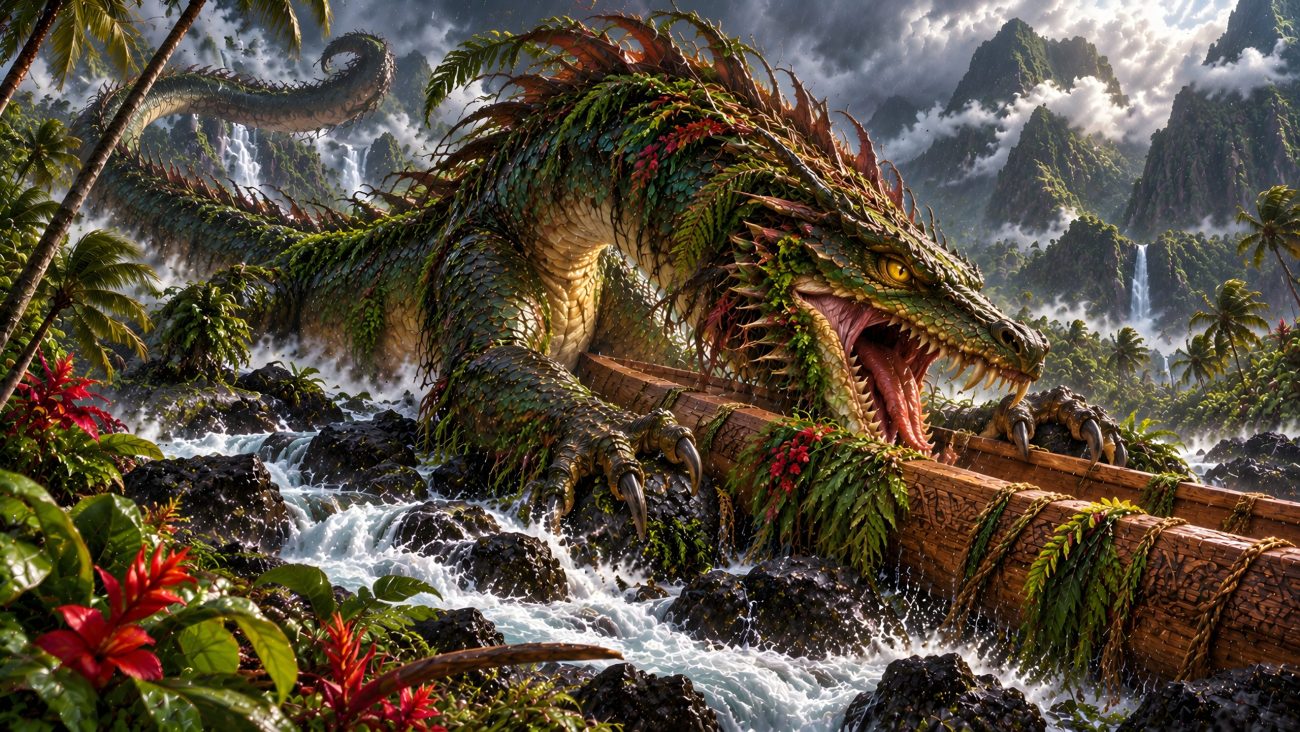
The Mo-o was a ferocious dragon-god associated with the forests and valleys of Hawaiʻi. These beings could appear in human form, but beneath this appearance they remained dragons, always ready to transform back into their true form. They watched for prey and were feared by travellers, who could be destroyed if they encountered one. The Mo-o described in this tale dwelled in a forested side valley where great koa trees grew, trees prized for making canoes.
When priests came to this forest to cut a great koa tree for the high chief, the Mo-o god descended to watch them. He observed the ceremonies and listened to the incantations spoken while the men worked. But he did everything within his power to prevent them from completing the canoe. He sent powerful winds sweeping down the valley against the workers, covered the sky with black clouds, and drove heavy rain upon them. He produced discouraging omens and signs that seemed to foretell failure, hoping that the priests and canoe-makers would abandon their work.
The priests persevered. Eventually the great tree fell, and they accepted it as suitable for the canoe. Its branches were quickly removed, the trunk was roughly shaped, and part of the interior was hollowed out. Cocoanut ropes and vines were then fastened around the massive log, and the people began dragging it down the valley toward the harbor of Kou, in Honolulu.
Their first great obstacle came when they tried to pull the canoe over the rough lava ridges along the side of the valley. The log refused to descend. Instead, it seemed to move uphill. The Mo-o had seized one end and was pulling against the men. They gathered their strength and made another tremendous effort, causing the canoe and the dragon-god to slide over the stones and partly down the hillside. The Mo-o braced himself again and made the canoe extraordinarily heavy, trying to hold it in place.
The god could not stop them completely, however, and the canoe eventually came down to the men. Pulling it through the forest and thickets proved extremely difficult, so they dragged it into the rough, rocky bed of the Nuuanu River. They hoped that the flowing water would help carry the canoe while the slippery stones made it harder for the Mo-o to resist them.
The struggle continued down the river. Eventually the Mo-o realized that the contest there was becoming hopeless. He released the canoe and turned his attention to the river itself.
The mountain stream was fed by springs and numerous waterfalls and cascades that carried water down from the mountains into the valley. The dragon-god rushed along the watercourse, stopping the springs and diverting the smaller streams until the riverbed was left dry. He then hurried back, seized the canoe once more, and pulled against the exhausted canoe-makers.
The struggle became increasingly wearying. Night fell while the people were still some distance from the sea. They eventually reached a place called Ka-ho-okane, in the heart of what is now Honolulu. There the route became especially difficult, with sharp turns, steep banks, and enormous stones. The Mo-o fought hardest there, finally wedging the great canoe firmly among the rocks.
By then the task had become almost impossible, and darkness had fallen. The high chief finally allowed his priests to call the people away, leaving the unfinished canoe where the last struggle had taken place. It was regarded as a gift to the Mo-o and became known as the Canoe of the Dragon-God.
According to the tradition, the canoe remained there forever, transformed into stone and trapped among the enormous rocks through which the mountain waters continued to flow, a monument to the dragon-god’s victory over the canoe-makers.
Sources
Westervelt, W. D. Legends of Old Honolulu (Mythology). Boston: Ellis Press, 1916. 277 pp.