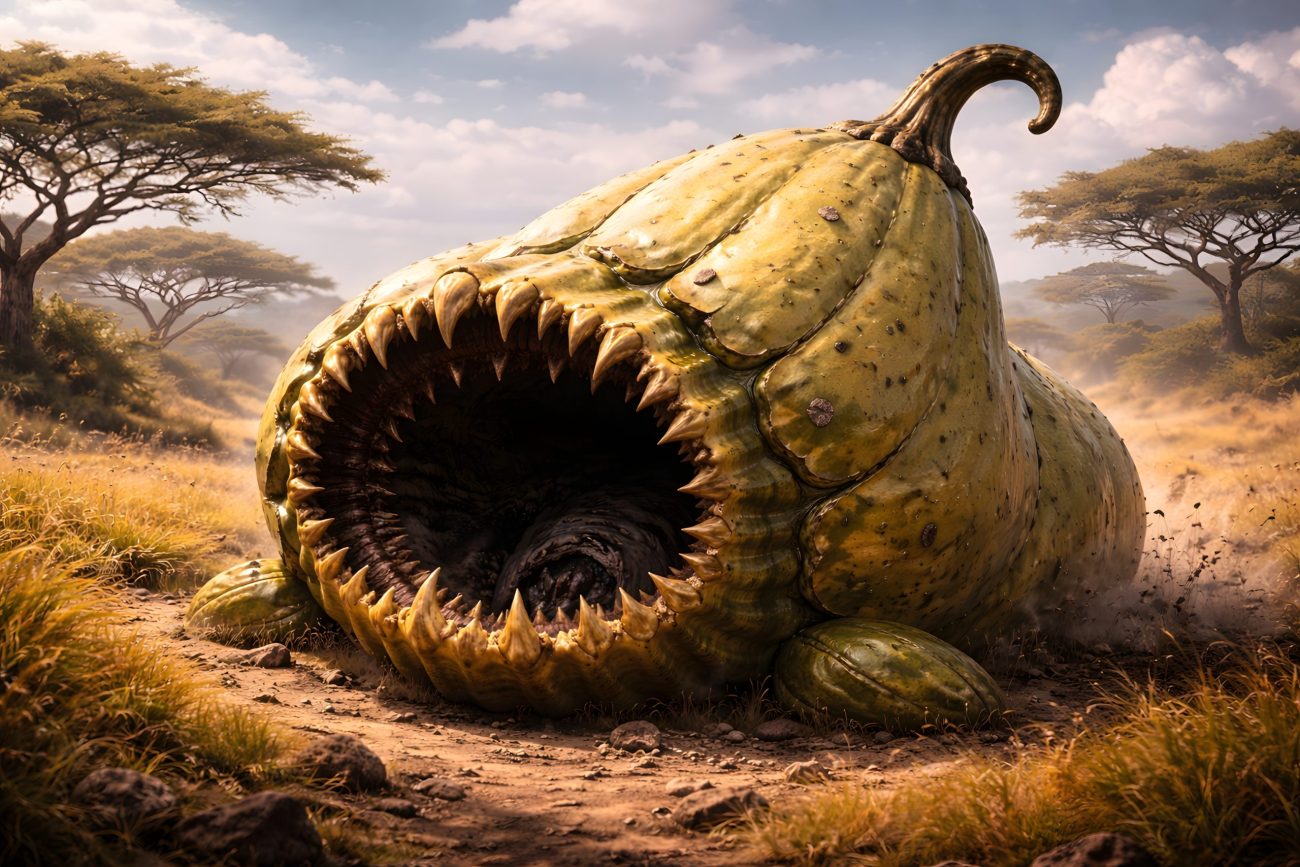
Devouring Gourd

Tradition / Region: Bantu Mythology, Congolese Mythology
Alternate Names: Man-Eating Gourd, Usambara Gourd
Category: Plant


The Myth

In some lands it is said that when a powerful sorcerer or ogre dies, the earth where they fall may grow strange plants. From that soil can rise gourds and pumpkins that are no longer harmless crops, but living beings with hunger and will.

One such gourd once grew in Usambara. A group of boys playing nearby noticed it swelling larger and larger. One of them laughed and said, “Look at how big that gourd is getting!”
To their shock, the gourd answered, “If you pluck me, I’ll pluck you!”

The boys fled and told their mother, but she did not believe them. Their sisters went to see for themselves and repeated the same words. This time the gourd remained silent, and the girls returned home mocking their brothers.

Since no one dared pick it, the gourd kept growing. It swelled until it was as large as a house. Then one day it tore itself free from the earth and began to move. Rolling through the village, it swallowed everyone it found, devouring men, women, and children alike. When no one remained, it rolled into a nearby lake and settled beneath the water.

Only one woman survived, and she was with child. She gave birth to a son, and the two lived alone among the empty huts. When the boy grew older, he asked about his father. His mother told him that the man had been swallowed by the great gourd now lying in the lake.

The boy vowed to avenge him. He went to the shore, where parts of the monster could be seen above the water, and shouted insults to provoke it.

“Gourd, come out!”

Angered, the creature rose from the lake and rolled toward him. But the boy was ready. He shot arrow after arrow into its body. When the tenth arrow struck, the gourd gave a thunderous roar that echoed across the land and fell dead. The boy cut it open, and all the villagers came out alive from inside it. In time he became a great leader among his people.

Other tales speak of similar plants. A pumpkin once grew over the grave of a wicked shapeshifter and echoed every word spoken to it until it swallowed those who came to cut it down. Among the Ronga, poisonous fruits are said to walk with arms and legs, carrying spears and shields.

Thus in these stories, the quiet plants of the earth may hide something terrible — and when they grow from places touched by evil, they may rise not to feed people, but to devour them.


Gallery


Sources

A Book of Creatures. (n.d.). Devouring Gourd. Retrieved March 1, 2026, from https://abookofcreatures.com/?s=Devouring+Gourd


Interpretive Lenses

Religious Readings
  • Christian Ascetic Deep Dive
Philosophical Readings
  • Nietzschean Deep Dive
Psychological Readings
  • Jungian Deep Dive
Esoteric Deep Dive
  • Hermetic Deep Dive
Political / Social Readings
  • Marxist Deep Dive

Simbi

Tradition / Region: Congolese Mythology
Alternate Names: Cymbee, Sim’bi; plural Bisimbi / Basimbi
Category: Mermaid


The Myth

In the lands of the Bakongo it is said that the waters are not empty. Rivers, springs, and pools are watched by spirits called Simbi, beings who belong to both the world of the living and the unseen realm beyond it.

They dwell where water meets earth—at riverbanks, deep pools, waterfalls, and hidden springs. Some appear as beautiful water people like mermaids, rising from the surface with shining skin and long hair. Others take the form of snakes, flashes of fire, or shapes glimpsed only for a moment in clay, gourds, or rippling water. Wherever they dwell, the place becomes sacred.

Those who respect the Simbi may receive their favor. The spirits are said to guard the balance of nature, to protect the land, and to guide those who approach them with reverence. Sometimes they reward a person with wealth or protection, drawing treasures from the depths of the water or revealing hidden paths to fortune.

Stories tell of people who encounter a Simbi beside a river and return with gold, blessings, or healing. But the spirits are not to be taken lightly, for they belong to an older order of the world and must be treated with care.

When the people of Central Africa were carried across the ocean, the Simbi were said to travel with them. In distant lands, the spirits were still believed to live in rivers and marshes. Among the Gullah Geechee people, one tale tells of a girl named Sukey who meets a mermaid called Mama Jo. The water spirit protects her and gives her gold, just as the Simbi were said to bless their followers in the old homeland.

So the Simbi remain—guardians of water, keepers of hidden riches, and watchers at the boundary between this world and the next.


Gallery


Sources

Wikipedia contributors. (n.d.). Simbi. In Wikipedia, The Free Encyclopedia. Retrieved February 14, 2026, from https://en.wikipedia.org/wiki/Simbi#Sukey_and_The_Mermaid


Interpretive Lenses

Religious Readings
  • Christian Ascetic Deep Dive
Philosophical Readings
  • Nietzschean Deep Dive
Psychological Readings
  • Jungian Deep Dive
Esoteric Deep Dive
  • Hermetic Deep Dive
Political / Social Readings
  • Marxist Deep Dive
Other
  • How to Invite The Simbi

Mami Wata

Tradition / Region: Congolese Mythology
Alternate Names: Mammy Water, Mami Muntu, Mamba Muntu, Papi Wata (male counterpart in some traditions)
Category: Mermaid, Goddess


The Myth

In the rivers, lakes, and ocean shores of Africa, there is said to dwell a powerful spirit of the waters known as Mami Wata.

She appears most often as a woman of striking beauty, sometimes with the lower body of a fish, sometimes entirely human, sometimes adorned with serpents coiled about her body. Her hair is long, her gaze mesmerizing, and her presence both alluring and dangerous. She is a being of wealth, mystery, and deep water.

Mami Wata rises from rivers or from the sea to encounter humans. She may appear to travelers at night, to fishermen on the water, or to those who wander too close to sacred pools. Those she favors may be drawn into her world beneath the water, where she offers them riches, power, or secret knowledge.

Some who are taken by her return to the world of the living with sudden fortune, beauty, or spiritual gifts. Others never return at all.

She is known to demand devotion from those she chooses. Shrines are raised to her beside water, decorated with mirrors, combs, perfumes, bright cloth, and foreign objects she is said to love. Those who honor her properly may receive protection, healing, prosperity, or children.

But she is not always gentle. If neglected or angered, she may bring misfortune, illness, poverty, or madness. She may wreck boats, claim lovers, or pull the unwary beneath the water.

In some traditions she is accompanied by a male spirit, sometimes called Papi Wata, who shares her watery domain.

Thus Mami Wata is remembered as a spirit of beauty and danger, wealth and temptation—
a queen of the waters who gives blessings to the devoted,
and whose depths remain beyond human control.


Gallery


Sources

Wikipedia contributors. (n.d.). Mami Wata. In Wikipedia, The Free Encyclopedia. Retrieved February 14, 2026, from https://en.wikipedia.org/wiki/Mami_Wata


Interpretive Lenses

Religious Readings
  • Christian Ascetic Deep Dive
Philosophical Readings
  • Nietzschean Deep Dive
Psychological Readings
  • Jungian Deep Dive
Esoteric Deep Dive
  • Hermetic Deep Dive
Political / Social Readings
  • Marxist Deep Dive
Other
  • How to Invite The Mami Wata