Nguruvilu

Tradition / Region: Mapuche mythology, Chilean Mythology, Argentinian Mythology
Alternate Names: Guruvilu, Guirivilu, Ngarrafilu, Fox-Serpent
Category: Fox


The Myth

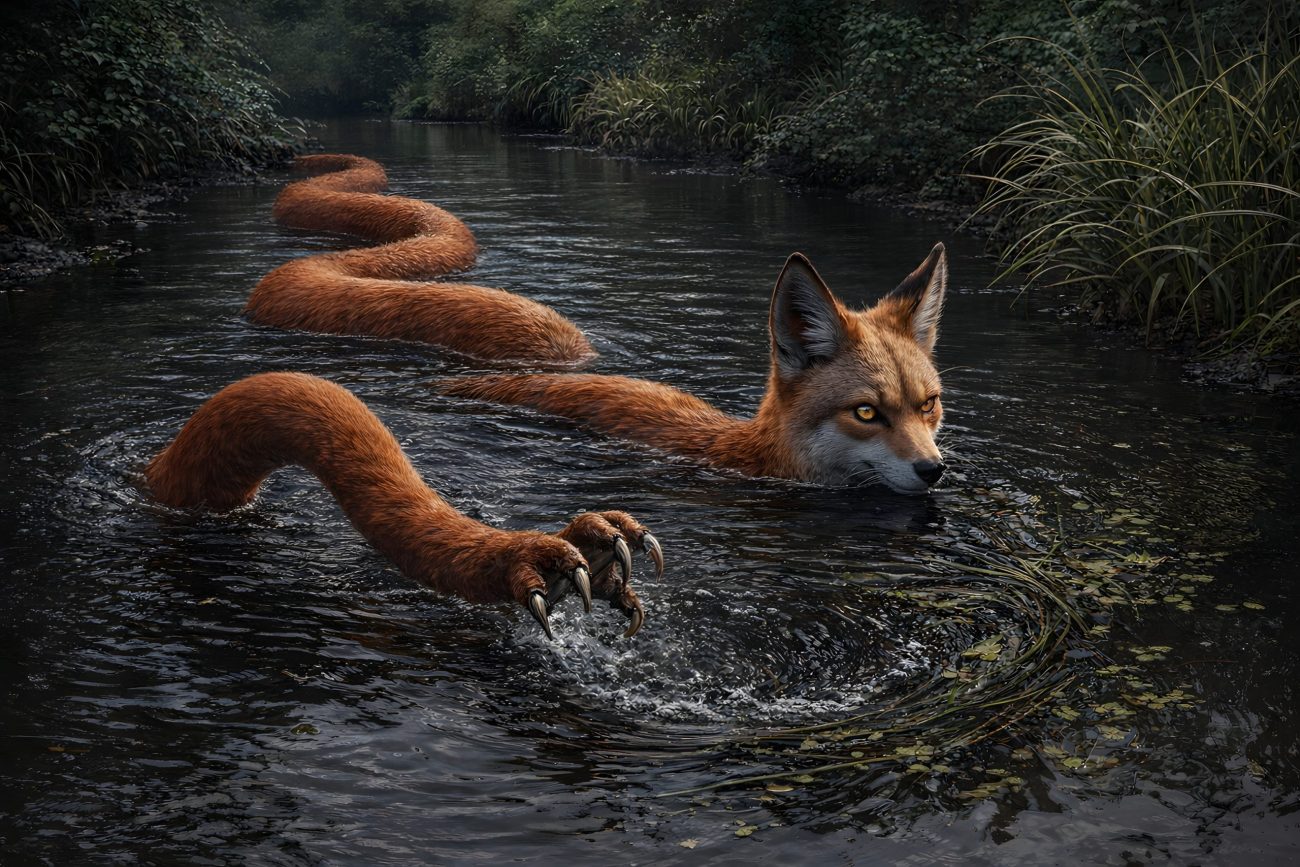
Among the Mapuche people there is a feared creature of the waters known as the Nguruvilu, whose name means “fox-serpent.” It is said to dwell in rivers, lakes, and dark channels where the current slows and deepens.

The creature is described as having the head of a fox or wildcat, with the body of a serpent or a small animal stretched long and thin. Its most terrible feature is its tail, long and powerful, tipped with claws. With this tail it snatches those who wade into the water, dragging them beneath the surface to drown or drink their blood.

People say the Nguruvilu waits in hidden places such as whirlpools, backwaters, or river crossings. Sometimes it makes the water seem shallow and safe, tempting travelers and herds to cross. But when they step into the river, the monster coils around them or their horses and pulls them down into the depths.

Stories tell of riders who scoffed at warnings and lost their animals in the river, barely escaping with their lives. Others say the creature grips people as though holding reins, controlling them like a rider controls a horse. Only with a sharp knife and great strength can one cut free from its grasp.

In some places it is said that the spirit of evil itself can take the form of the Nguruvilu. In others, it is believed the creature’s life rests in its tail, and that if the tail is cut off, the monster will die.

Because of this, people once avoided bathing or fording rivers where it was thought to dwell, choosing instead to cross by boat. Thus the Nguruvilu was remembered as a guardian of dangerous waters — a fox-headed serpent that waits beneath the surface, turning quiet rivers into places of fear.


Gallery


Sources

Wikipedia contributors. (n.d.). Nguruvilu. In Wikipedia. Retrieved March 1, 2026, from https://en.wikipedia.org/wiki/Nguruvilu.


Interpretive Lenses

Religious Readings
  • Christian Ascetic Deep Dive
Philosophical Readings
  • Nietzschean Deep Dive
Psychological Readings
  • Jungian Deep Dive
Esoteric Deep Dive
  • Hermetic Deep Dive
Political / Social Readings
  • Marxist Deep Dive

Cuero

Tradition / Region: Chilean Mythology
Alternate Names:
Category: Cow


The Myth

In the rivers and lakes of southern Chile and Argentina there is said to live a dreadful creature known as the Cuero.

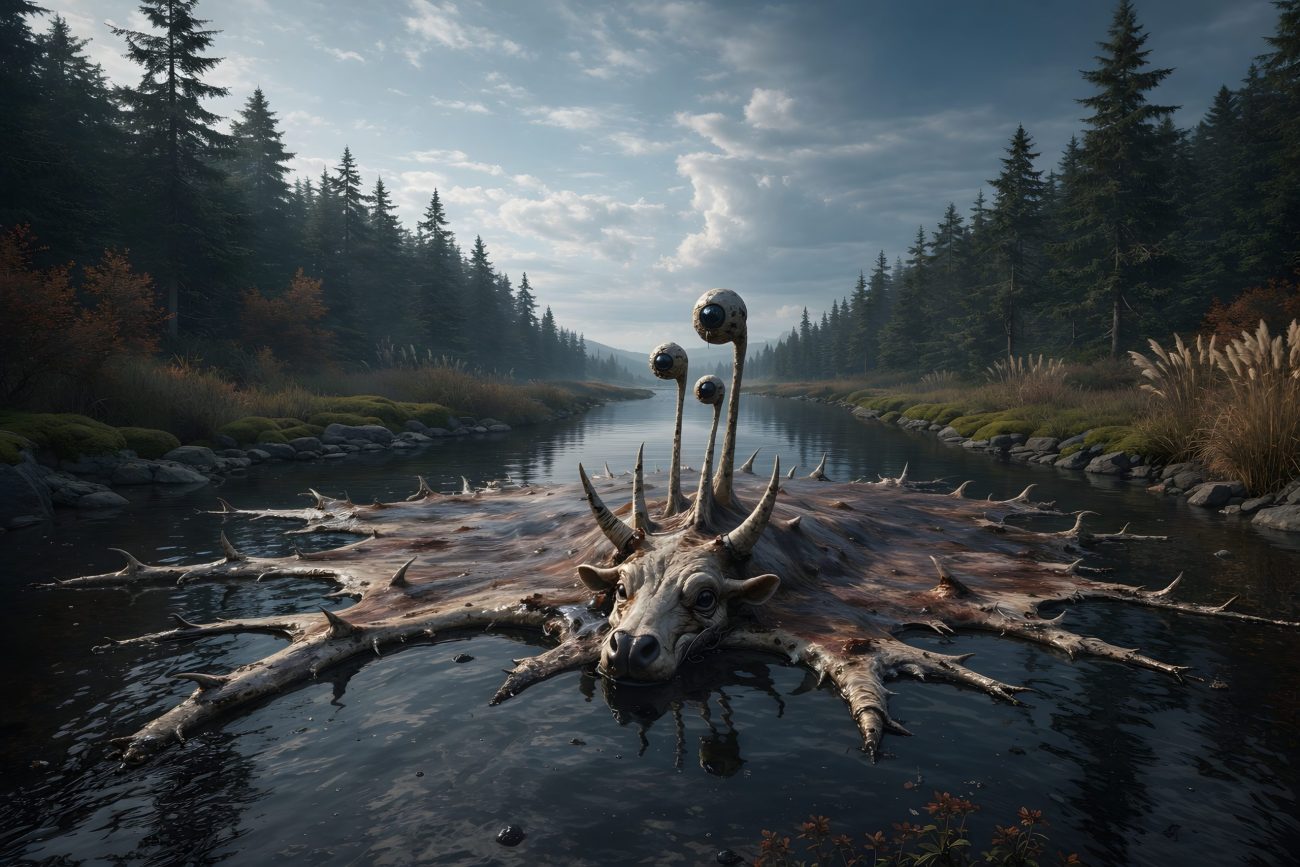
It is described as resembling a living bull’s hide, flat and wide, with no hair upon its body. Along its length runs a raised spine, while its edges are lined with hooked claws and sharp points. From its body extend broad fins, and behind it trails a long, whip-like tail. Its eyes, red and swollen, rise on stalks like those of a crab, watching the shores and waters where prey may come.

The Cuero waits quietly near the banks, most often at dusk. When an animal or person comes close, the creature glides forward and spreads itself over its victim like a blanket. Once it has covered them, it drags them beneath the water.

On the underside of its body lies a sucking mouth filled with small teeth. With this it drains the victim’s blood and moisture until nothing remains but a dried body.

People say the size of the Cuero varies, some being no larger than a small animal, others vast enough to cover a man entirely. It is feared wherever it dwells, for few can escape once it has closed upon them.

Only the most skilled shamans are said to be able to destroy one. They use thorny branches as bait, for when the Cuero attempts to seize the offering, the sharp spines pierce its body and hold it fast, making it vulnerable.

Thus the Cuero is remembered as a silent hunter of the waters, shaped like a hide yet alive, waiting beneath the surface for the moment to strike.


Gallery


Sources

Trincau, R. (1918). VII. El Indo y el Cuero. In S. R. de Saunière (Ed.), Cuentos populares araucanos y chilenos: recogidos de la tradición oral (p. 70). Santiago: Imprenta Universitaria.

Wikipedia contributors. (n.d.). Cuero (leyenda). Wikipedia, from https://es.wikipedia.org/wiki/Cuero_(leyenda)


Interpretive Lenses

Religious Readings
  • Christian Ascetic Deep Dive
Philosophical Readings
  • Nietzschean Deep Dive
Psychological Readings
  • Jungian Deep Dive
Esoteric Deep Dive
  • Hermetic Deep Dive
Political / Social Readings
  • Marxist Deep Dive

Camahueto

Tradition / Region: Chilean Mythology
Alternate Names:
Category: Cow


The Myth

In the southern lands of Chile, especially among the people of Chiloé and Patagonia, there is said to live a mighty beast called the Camahueto.

It is born in lonely freshwater places — marshes, lakes, or rivers — where its life begins in secret. Some say it comes from a horn of another Camahueto, planted in the earth by a sorcerer so that the creature may grow there. Over many years, sometimes twenty or more, the young beast gains enormous strength and speed. As it matures, a horn grows from its forehead, often said to be bright like silver, and even if broken it will grow again.

When its time comes, the Camahueto leaves the inland waters and journeys toward the sea. It chooses stormy nights for this passage. As it moves down rivers and streams, terrible crashing sounds are heard, and people say the beast drags trees, animals, and even parts of the land itself along its path. Rivers rise suddenly and violently when it passes, as though the waters themselves are driven by its strength.

Once it reaches the ocean, the Camahueto becomes a creature of the deep. There it is said to overturn ships, devour fish and men, and shatter coastal rocks with its horn. Many shipwrecks and strange disappearances along the coast are blamed on its presence.

Yet the beast is not beyond control. Sorcerers are said to master it with a lasso made from thick brown sea-kelp. Those who command it may ride the Camahueto across great distances, though such power is dangerous and feared.

Because of its strength and the strange power believed to lie in its horn, the Camahueto is both dreaded and respected, a creature of land, river, and sea whose coming is always marked by noise, destruction, and awe.


Gallery


Sources

Bestiary.us. (n.d.). Kamahujeto, from https://www.bestiary.us/kamahujeto

García Barría, N. (1997). Tesoro mitológico del archipiélago de Chiloé: bosquejo interpretativo. Andrés Bello, p. 75–79.


Interpretive Lenses

Religious Readings
  • Christian Ascetic Deep Dive
Philosophical Readings
  • Nietzschean Deep Dive
Psychological Readings
  • Jungian Deep Dive
Esoteric Deep Dive
  • Hermetic Deep Dive
Political / Social Readings
  • Marxist Deep Dive

Millalobo

Tradition / Region: Chilean mythology
Alternate Names: none recorded
Category: Mermaid


The Myth

In the mythology of Chiloé, the lord of all waters is Millalobo, ruler of the seas, rivers, and lakes, protector of all creatures that live within them, and father of the sea maidens.

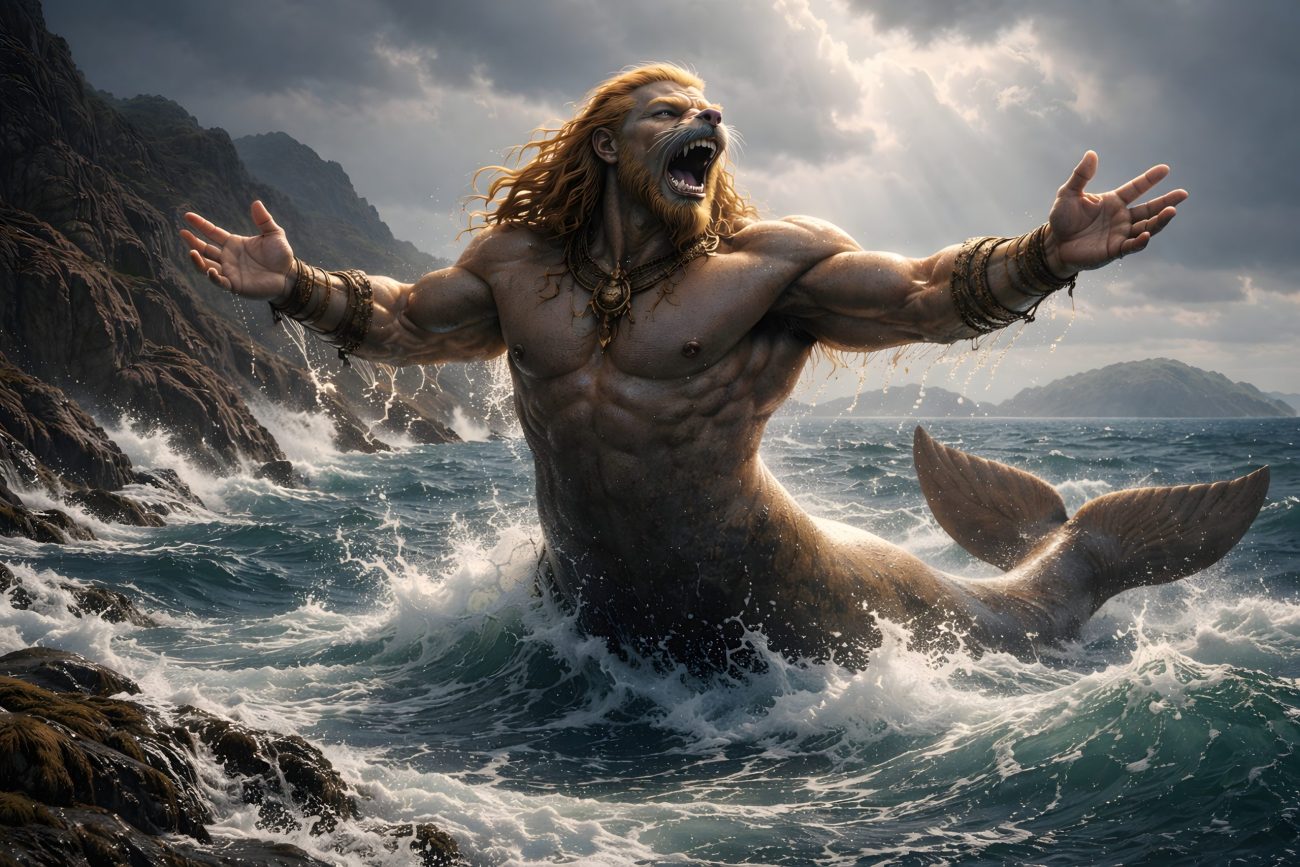
Millalobo was born from the union of a beautiful human woman and a mighty sea lion. Because of this, his form is neither fully human nor fully beast. From the waist up he has the powerful torso of a man, but below he bears the body of a great sea creature, like a pinniped. His face carries both human and animal traits, and his skin and hair shine with a golden color.

Though he cannot speak with human words, Millalobo communicates through deep, roaring sounds like those of a sea lion. Anyone who hears these cries understands his meaning clearly.

From his throne in the waters, Millalobo governs the movement of the tides and the bounty of the sea. When he flaps his great arms, the waves rise and fall. Storms, gales, and calm seas alike answer to his will. He sends fish, shellfish, and all marine riches to humans when he is pleased, and withholds them when angered.

He is also the father of the sea damsels who inhabit the waters around Chiloé, and through them his presence spreads across the coasts and islands.

Thus the people say that whenever the sea roars or the tides shift, it is Millalobo moving in his domain—
the golden lord of the waters,
whose power governs all that lives beneath the waves.


Gallery


Sources

Bestiary.us contributors. (n.d.). Miialobo. In Bestiary.us, from http://www.bestiary.us/miialobo


Interpretive Lenses

Religious Readings
  • Christian Ascetic Deep Dive
Philosophical Readings
  • Nietzschean Deep Dive
Psychological Readings
  • Jungian Deep Dive
Esoteric Deep Dive
  • Hermetic Deep Dive
Political / Social Readings
  • Marxist Deep Dive
Other
  • How to Invite The Millalobo