Jarjacha

Tradition / Region: Andean Folklore (Southern Peru; Ayacucho, Junín)
Alternate Names:
Category: Llama / Shapeshifter / Mountain dweller


The Myth

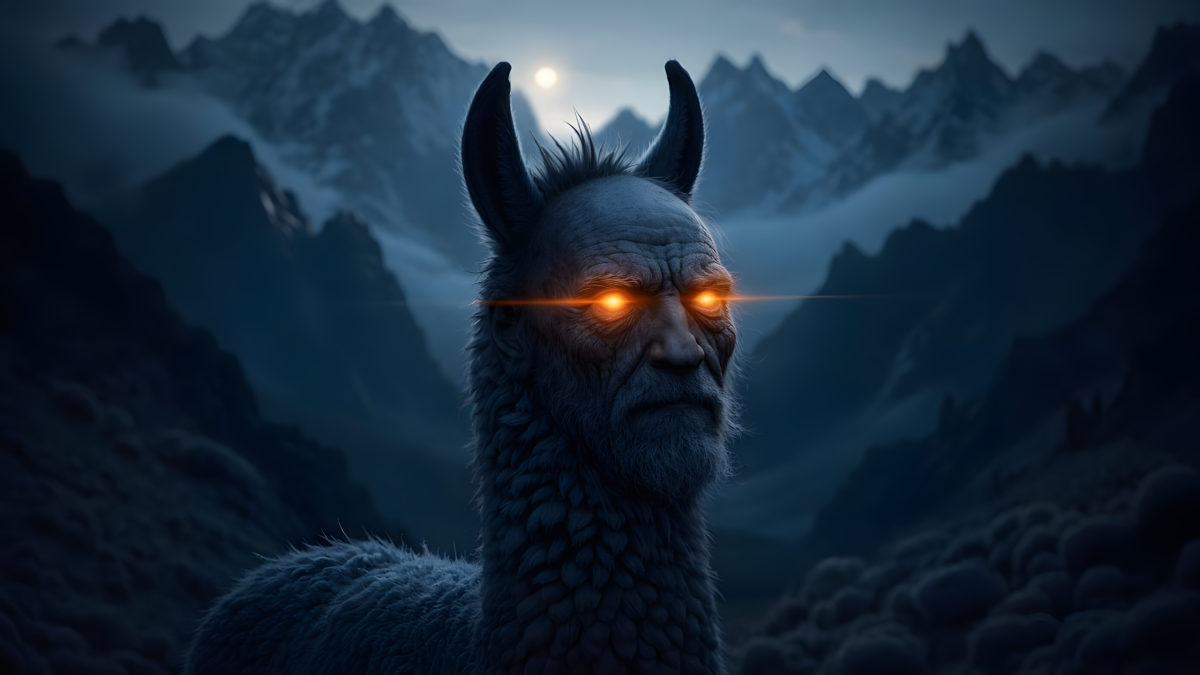
In the mountain regions of southern Peru, especially around Ayacucho, people speak of a nocturnal creature known as the Jarjacha. It is said to appear after nightfall, wandering the hills and remote paths near villages. Its presence is announced by a piercing call—“Jar-jar-jar” or “Qar-qar-qar”—a sound that echoes through the mountains and strikes fear into those who hear it.

According to tradition, the cry of the Jarjacha signals that a grave transgression has occurred within the community, most often incest. The creature is believed to be the transformed result of such an act, condemned to roam the night and reveal the hidden wrongdoing through its voice. When the call is heard, villagers know that someone nearby carries a secret that has violated the deepest social and moral boundaries.

Descriptions of the Jarjacha vary by region. Most accounts connect it to llamas or alpacas. Some say it appears as a llama with a human head; others describe it as a two-legged creature resembling a llama or alpaca, sometimes with two or even three heads. In certain stories, its glowing eyes shine unnaturally in the darkness, making it unmistakable even from a distance.

The Jarjacha is not bound to a single form. Some tales claim it can briefly disguise itself as a dog or even as a human, allowing it to move unnoticed among people before returning to its true shape at night. Though rarely said to attack directly, its appearance brings fear, shame, and unrest to the community.

When dawn comes, the Jarjacha disappears, retreating into the mountains until night falls again. Its cries linger in memory, a reminder that hidden acts cannot remain concealed forever, and that the night itself will give them voice.


Interpretive Lenses

Religious Readings
  • Christian Ascetic Deep Dive
Philosophical Readings
  • Nietzschean Deep Dive
Psychological Readings
Esoteric Deep Dive
  • Hermetic Deep Dive
Political / Social Readings
  • Marxist Deep Dive
Other

Jarjacha — How To Invite This Spirit

Tradition / Region: Andean folklore (Southern Peru; Ayacucho, Junín)
Alternate Names:
Category: Nocturnal Spirit / Shapeshifter


The Kind of Person This Spirit Draws Near To

A person who breaks a fundamental boundary and then tries to live as if nothing changed.

Not impulsive, not ignorant — but someone who knowingly crosses a line that holds a community together, and then hides it. They attempt to preserve normalcy while carrying a secret that cannot coexist with it.

Jarjacha draws near where belonging is faked.


How This Person Thinks

Mental habits

  • Compartmentalized thinking
  • Strong separation between “what happened” and “daily life”
  • Persistent internal justification

How they approach ideas

  • Ideas are bent to preserve secrecy
  • Moral reasoning becomes selective

How they relate to uncertainty

  • Uncertainty feels dangerous
  • Exposure is feared more than wrongdoing

What they obsess over / ignore

  • Obsess over concealment and normal appearance
  • Ignore the social fabric their actions strain

How This Person Deals With Problems

  • Avoidance rather than repair
  • Silence rather than confession
  • Preservation of appearance at all costs

Response to obstacles

  • Deception
  • Withdrawal
  • Increased secrecy

They manage fallout —
not consequence.


How This Person Responds to Stress

Stress behavior

  • Heightened vigilance
  • Hyper-awareness of others’ reactions
  • Sleeplessness

Collapse or sharpening

  • Stress sharpens fear but erodes coherence

What they cling to

  • Routine
  • Familiar roles
  • The hope that time will bury the act

Emotional Landscape

When Calm

  • Artificial calm
  • Tension beneath surface

When Angry

  • Anger redirected outward
  • Irritation at scrutiny

When Afraid

  • Fear of recognition
  • Fear of being named

When Joyful

  • Joy feels false
  • Quickly undercut by dread

Relationship to Time

  • Nocturnal
  • Daytime is performance
  • Night brings exposure

Time splits into seen and unseen.


Relationship to Pleasure and Comfort

  • Pleasure is muted
  • Comfort is unstable
  • Rest is shallow

The body remembers what the mind hides.


Living Space

  • Familiar
  • Close-knit
  • Charged with unspoken tension

The space knows.


Relationship Patterns

  • Strained intimacy
  • Fear of closeness
  • Overcompensation through normalcy

Relationships are maintained through silence.


How This Person Works

  • Functional
  • Distracted
  • Motivated by avoidance

Work fills time —
it does not resolve.


What Makes the Spirit Stay

  • Continued concealment
  • Nighttime movement
  • Remaining within the community without repair
  • Refusal to name the transgression

Jarjacha remains where the unspeakable is lived with.


What Makes the Spirit Leave

  • Exposure
  • Confession
  • Exile or ritual separation
  • Breaking the pretense of normal belonging

Once the secret is no longer carried alone, the spirit loses voice.


The Cost of Keeping This Spirit Close

  • Loss of trust
  • Community destabilization
  • Identity fractures into roles

What is lost is belonging.
What remains is a voice that cries what cannot be said.


Final Human–Spirit Portrait

“A life lived in daylight as if whole, while the night walks the truth aloud for everyone to hear.”

Jarjacha — A Freudian Deep Dive

Under a Freudian psychoanalytic lens, the Jarjacha is not a folkloric monster in the wilderness but a return of the repressed, a creature generated by incest taboo, communal guilt, and nocturnal anxiety. It is a symptom rather than an entity—an externalized formation of desire that has violated prohibition and must therefore be expelled into monstrosity. The Jarjacha does not hunt randomly; it announces transgression.

Guiding question:
What happens to forbidden desire when it cannot be spoken?


Lens Effect

Under this lens, the subject appears as:
Repressed incestuous desire displaced into a monstrous auditory hallucination.

Primary effect on humans:
It enforces taboo through fear, projection, and collective surveillance of the unconscious.


1. Incest Taboo and the Birth of the Monster

In Freud’s framework, the incest taboo is the foundational law of civilization, arising from the Oedipal complex and necessary for social cohesion. The Jarjacha exists only because this law exists. Its call—Jar-Jar-Jar—functions as a superegoic alarm, sounding when the primal prohibition has been breached.

The monster is not the crime’s cause; it is the crime’s psychic remainder. Once incest occurs, desire cannot remain internal. It must be expelled, transformed, made visible—and punishable.

Thus the offender does not merely sin; they become the sin.


2. The Cry in the Night — The Voice of the Superego

The Jarjacha’s defining trait is not its form but its voice. Freud treats the voice as a privileged site of anxiety: the point where inner compulsion breaks into the external world.

The call does not accuse a specific individual; it announces that someone has transgressed. This ambiguity is crucial. It induces diffuse guilt, activating paranoia, vigilance, and communal self-policing. Everyone listens. Everyone wonders.

The superego speaks not in clear sentences, but in repetition.


3. Hybrid Bodies — Regression and Bestialization

Descriptions of the Jarjacha—llama-bodied, human-headed, multi-headed, two-legged—signal regression. The incestuous subject is imagined as slipping backward along the developmental axis, losing the fully human form achieved through repression and sublimation.

Animality here is not freedom; it is punishment. To violate the incest taboo is to forfeit symbolic humanity and return to a pre-social, pre-law state—what Freud would associate with the id unrestrained by ego or superego.

The llama, a domesticated animal tied to labor and rural life, makes the regression intimate and shameful rather than exotic.


4. Shape-Shifting — The Unstable Ego

Some accounts describe the Jarjacha as temporarily passing as human or dog. This reflects ego instability: the offender is no longer securely human but cannot fully escape humanity either.

This oscillation mirrors the psychological state of taboo violation—splitting, dissociation, and anxiety. The subject moves between concealment and exposure, familiarity and horror. The monster hides by day, cries by night.

Repression does not erase desire; it distorts it.


5. Community as Analyst — Fear as Therapy

The legend’s function is not explanation but containment. By locating incest in a terrifying external figure, the community avoids confronting desire directly. The monster absorbs what cannot be discussed.

In Freudian terms, the Jarjacha is a collective defense mechanism. It transforms an internal conflict into an external threat, allowing society to maintain cohesion without introspection.

Fear replaces confession. Listening replaces analysis.


Final Reading

The Jarjacha is incest made audible—a psychic excess expelled into the mountains so that society can continue to function without acknowledging its own forbidden desires.


Lesson for the Reader

Do not assume that what a culture calls a monster is foreign to it. Often it is the most intimate thing—what cannot be admitted, only feared.


What cannot be spoken returns as a scream in the dark.

Shirodawashi — A Mīmāṃsā Deep Dive

Under a Pūrva-Mīmāṃsā lens, Shirodawashi is not interpreted as a moral allegory, psychological symbol, or cosmic force, but as a case-study in adhikāra collapse—the breakdown of ritual eligibility through persistent violation of dharma as enacted action (karma). Mīmāṃsā does not ask what a being is, but whether its acts are valid, binding, and efficacious within the normative order sustained by rule (vidhi), prohibition (niṣedha), and consequence (apūrva).

This reading rejects metaphysical speculation. Meaning resides not in intention, emotion, or interiority, but in performed action and its unseen residue.

Guiding question:
What happens when a being repeatedly performs acts that negate its own ritual standing?


Lens Effect

Under this lens, the subject appears as:
A living accumulation of defective ritual acts generating destructive apūrva.

Primary effect on the world:
It destabilizes social and cosmic order by producing karma without lawful fruition.


1. Cave, Kimono, and Hooves — The False Markers of Adhikāra

Shiro’s initial appearance is crucial. He presents himself as socially legible: helpful, resident, dressed, cooperative. In Mīmāṃsā terms, he appears to possess adhikāra—eligibility to participate in shared norms.

But eligibility is not symbolic; it is procedural. It depends on sustained conformity to dharma through action. Shiro’s hooves, beast-face, and brush-patterned kimono function as contradictory semiotics: external conformity masking internal ritual invalidity.

This is adhikāra-bhāsa—the semblance of eligibility without substance.


2. Hospitality Abused — From Vidhi to Niṣedha

Hospitality in folklore corresponds to a positive injunction (vidhi): reciprocal support, restraint, and measured consumption. Shiro violates this repeatedly—demanding excess food, drink, wealth.

Each violation is not a moral failure but a niṣedha-transgression: an act explicitly forbidden by the logic of social dharma.

Mīmāṃsā insists that repetition matters. Shiro does not err once; he establishes a pattern. This produces cumulative apūrva, an unseen residue that conditions future outcomes.

At this stage, Shiro is no longer neutral. He is ritually compromised.


3. Ochiyobon’s Seizure — Karma Without Rightful Fruit

The seizure of Ochiyobon is decisive. Marriage, in Mīmāṃsā logic, is a regulated act requiring mutual consent and social recognition—otherwise it is aprāmāṇika, non-valid.

Shiro’s act is karma without authorization (anadhikṛta-karma). Such acts still generate apūrva, but it is malformed apūrva—fruit that cannot ripen properly.

This explains the paradox of Shiro’s later life:

  • He acts constantly
  • He gains power episodically
  • Yet nothing stabilizes

This is karma-vaiparītya—action that accelerates disorder instead of resolution.


4. Repeated Escapes — Deferred Phala, Not Grace

Shiro repeatedly escapes punishment: from demons, from social correction, from cosmic enforcement. A moral reading might call this luck or divine mercy. Mīmāṃsā rejects this.

This is phala-vilamba—delayed fruition. Apūrva is patient. The system does not forget.

Every escape compounds imbalance. Each act stacks unresolved consequence, tightening the eventual collapse.

The tanuki, demons, and mountain beings are not judges—they are secondary agents within a karmic field already saturated by Shiro’s prior acts.


5. Ochiyobon’s Final Act — Pratyavāya and Closure

Ochiyobon’s killing of Shiro is not vengeance in a moral sense. It is pratyavāya—the corrective consequence triggered when prohibited acts overwhelm the system.

Importantly, the agent is not a god, judge, or demon, but the directly affected party. Mīmāṃsā emphasizes this: dharma restores itself through lawful sequence, not moral drama.

Shiro’s death is not punishment—it is ritual exhaustion. His accumulated apūrva has nowhere left to discharge.

The system closes.


Final Reading

Shirodawashi is not destroyed for being evil, lustful, or monstrous. He is extinguished because his actions rendered him ritually ineligible to continue existing within order.


Lesson for the Reader

Do not confuse survival with validity. Action always leaves residue. Even when judgment is delayed, the system remembers.


In Mīmāṃsā, nothing is forgiven—everything is fulfilled.
Shiro (Shirodawashi)

Tradition / Region: Japanese Mythology
Alternate Names: Shirodashi, Shirodawashi (White Scrubber)
Category: Yōkai / Mountain Dweller / Cave Dweller


The Myth

Shiro, also called Shirodawashi, was a yōkai known for his beast-like face, hooves, and a kimono patterned with scrubbing brushes. He lived in a cave near a remote mountain settlement and first appeared as a friendly and helpful figure.

A pair of monsters, Mōryō and his wife Ochiyobon, fled from Ushū to the mountains beyond Hakone and settled in a ruined house. Shiro assisted them in establishing their new home, but his friendliness soon revealed another nature. He was a heavy drinker and a troublemaker who repeatedly visited their house, demanding food, drink, and money.

Shiro became infatuated with Ochiyobon and schemed to take her for himself. One day, he borrowed a padded robe from Mōryō and never returned it. When Ochiyobon came to demand its return, Shiro claimed he had pawned it and left to retrieve it. Instead, he went to Mōryō’s shack armed with a blade and declared that Ochiyobon was now his wife. Intimidated and afraid, Mōryō surrendered, giving Shiro all his possessions, including clothing, bedding, and cosmetics.

When Ochiyobon learned what had happened, she was devastated. Shiro responded brutally, declaring that since she was now his wife, she must submit. Other monsters gathered, and even Momojii, the master of the cave dwellings, appeared. Momojii attempted to restore Ochiyobon to her husband, but Mōryō, fearing public shame, refused reconciliation and announced plans to remarry.

Abandoned, Ochiyobon grew close to Momojii, who treated her with kindness. Enraged, Shiro attacked Momojii with an oak log, but Momojii overpowered him with a massive axe and drove him away. To settle the conflict, Momojii arranged for Shiro to marry a beautiful female ghost.

Despite her beauty, the ghost suffered under Shiro’s relentless desire. Unable to endure him, she abandoned her lingering grudge against the living and wished to return to the underworld. When demons arrived to claim her, Shiro fought them fiercely. During the chaos, the ghost passed on peacefully, leaving the demons with no soul to seize. They attempted to drag Shiro to hell instead, but along the way a mysterious boy appeared and gave Shiro demon-slaying sake. The boy revealed himself to be the tanuki Kakubei, who slew the demons.

Grateful, Kakubei asked Shiro to help abduct the daughter of a fox whose marriage proposal had been rejected. Shiro eagerly agreed and joined the tanuki in attacking the wedding procession, successfully capturing the bride’s palanquin. However, he soon encountered Mikoshi Nyūdō, who defeated him and took him prisoner. Impressed by Shiro’s boldness, Mikoshi Nyūdō eventually released him, predicting he might serve a greater purpose someday.

Later, tanuki thieves stole the White Fox Jewel and entrusted it to Shiro. When monsters and foxes came to retrieve it, they heard a woman’s voice from within Shiro’s cave. Ochiyobon emerged, holding a bloodstained knife and the jewel. Having been disgraced and betrayed, she took revenge by killing Shiro and returning the treasure to its rightful owners.

Thus ended Shirodawashi, remembered as a violent, cunning, and lust-driven yōkai whose ambition and cruelty ultimately led to his downfall.


Interpretive Lenses

Religious Readings
Philosophical Readings
  • Nietzschean Deep Dive
Psychological Readings
  • Jungian Deep Dive
Esoteric Deep Dive
  • Hermetic Deep Dive
Political / Social Readings
  • Marxist Deep Dive
Other
  • How to Invite The Spirit

Zarazarazattara — How To Invite This Spirit

Tradition / Region: Japanese folklore (Haibara County, Shizuoka Prefecture)
Alternate Names:
Category: Yōkai


The Kind of Person This Spirit Draws Near To

A person who believes their inner world is unobservable.

Someone who relies heavily on silent thought as a place of safety. They may be careful with words, polite in action, and restrained in expression — but internally restless, calculating, or anxious. They assume that what is unspoken remains protected.

This spirit draws near where thinking is used as hiding.


How This Person Thinks

Mental habits

  • Constant inner commentary
  • Silent rehearsal of fears and contingencies
  • Strong distinction between “what I think” and “what I show”

How they approach ideas

  • Ideas are tested privately before being expressed
  • Thinking is treated as a shield

How they relate to uncertainty

  • Uncertainty triggers internal narration
  • Thoughts multiply under pressure

What they obsess over / ignore

  • Obsess over being found out
  • Ignore how much inner tension leaks outward

How This Person Deals With Problems

  • Thinks rather than acts
  • Delays outward movement
  • Attempts to resolve situations internally

Response to obstacles

  • Mental strategizing
  • Silent planning
  • Avoidance of visible reaction

They trust thought more than behavior.


How This Person Responds to Stress

Stress behavior

  • Intensified internal monologue
  • Racing thoughts
  • Mental catastrophizing

Collapse or sharpening

  • Stress overwhelms cognition rather than clarifying it

What they cling to

  • The belief that silence equals safety
  • The idea that concealment prevents consequence

Emotional Landscape

When Calm

  • Alert
  • Contained
  • Slightly guarded

When Angry

  • Anger stays internal
  • Expressed as rumination

When Afraid

  • Fear spirals inward
  • Thoughts become louder, not actions

When Joyful

  • Joy is restrained
  • Quickly monitored and moderated

Relationship to Time

  • Immediate
  • Moment-to-moment vigilance
  • Little long-term grounding

Time feels like waiting for exposure.


Relationship to Pleasure and Comfort

  • Comfort comes from control
  • Pleasure is moderated
  • Relaxation feels unsafe

The mind never fully rests.


Living Space

  • Small
  • Enclosed
  • Minimal exposure

The space mirrors a desire to contain.


Relationship Patterns

  • Reserved
  • Polite
  • Guarded

Others see calm; inside is noise.


How This Person Works

  • Thoughtful
  • Careful
  • Over-prepared

Action follows thinking too slowly.


What Makes the Spirit Stay

  • Silent fear
  • Heavy inner narration
  • Treating thought as concealment
  • Belief that privacy exists without action

Zarazarazattara remains where thinking replaces presence.


What Makes the Spirit Leave

  • Unexpected physical action
  • Embodied interruption
  • Noise, movement, or chance
  • Acting without thinking first

When the body acts before the mind, the spirit loses access.


The Cost of Keeping This Spirit Close

  • Loss of inner privacy
  • Heightened anxiety
  • Feeling watched even when alone

What is lost is mental refuge.
What remains is exposure without witness.


Final Human–Spirit Portrait

“A life lived entirely inside the head, until even thought itself begins to answer back.”

Zarazarazattara — A Calvinist Deep Dive

Under a Reformed (Calvinist) lens, Zarazarazattara is not treated as a curious yōkai nor as a psychological projection, but as a didactic manifestation of total depravity encountered under divine providence. This lens refuses neutrality: every encounter unfolds beneath the absolute sovereignty of God, every thought is exposed before divine omniscience, and every fear reveals the creaturely condition of fallen humanity. The mountain hut becomes a theater of doctrine.

This is not a story about a monster in the dark.
It is a story about the impossibility of hiding—from God, from judgment, or from the truth of one’s own heart.

Guiding question:
What happens when fallen interiority realizes it is no longer private?


Lens Effect

Under this lens, the subject appears as:
A providential instrument exposing the fiction of autonomous interior life.

Primary effect on humans:
It annihilates the illusion of neutral thought and reveals the total visibility of the soul.


1. The Mountain Hut — Creaturely Isolation Under Providence

The setting is not incidental. The mountain hut is a locus of apparent autonomy—a space removed from society, law, and witness. Calvinism insists that such autonomy is illusory. Even in isolation, the human stands coram Deo—before the face of God.

The hearth represents common grace: warmth, survival, order temporarily granted even to fallen creatures. But common grace does not restore innocence; it merely restrains collapse.

Thus the silence of the hut is not safety. It is exposure.


2. The Rolling Form — Total Depravity Made Audible

Zarazarazattara enters not with violence, but with presence. Its pumpkin-like form is deliberately absurd—non-heroic, non-sublime. Calvinist theology recognizes this pattern: sin does not always appear monstrous; it often appears banal, round, and near the fire.

Its first speech—“It’s nothing”—is a lie that mirrors the fallen heart’s self-talk. This is self-deception, the hallmark of total depravity (corruptio totalis): not that humans are maximally evil, but that every faculty, including perception and thought, is compromised.


3. Thought Exposure — The Death of Mental Privacy

The decisive terror is not the creature’s presence, but its response to unspoken thought. Calvinism has no doctrine of “inner refuge.” The heart is not a sanctuary; it is, per Jeremiah, “deceitful above all things.”

Zarazarazattara’s ability to answer thought dramatizes divine omniscience displaced into creaturely terror. The man realizes what Reformed theology has always claimed:

  • Thought is not morally neutral
  • Silence is not concealment
  • Interior wishing is still accountable willing

This is the collapse of autonomous interiority, the death of the fantasy that one may sin, fear, or judge privately.


4. “I’ll Be Right There” — Irresistible Encounter

The creature’s reply—“I’ll be right there”—mirrors the logic of irresistible grace, inverted into dread. Just as divine calling cannot be evaded by the elect, exposure cannot be evaded by the fallen.

The man does not summon the creature. He does not consent. Yet the encounter advances.

This is not demonic omnipotence. It is providential inevitability: when exposure is ordained, it arrives without negotiation.


5. The Flying Splinter — Unintended Instrument of Deliverance

Salvation does not arrive through strategy or purity of thought. It arrives accidentally, through a splinter—a fragment of broken wood. Calvinism recognizes this pattern immediately:

  • Deliverance is monergistic, not synergistic
  • Human intention is irrelevant
  • God uses secondary causes without consulting human wisdom

The splinter strikes without moral planning. And the creature flees—not because it was out-thought, but because the event was not anticipated.

“I never thought of that” is the key line. It is not ignorance—it is creaturely limitation exposed. Only God possesses exhaustive foreknowledge. The yōkai, like all created beings, is finite.


Final Reading

Zarazarazattara functions as a providential exposure of fallen interiority: a being that dramatizes what theology insists—that thought itself is accountable, visible, and unsafe apart from grace.


Lesson for the Reader

Do not trust silence. Do not trust privacy. Do not trust your thoughts to remain unseen. Safety is not found in concealment, but only in submission to sovereign grace.


There is no refuge in the mind; there is only refuge in God.

Oshoné — How To Invite This Spirit

Tradition / Region: Japanese folklore (Yatsuka-chō, Matsue City, Shimane Prefecture)
Alternate Names: Osshine (variant pronunciation)
Category: Yōkai / Waterside Spirit


The Kind of Person This Spirit Draws Near To

A person who remains awake in conditions meant for sleep.

Someone who endures cold, solitude, repetition, and fatigue without breaking — but also without grounding themselves. They linger too long at the edge of consciousness. Not reckless, not careless, but overexposed to liminality.

This is a person whose awareness has thinned, not vanished.


How This Person Thinks

Mental habits

  • Hypnotic focus
  • Repetitive attention
  • Long stretches without interruption

How they approach ideas

  • Ideas drift in rather than being pursued
  • Boundaries between imagination and perception soften

How they relate to uncertainty

  • Uncertainty feels atmospheric, not threatening
  • The strange is tolerated rather than challenged

What they obsess over / ignore

  • Obsess over staying awake, staying present
  • Ignore bodily limits and perceptual fatigue

How This Person Deals With Problems

  • They persist rather than stop
  • Adjust conditions instead of withdrawing
  • Use small rituals (sounds, motions) to remain alert

Response to obstacles

  • Endurance
  • Minor improvisation
  • Refusal to fully disengage

They do not retreat —
they hover.


How This Person Responds to Stress

Stress behavior

  • Narrowed attention
  • Visual distortions
  • Dissociation without panic

Collapse or sharpening

  • Stress blurs perception rather than sharpening it

What they cling to

  • Routine actions
  • Familiar sounds
  • Small sources of warmth or light

Emotional Landscape

When Calm

  • Detached
  • Quiet
  • Slightly unreal

When Angry

  • Anger is muted or absent
  • Replaced by confusion

When Afraid

  • Fear arrives late
  • Often after recognition

When Joyful

  • Joy is faint and distant
  • Quickly absorbed back into numbness

Relationship to Time

  • Suspended
  • Neither night nor morning
  • Time stretches without markers

Time feels like open water in fog.


Relationship to Pleasure and Comfort

  • Comfort is minimal
  • Warmth is functional, not restorative
  • Pleasure is postponed

The body is kept going, not cared for.


Living Space

  • Exposed
  • Transitional
  • Boats, huts, shorelines

The space lacks enclosure.


Relationship Patterns

  • Solitary
  • Minimal interaction
  • Human presence is rare and distant

They are alone, but not fully with themselves.


How This Person Works

  • Methodical
  • Repetitive
  • Enduring

Work becomes trance-like.


What Makes the Spirit Stay

  • Prolonged wakefulness
  • Cold and solitude
  • Passive acceptance of strangeness
  • Letting perception drift without correction

Oshoné remains where attention floats free of grounding.


What Makes the Spirit Leave

  • Sudden noise
  • Sharp interruption
  • Fire, heat, or decisive action
  • Reassertion of bodily presence

When awareness snaps back into the body, Oshoné scatters.


The Cost of Keeping This Spirit Close

  • Distorted perception
  • Confusion between inner and outer
  • Lingering unease after the moment passes

What is lost is clarity.
What remains is the memory of something half-seen.


Final Human–Spirit Portrait

“A life lived too long in the cold quiet, where the world begins to people itself with shapes that vanish the moment you fully wake.”

Shanjing — A Jonang Deep Dive

Under a Jonang Buddhist lens, Shanjing is not read as a demon to be feared nor merely as a folkloric monster, but as a manifestation of obscured luminosity—a being whose strange form reveals the tension between empty appearances (rangtong) and innate, other-empty reality (shentong). Jonang thought does not flatten spirits into illusion alone; it insists that ultimate reality is full, luminous, and real, while distorted appearances arise from obscuration rather than nonexistence.

This lens therefore treats Shanjing as a misaligned appearance of primordial presence, not a hallucination, not a metaphor, but a partial disclosure of reality seen through karmic veils.

Guiding question:
What does awakened luminosity look like when it is fractured by obscuration rather than realized as wisdom?


Lens Effect

Under this lens, the subject appears as:
A partially manifested luminous being whose form is warped by karmic opacity rather than voidness.

Primary effect on humans:
It destabilizes naïve emptiness-thinking and forces confrontation with real but obscured presences in the world.


1. One Leg, Reversed Foot — Asymmetrical Manifestation of Luminosity

In Jonang metaphysics, ultimate reality (dharmadhātu) is symmetrical, whole, and complete. Shanjing’s single leg and backward heel indicate not non-being, but asymmetrical manifestation—a being arising from partial disclosure of tathāgatagarbha under karmic distortion.

This is not symbolic deformity. It is misalignment between appearance and ground. The being participates in luminous reality (gzhi snang) but cannot stabilize into coherent form due to obscuring conditions (sgrib pa).

The reversed foot marks inverted orientation toward the ground—a being facing the ultimate but moving within the conventional backwards. This is a classic Jonang pattern: reality is present, but orientation is wrong.


2. Nocturnality — Obscured Luminosity Operating Under Conditions

Shanjing’s emergence only at night is critical. In Jonang thought, luminosity is ever-present, but it becomes perceptible only when conditions allow. Night here is not evil; it is reduced conceptual glare—a thinning of ordinary perception.

The Mountain Spirit appears when discursive mind weakens. This aligns with Jonang’s insistence that ultimate reality is not absent during the day—it is merely overpowered by conceptual radiance (rtog pa’i ‘od).

Thus, Shanjing is not born of darkness; it is revealed by it.


3. Salt Theft — Appropriation of Condensed Essence

Salt, in premodern cosmology, is condensed elemental balance—a crystallization of earth and water. Shanjing’s theft of salt reflects a being unable to generate internal balance, forced to siphon essence from human order.

In Jonang terms, this indicates lack of stabilized wisdom-energy (ye shes kyi rtsal). The being feeds not on flesh, but on concentrated coherence. This is what obscured beings do: they draw vitality from structured worlds because they cannot self-sustain.

This explains why harming Shanjing leads to illness or fire—not revenge, but karmic recoil from disrupting a misaligned but real energetic node.


4. The Word “Ba” — Sound as Direct Access to Suchness

The belief that uttering “Ba” neutralizes Shanjing is not magical thinking. In Jonang logic, sound precedes concept. Certain phonemes function as direct vibrational access points to reality (sgra nyid), bypassing elaboration.

“Ba” operates as a non-conceptual interruption, momentarily realigning the being with its ground. This does not destroy Shanjing; it collapses the distorted appearance back into latency.

This reflects a core Jonang claim: ultimate reality responds to direct presence, not force.


5. Laughter and Illness — Friction Between Worlds

Shanjing’s laughter upon seeing humans is not mockery. It is ontological friction—the response of a being caught between full reality and fractured appearance encountering stabilized human form.

Illness following injury to Shanjing reflects interference with a real but unstable manifestation. In Jonang, such beings are not imaginary; they are mislocalized disclosures of the dharmadhātu. Harm causes energetic backlash, not punishment.

Fire consuming houses after provocation reflects release of uncontained luminosity, not demonic intent.


Final Reading

Shanjing is not empty illusion nor independent demon, but a fractured manifestation of luminous reality, appearing incomplete because obscuration prevents full disclosure of its ground.


Lesson for the Reader

Do not assume that what appears monstrous is unreal. Some presences are real precisely because they are unfinished. Respond with awareness, not violence.


Luminosity does not vanish when obscured; it reappears sideways, limping, and laughing in the mountains.

Shanjing — How To Invite This Spirit

Tradition / Region: Chinese folklore (Hebei Province; Anguo / Ankoku region)
Alternate Names: Mountain Spirit; One-Legged Mountain Spirit; Xiao
Category: Mountain Dweller / Nocturnal Spirit


The Kind of Person This Spirit Draws Near To

A person who treats wild places as extensions of their household.

Someone who assumes access where there is only proximity. They build, store, travel, or take resources in places that are not fully theirs, and they do so without hostility — but also without reverence.

They do not feel malicious.
They feel entitled by presence.


How This Person Thinks

Mental habits

  • Practical, task-focused thinking
  • Little symbolic awareness
  • Treats environments as neutral backdrops

How they approach ideas

  • Values usefulness over meaning
  • Sees customs and warnings as superstition
  • Prefers shortcuts

How they relate to uncertainty

  • Uncertainty is ignored rather than engaged
  • Night is treated like day

What they obsess over / ignore

  • Obsess over supplies, preparation, efficiency
  • Ignore ritual boundaries and local taboos

How This Person Deals With Problems

  • Solves problems directly
  • Uses force or improvisation
  • Rarely pauses to ask whether they should

Response to obstacles

  • Push through
  • Take what is needed
  • Fix later

They assume resistance is logistical, not spiritual.


How This Person Responds to Stress

Stress behavior

  • Increased activity
  • Night work
  • Cutting corners

Collapse or sharpening

  • Stress sharpens efficiency but erodes awareness

What they cling to

  • Supplies
  • Stored resources
  • Control over environment

Emotional Landscape

When Calm

  • Alert
  • Functional
  • Slightly dismissive of fear

When Angry

  • Irritated at inconvenience
  • Likely to strike or chase

When Afraid

  • Fear turns into aggression or ridicule

When Joyful

  • Satisfaction comes from preparedness and surplus

Relationship to Time

  • Nocturnally careless
  • Treats night as available
  • Ignores rhythm of rest

Time is something to use, not respect.


Relationship to Pleasure and Comfort

  • Comfort comes from stored goods
  • Pleasure tied to security and supply
  • Little interest in ritualized rest

Salt matters more than silence.


Living Space

  • Temporary shelters
  • Storage huts
  • Places that blend human use with wild terrain

The space is occupied, not consecrated.


Relationship Patterns

  • Transactional
  • Minimal ceremony
  • Trust based on function

Relationships are practical, not reverent.


How This Person Works

  • Industrious
  • Prepared
  • Comfortable working alone

Work continues even when conditions suggest stopping.


What Makes the Spirit Stay

  • Night activity in wild or liminal places
  • Unacknowledged taking (especially essentials like salt)
  • Striking first when startled
  • Treating the mountain as inert

Shanjing stays where use replaces permission.


What Makes the Spirit Leave

  • Naming it
  • Acknowledging presence
  • Respecting night boundaries
  • Withdrawing rather than striking

When recognition replaces reaction, it loses power.


The Cost of Keeping This Spirit Close

  • Sudden illness
  • Domestic disaster (fire, spoilage)
  • The sense that home is no longer safe

What is lost is containment.
The wild enters the house.


Final Human–Spirit Portrait

“A life lived efficiently in places that were never meant to be efficient — until the mountain begins to answer back.”