Tradition: Indian Mythology
Alternative Names: Wakmabitchi Warak Wakkimbi, Seven-Headed Boar
Category: Pig
The Myth
Wakmangganchi Aragondi was the greatest and most terrifying monster in Garo mythology, a primordial boar whose rampage devastated the Garo Hills before the god Goera finally slew it. Its story began when Goera’s maternal uncles descended into the subterranean world with the fisherman Gonga Tritpa Rakshanpa and his dog. They returned to the surface with the progenitor of all the world’s birds and a tiny piglet, which they named Wakmabitchi Warak Wakkimbi. The piglet was kept in a stone enclosure, where it continued to grow until the walls had to be dismantled to release it. As it grew enormous and increasingly uncontrollable, people fed it from a safe distance. Eventually, it knocked its three caretakers into its feeding trough and devoured them. From then on, nobody dared approach the beast, which continued to grow in size and power until it became known as Wakmangganchi Aragondi.
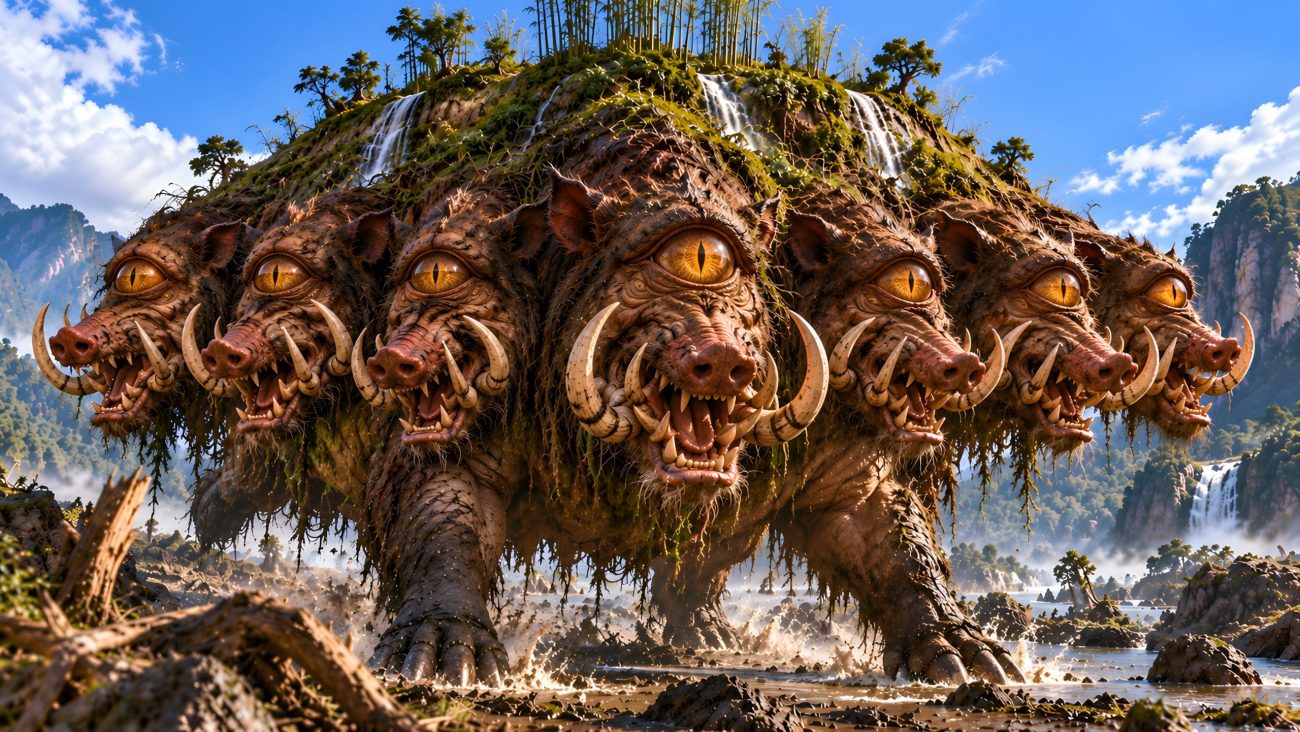
The monstrous boar was so immense that its body stretched across the landscape: when it stood upright, its snout touched Dura Hill, while its tail lay in the Songdu River. It possessed seven heads, each bearing seven tusks as sharp as double-edged scimitars and a single eye in its forehead that shone like the full moon. Seven clumps of bamboo, seven plots of thatch grass, and seven bulrushes grew on its back, alongside seven perennial streams. This miniature landscape sheltered a pair of langurs and their offspring, as well as seven pairs of moles. Wakmangganchi Aragondi roamed freely, devouring anyone it encountered and destroying crops, particularly gourds, melons, pumpkins, and yams. Its attacks continued even after Goera’s birth, when two more of his maternal uncles were eaten while travelling to buy a goat. When Goera came of age, he resolved to end the monster’s reign of terror.
To prepare for the battle, Goera enlisted the aid of the giant crab Songduni Angkorong Sagalni Damohong and forced his grandmother to reveal what she knew about the monster. He also befriended supernatural beings, including the progenitors of Steel and Dolomite, and obtained a magical double-edged sword, bow, and arrows from the smith-god Dygkyl Khongshyl. His weapons could shatter trees and cure disease. He further allied himself with Tengte Kacha, king of the Elfs, and Maal, the dwarf god, both of whom possessed great magical powers despite their small stature.
Goera eventually found Wakmangganchi Aragondi sleeping in mud at Ahnima Gruram Chinima Rangsitram. He sent his servant Toajeng Abiljeng to strike the beast from behind and awaken it. Enraged, the boar charged at Goera, who answered with a hail of burning darts. The monster fled east, then north, before turning back and making wild charges across the land. Goera pursued it, firing volleys of arrows that tore into its body. Its movements caused the earth to rumble and quake, while Goera repeatedly escaped its charges by creating piles of rocks to climb and hide upon. Finally, one of his maternal uncles, still in the subterranean region, shot an arrow through the boar’s armpit. The wounded monster collapsed at Ahguara Rongpakmare Shohlyng Janthihol, where Goera decapitated it.
The battle lasted seven summers and seven winters. When the monster’s body was cut open, Goera’s two uncles were found inside, alive but blind; they eventually recovered their sight. The boar’s meat was distributed among the people, and the remainder was left to decompose. The battle’s traces are said to remain in the landscape: the rock piles created by Goera are known as Goerani Ronggat, or the “Stone Piles of Goera,” while the monster’s droppings became rocks containing visible seeds. Red patches of land mark places where its blood was spilled.
Sources
“Wakmangganchi Aragondi.” A Book of Creatures, June 14, 2021. https://abookofcreatures.com/2021/06/14/wakmangganchi-aragondi/