Tradition: Japanese Mythology
Alternative Names: Zashiki bokko, Zashiki-warashi
Category: House dweller
The Myth
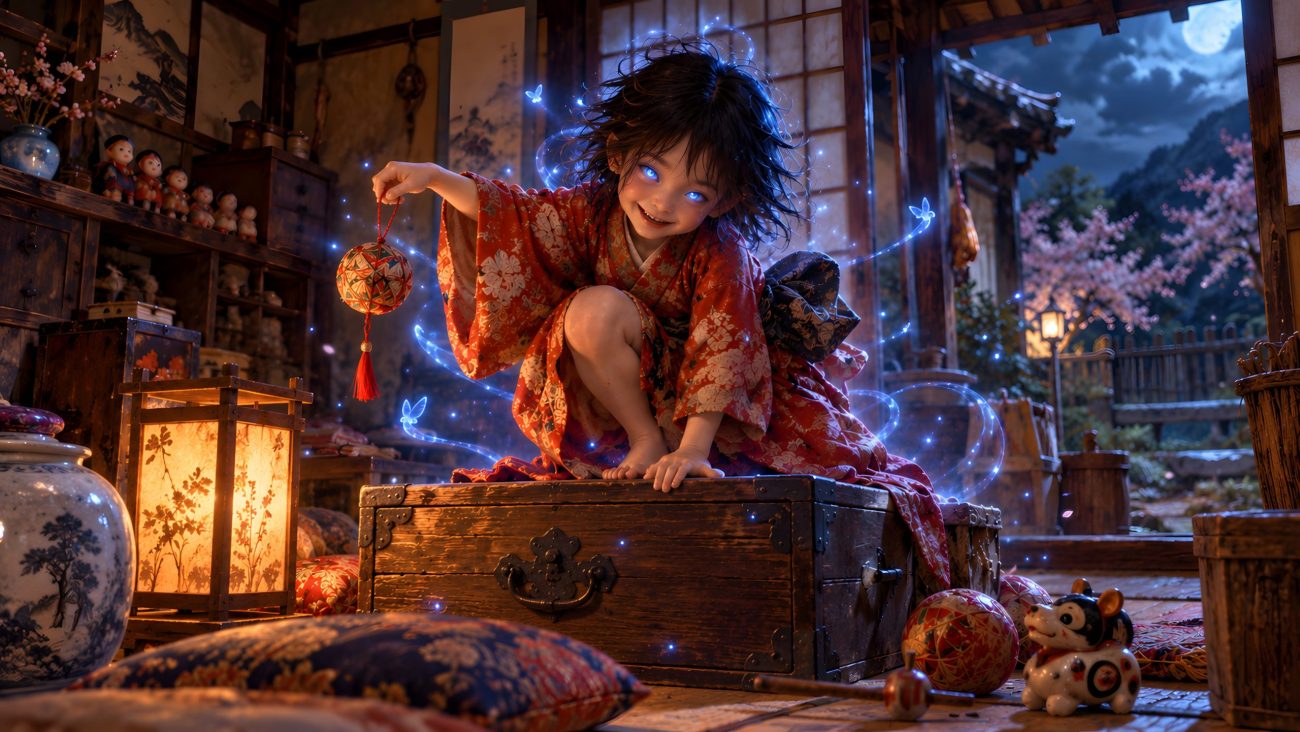
Zashiki-warashi are childlike supernatural beings in Japanese folklore, especially associated with Iwate Prefecture and the Tōhoku region of northeastern Japan. They inhabit traditional homes, particularly parlors and storage rooms, where they perform mischievous pranks. Although their appearance is not described in detail in every account, they are understood as spirits that take the form of children. Their presence is often considered a sign of good fortune, and families believed to host one could become prosperous and wealthy.
These spirits are not always seen directly. Their activities may be noticed through disturbances inside the house, and some traditions describe them moving around the edges of homes on rainy days, frightening visitors. Related beings include the notabariko, which peeks out from the inner dirt-floored room and crawls around, and the usu-tsuki warashi, which makes noises with a stone mortar. These figures are regarded as related, lower-ranking forms of the zashiki-warashi.
The presence of a zashiki-warashi is traditionally associated with the prosperity of a household. In the Tōno Monogatari, a collection of Japanese folktales recorded by Kunio Yanagita, it is said that families in whose homes these spirits dwell become prosperous. Their appearance in a house can therefore be interpreted as a sign that the family’s fortunes will improve. Conversely, stories connect the departure or loss of supernatural protection with a household’s decline, making the spirits important figures in explanations of changing fortunes within village communities.
Some darker traditions connect zashiki-warashi with the spirits of children who died through infanticide. In parts of the Tōhoku region, accounts describe unwanted children being killed and buried in the dirt-floored rooms or kitchens of homes. The spirits of these children were said to wander around houses, particularly on rainy days, frightening visitors. These traditions offer a more tragic explanation for the spirits’ childlike appearance and their association with old family homes.
Other stories suggest that zashiki-warashi may be connected to curses involving carpenters and tatami makers, or that they are related to kappa, supernatural beings associated with water. In some accounts, a kappa leaves the depths and enters a nearby house to play pranks before settling there. Their childlike form has also been linked to religious beliefs in which children serve as intermediaries between the human and divine worlds, resembling protective child-shaped figures in Buddhism.
Zashiki-warashi therefore occupy an ambiguous place in Japanese folklore. They can be playful household tricksters, protective spirits, or reminders of darker histories hidden within traditional homes. Above all, they are closely associated with family prosperity and the belief that the presence of an unseen supernatural being can influence the fortunes of an entire household.
Sources
“Zashiki-warashi.” Wikipedia: The Free Encyclopedia. Wikimedia Foundation. Accessed October 24, 2026. https://en.wikipedia.org/wiki/Zashiki-warashi