Tradition: Mesopotamian Mythology, Iraqi Mythology
Alternative Names: Pazuzu, Pà.zu.zu
Category: Lion
The Myth
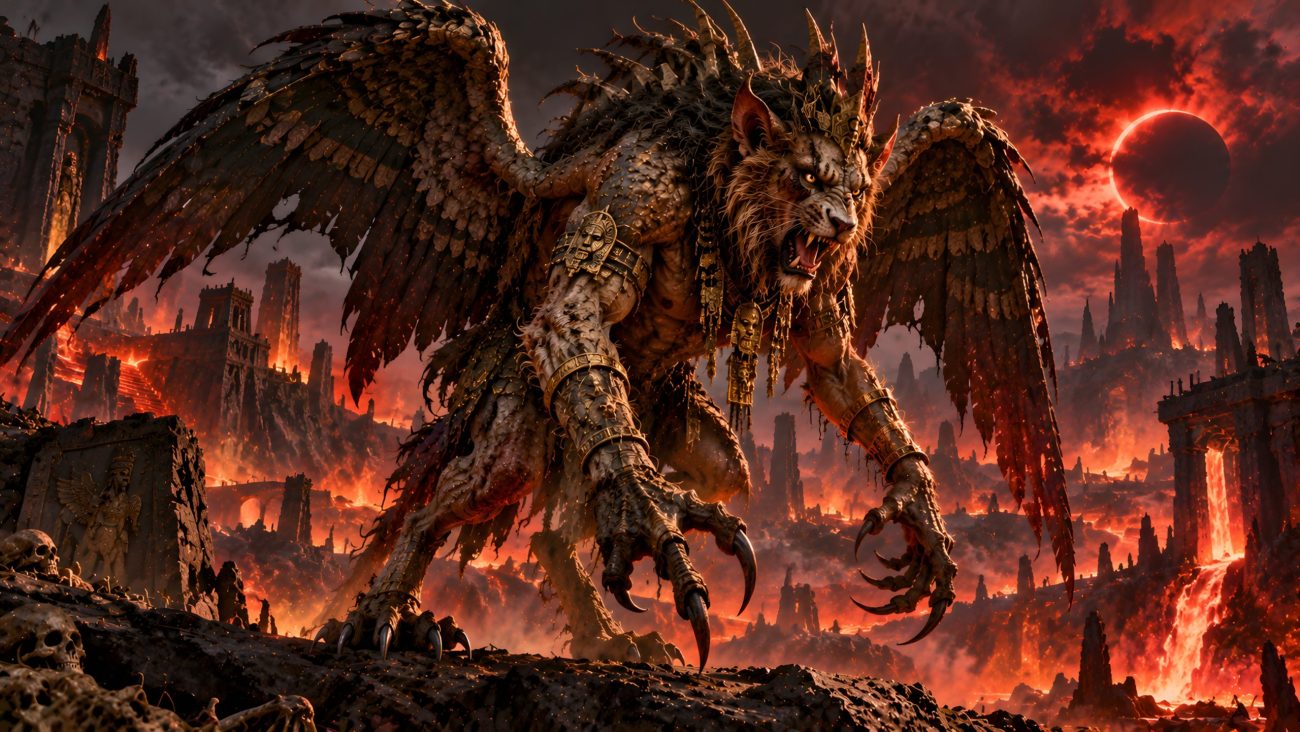
Pazuzu was a powerful demonic deity worshipped in ancient Assyria and Babylonia. He had a grotesque, hybrid appearance, with a canine-like face, bulging eyes, a scaly body, the talons of a bird, and usually a pair of wings. His body also included a serpent-headed penis. He was regarded as the son of Hanbi and was associated with destructive winds that swept down from the mountains, carrying disease and suffering. In an incantation, Pazuzu describes ascending mighty mountains and encountering evil winds, whose wings he breaks to prevent them from spreading harm.
Although Pazuzu was feared as a dangerous wind demon, he could also be invoked as a protector against other supernatural threats. His most important rival was Lamashtu, a malevolent demoness who endangered pregnant women, caused miscarriages, and attacked infants. Pazuzu was believed to be capable of driving her back into the underworld, making his frightening appearance a source of protection against evil. His image was therefore used in protective magic, particularly to safeguard pregnant women, mothers, and young children from illness and demonic attacks.
Amulets bearing Pazuzu’s head were worn as necklaces, especially by pregnant women, while larger figures and stone charms were placed inside homes or near entrances to repel harmful spirits. These objects were made from materials including bronze, terracotta, gold, glass, and bone. Some depicted him standing or crouching, with his gaze directed outward toward supernatural enemies. Rituals and incantations also invoked his power to banish sickness and prevent Lamashtu from entering a home. Pazuzu thus embodied a dangerous but useful supernatural force: a destructive demon whose terrifying power could be turned against other demons and used to protect the living.
Sources
“Pazuzu.” Wikipedia: The Free Encyclopedia. Wikimedia Foundation. Accessed October 21, 2026. https://en.wikipedia.org/wiki/Pazuzu