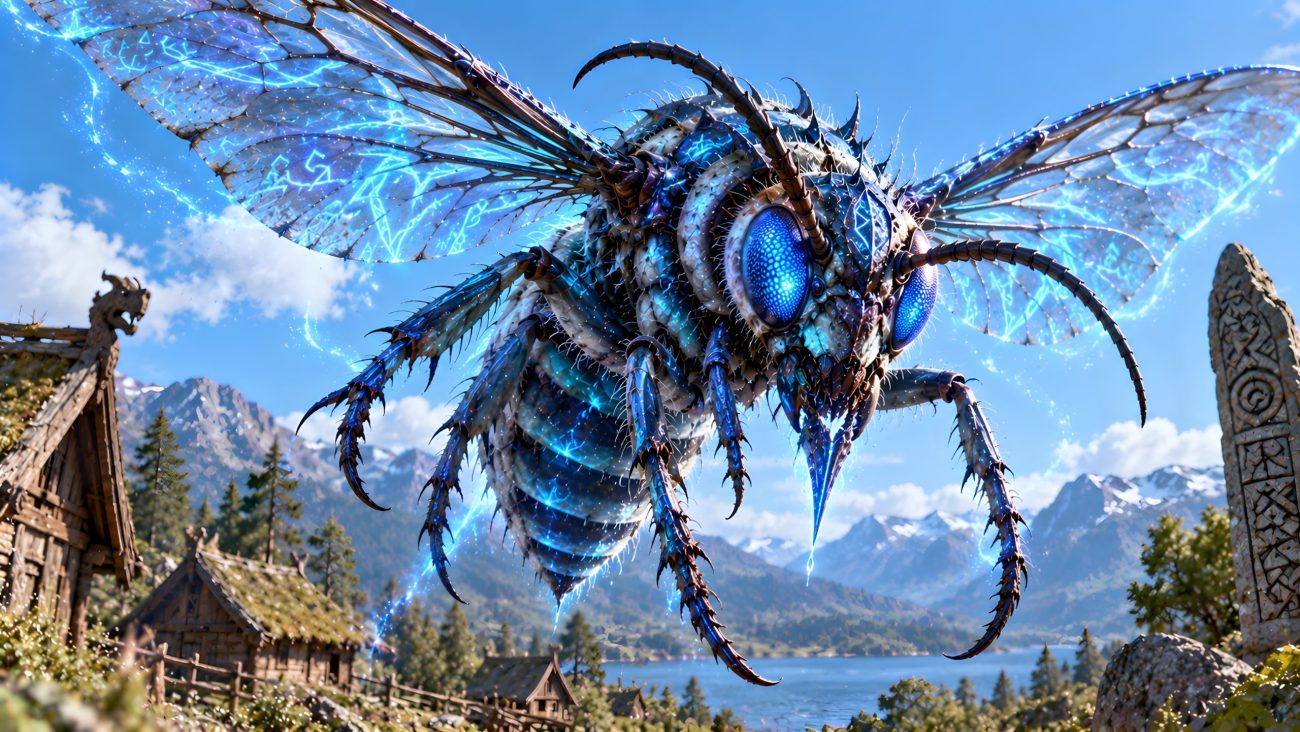
Tradition: Swedish Mythology
Alternative Names: The Devil’s Hornets, The Enchanted Hornets
Category: Insect
The Myth
The Magic Hornets are a swarm of enchanted insects kept inside a large hornets’ nest. Unlike ordinary hornets, they obey human commands and can be directed to attack a specific person. When released, they fly out in a swarm and sting their chosen target until someone orders them to stop. Their appearance is not described in detail, but their ability to act together under supernatural control makes them a powerful magical weapon.
Their abilities appear in a Swedish folktale titled The Rooster, the Hand-Mill and the Swarm of Hornets. In the story, a poor peasant sells a pig to a mysterious gentleman at the devil’s dwelling. In exchange, he receives a magical rooster that lays silver coins whenever commanded. However, an old woman who keeps a tavern steals the rooster while the peasant sleeps and replaces it with an ordinary bird.
The peasant returns to the gentleman and receives a second magical gift: a hand-mill that produces whatever kind of meal he requests and stops only when ordered. Unfortunately, the old woman steals this gift as well. When the peasant returns to complain for a second time, the gentleman gives him a large hornets’ nest filled with the enchanted insects.
The peasant takes the swarm to the tavern and boasts of his new possession. When the old woman asks to see it, he commands the hornets to emerge and sting her. The insects immediately attack, causing her to scream and beg for mercy. She promises to return both the stolen rooster and the magical mill if he calls them off.
The peasant agrees and orders the hornets to leave the woman alone and fly back into their nest. Having recovered his stolen gifts, he returns home with all three magical possessions, becomes wealthy, and lives happily until his death.
The story presents the Magic Hornets as instruments of supernatural punishment and a means of recovering what has been stolen. Their power depends on obedience to spoken commands: they can be unleashed against a victim but must also be ordered to stop. Although the tale gives them little individual characterization, their role is decisive. The threat of their stings finally forces the dishonest tavern keeper to surrender the peasant’s possessions.
Sources
Stroebe, Clara, ed. The Swedish Fairy Book. Translated by Frederick H. Martens. Illustrated by George W. Hood. New York: Frederick A. Stokes Company, 1921.