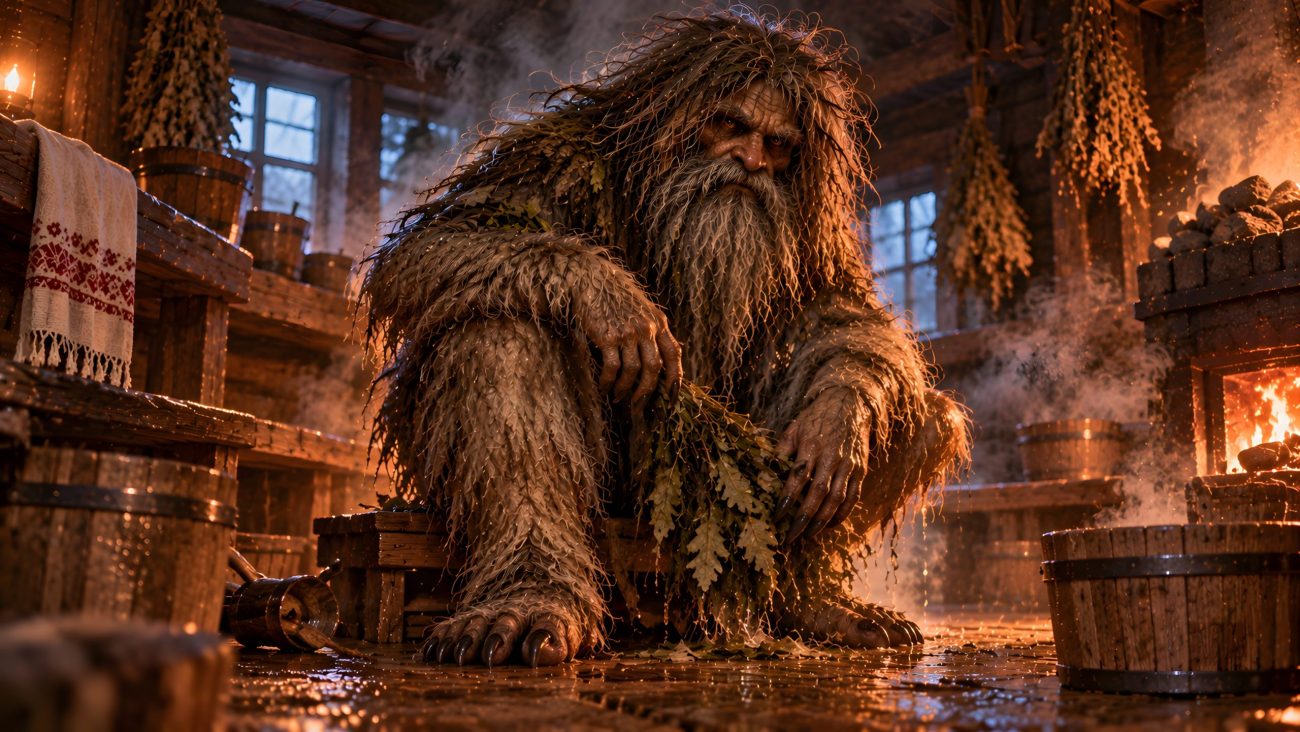
Tradition: Russian Mythology
Alternative Names: Bannik, Ban’ka, Banitsa, Bathhouse Master, Bathhouse Attendant
Category: House dweller
The Myth
The Bannik is a supernatural being believed to inhabit the Russian bathhouse, or banya. It is considered the master of this building, which was regarded as a necessary but dangerous place where people washed and steamed themselves. The Bannik usually lives beneath a shelf or emerges from under it, although it may also be associated with the stove, benches, and other parts of the bathhouse. Despite its connection with cleanliness, the Bannik is far from harmless: it can frighten visitors, interfere with bathing, and inflict severe injuries on those who offend it.
The Bannik’s appearance varies between accounts. It may resemble a tiny, very strong old man with a long, mouldy beard, or a terrifying figure with a black shaggy mane, enormous stature, long hair, iron hands, and claws capable of strangling people. Other descriptions portray it as grey and shaggy, sometimes covered in dirt or leaves from the woods. In some regions, it appears as a cat, while others describe a small white-haired figure or a creature resembling a devil. It can remain invisible, revealing its presence through knocking, noises, thrown stones, or sudden disturbances inside the bathhouse.
The Bannik punishes people who disregard the customs governing the banya. Bathing at prohibited times, especially alone after sunset or late at night, was considered dangerous. Visitors were expected to leave water, a broom, and soap for the spirit and to keep the bathhouse clean. Some traditions also required people to ask permission before entering. Those who ignored these rules risked being strangled, scalded by boiling water, struck with a broom, or dragged onto the hot stove. The Bannik might even tear the skin from an unwanted visitor and hang it up to dry. Misfortune occurring in the bathhouse was often attributed to the tricks of its supernatural master.
Despite its hostility toward intruders and rule-breakers, the Bannik could also protect the household to which the bathhouse belonged. It was sometimes understood as a guardian spirit that defended its owners against foreign or malevolent supernatural beings. This protective role existed alongside its dangerous reputation, reflecting the dual nature of the bathhouse itself: a place essential to domestic life but also associated with darkness, heat, steam, and supernatural danger.
The Bannik was also connected with divination and fortune-telling. The bathhouse could be used to seek information about marriage, future spouses, and other uncertainties. In some traditions, people asked the Bannik questions about their future, while other rituals involved looking into a mirror or using objects such as a comb. These practices drew on the bathhouse’s reputation as a place where ordinary boundaries could be crossed and supernatural knowledge obtained.
Stories also describe encounters with the Bannik as though it were a member of a household. In one account, a worker washing in the bathhouse is warned that an old man is crawling out from beneath the shelf. The worker refuses to be frightened, and the old man eventually comes out, steams himself with a broom, and returns beneath the shelf. Other tales refer to several Banniki living together, sometimes with a wife and children. These accounts portray the bathhouse spirit not merely as an isolated demon but as a supernatural inhabitant with its own domestic life.
The Bannik’s association with childbirth could be especially dangerous. Some traditions warned that a woman should never give birth alone in the bathhouse, as the spirit might kill her or steal her baby and replace it with one of its own. Bannik children were said to be deformed and to grow poorly. The bathhouse could therefore be both a place of healing and purification and a location where mothers and newborns faced supernatural threats.
The Bannik embodies the contradictory character of the traditional Russian bathhouse. It was a place of washing, healing, ritual preparation, and fortune-telling, but it was also considered unclean and perilous. The spirit personified these dangers while also protecting the people who belonged to the household. To bathe safely, people had to respect the customs of the banya, acknowledge its supernatural master, and recognize that a place essential to everyday life could also belong to powers beyond human control.
Sources
“Bannik.” New Bestiary (Bestiary.us). https://www.bestiary.us/bannik