Tradition / Region: Papua New Guinea Mythology
Alternate Names: —
Category: Dwarf, Shapeshifter
The Myth
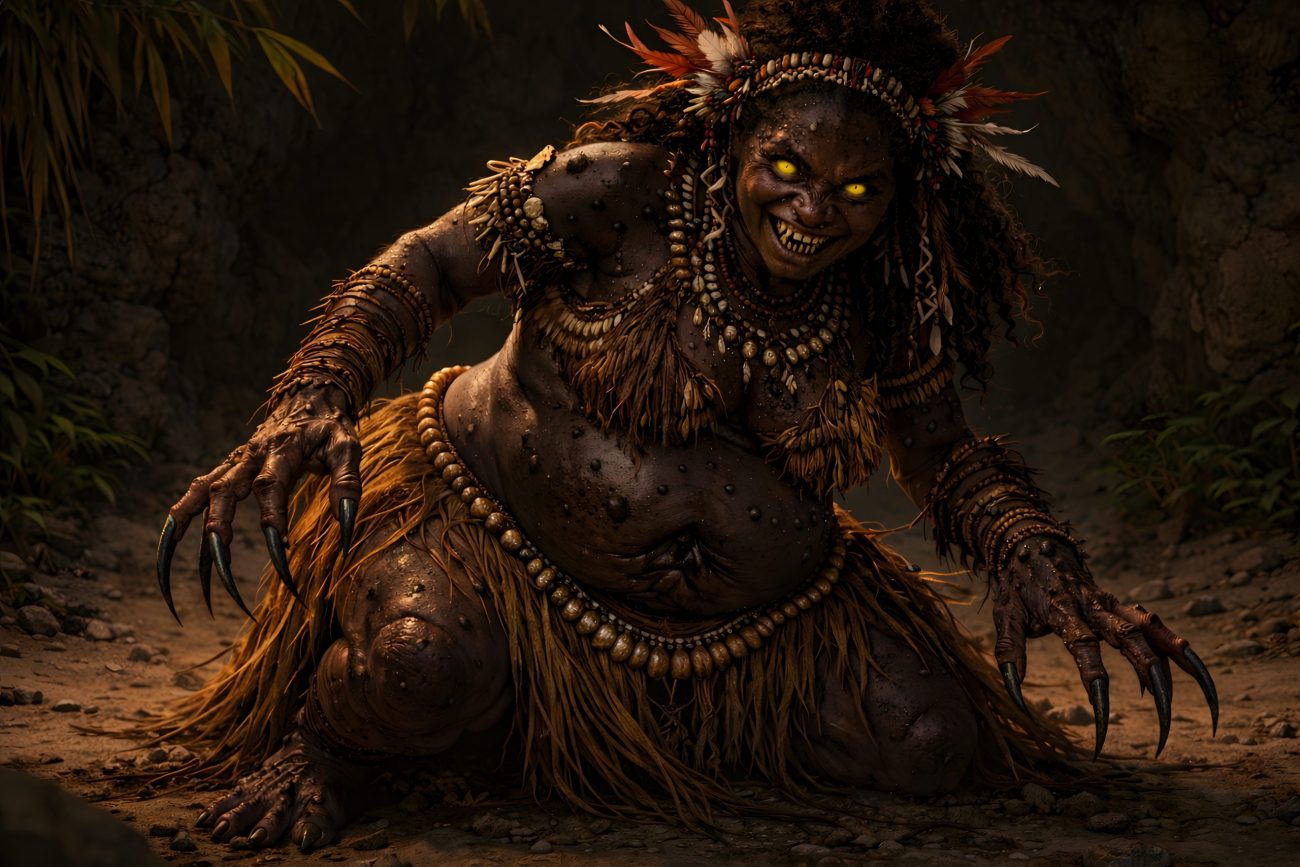
Hiwai-abere are wicked female beings who resemble women but are marked by grotesque and unsettling features. They are described as very fat, with large heads, swollen bellies, and unusually short legs. Their fingernails are long and sharp like spears, and with these they are able to hunt and kill wild pigs. Wherever they go, they constantly break wind, an action that is both comic and disturbing, and yet they possess extraordinarily sharp hearing, able to detect even a whisper from far away.
Despite their monstrous nature, hiwai-abere are masters of deception. They can disguise themselves perfectly, even taking on the appearance and features of specific human women. Through this ability, they approach men they desire and insert themselves into human society unnoticed. In many folk tales, a hiwai-abere replaces a bride at a wedding or abducts the rightful wife and takes her place in the household.
At first, the husband notices only that something is wrong. His wife seems changed in strange and troubling ways. The hiwai-abere cannot properly perform ordinary women’s work and instead demands to be served. She becomes possessive and jealous, preventing her husband from speaking to or approaching other women. The household falls into disorder, and the husband grows increasingly distressed by the inexplicable transformation of his wife.
Eventually, the deception is uncovered. The hiwai-abere is exposed for what she truly is, often through her inability to maintain human behavior or through the intervention of others. Once revealed, she is driven away, and the rightful wife is restored. The tales always end with the reuniting of the legitimate couple and the removal of the dangerous impostor.
Through these stories, the hiwai-abere stand as symbols of deception, disruption, and the fear of identity being stolen. They embody the danger of false appearances and the belief that what looks human may not always belong to the human world.
Gallery
Sources
Landtman, G. (1970). The Kiwai Papuans of British New Guinea: A nature-born instance of Rousseau’s ideal community.
Interpretive Lenses
Religious Readings
- Christian Ascetic Deep Dive
Philosophical Readings
- Nietzschean Deep Dive
Psychological Readings
- Jungian Deep Dive
Esoteric Deep Dive
- Hermetic Deep Dive
Political / Social Readings
- Marxist Deep Dive
Other
- How to Invite The Hiwai-abere