Tradition: Greek Mythology
Alternative Names: Talus, Talon, Tálōs (Τάλως), Tálōn (Τάλων)
Category: Giant
The Myth
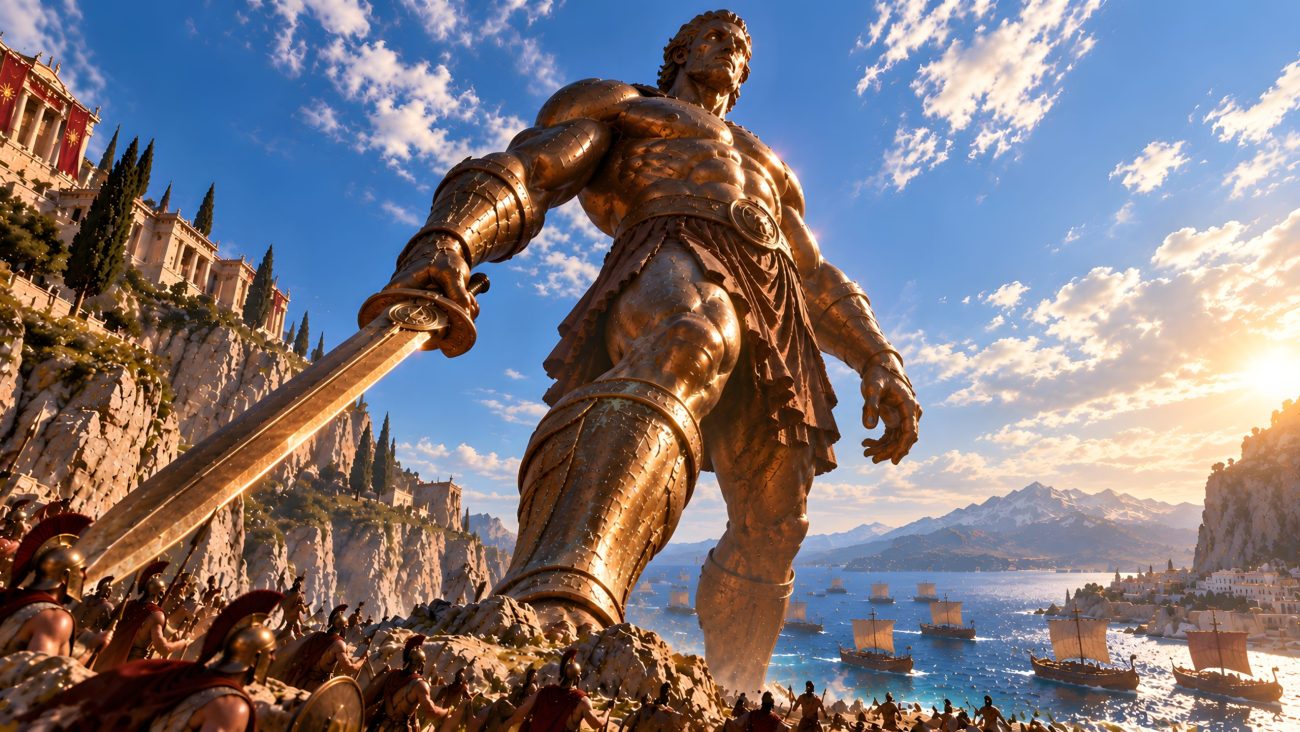
Talos was a mysterious bronze being who protected the island of Crete from pirates and invading forces. In Greek mythology, he was an extraordinary guardian who circled the island three times each day, watching its shores for approaching enemies. Although he is popularly depicted as a gigantic bronze automaton, ancient accounts do not explicitly establish that he was a giant. His origins and nature vary between literary traditions: he was described either as a bronze man or as a bull, and some accounts identified him as a member of the ancient Bronze Race.
According to the Argonautica by Apollonius of Rhodes, Talos belonged to the Bronze Race, whose members were said to have sprung from ash trees. He was made entirely of bronze and was nearly invulnerable, with only a vulnerable vein running from his neck to his ankles. This vein was sealed at the ankle by a thin layer of skin. Zeus gave Talos to Europa to protect Crete, while other traditions state that the god Hephaestus created him and gave him to King Minos.
Talos fulfilled his duty by patrolling the entire island three times daily. When the Argonauts returned from their quest for the Golden Fleece and approached Crete aboard the Argo, the bronze guardian prevented them from landing. He hurled enormous boulders at their ship, threatening to destroy it if the crew attempted to come ashore. His strength and tireless vigilance made him a formidable obstacle, and the Argonauts could not easily overcome him through ordinary force.
The sorceress Medea eventually brought about Talos’s destruction. In Apollonius’s account, she summoned the keres, female spirits of death, and caused Talos to injure his vulnerable ankle. His precious ichor, the divine fluid flowing through his bronze body, poured out through the wound. As the life drained from him, Talos collapsed like a great pine tree being felled, and Crete lost its powerful guardian.
Other ancient accounts offer different explanations for his death. According to Pseudo-Apollodorus, Medea either drove Talos mad with drugs or deceived him by promising immortality before removing the bronze nail that sealed his ankle. Once the nail was removed, his ichor flowed out and he died. A third version claims that the Argonaut Poeas killed him by shooting an arrow into his ankle.
Talos’s legend presents him as an extraordinary guardian whose immense strength concealed a single fatal weakness. His bronze body made him nearly invulnerable, but the vulnerable point at his ankle allowed his enemies to defeat him. Through his tireless patrol of Crete and his confrontation with the Argonauts, Talos became one of the most memorable protective figures in Greek mythology, embodying both the power of an artificial guardian and the limits of even the strongest supernatural beings.
Sources
“Talos.” Wikipedia: The Free Encyclopedia. Wikimedia Foundation. Accessed October 16, 2026. https://en.wikipedia.org/wiki/Talos