Tradition: German Mythology
Alternative Names: Gütchen, Gütgen, Güetel, Gietel, Gitel, Gidl, Gidle, Göthel, Jütel, Heugütel
Category: Dwarf
The Myth
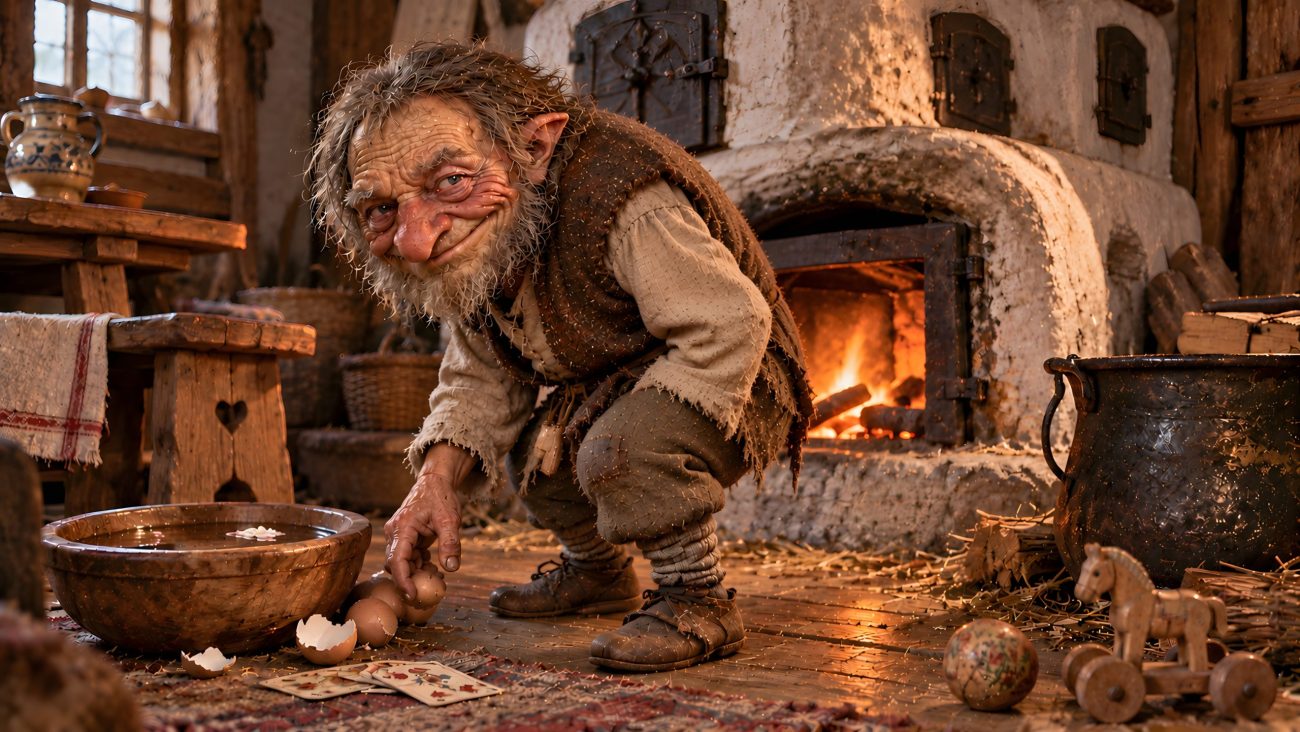
The Gütel is a small household spirit of German folklore, sometimes appearing as a little man or dwarf. In the Vogtland and Ore Mountains, the related Heugütel is described as a bearded little old man who lives in the hayloft. Despite his aged appearance, the Heugütel is believed to be the soul of a child who died without being baptized, and its tiny footprints may sometimes be found in ashes. Other Gütel are associated with the stove itself, where they are believed to make their homes. Geplakte markdown
The Gütel are generally helpful household spirits. They assist with work around the house and stable, while the Heugütel is particularly fond of children, rocking them to sleep and keeping them company while they dream. These spirits are most comfortable in households where people live piously, and the Heugütel is said to remain only where the inhabitants lead a Christian life. Geplakte markdown
Not every Gütel is friendly, however. Some of their darker forms torment children during the night, making them restless and causing illnesses such as chills, seizures, and measles. Women giving birth are also considered vulnerable to their attention. A Gütel can sometimes be distracted with small amusements: a little pot of leftover bathwater placed on the stove gives it something to play with, while eggshells, playing cards, and small bows and arrows can be left around the house or barn for its entertainment. Geplakte markdown
There are also ways of driving them away. Greasing the stove door with bacon rind or placing straw from the bed of a woman in childbirth across the doors can keep them out. In Saxony, giving the spirit new clothing is another way to make it leave. With the departure of the benevolent Heugütel, however, the household may lose the blessing and protection that came with its presence. Geplakte markdown
The Gütel can become especially dangerous when illness or death is near. In the Ore Mountains, a loud and heavy crash heard during the night was regarded as an omen of impending death. When someone had already fallen ill, offerings could be made to the Gütgen in the hope that the spirit would take an animal instead of the sick person. A cock was offered for a man, a sow for a woman, a goat for the person making the offering, and hens for children. Geplakte markdown
At night, the more troublesome forms also visit the stables. They torment cows until the animals growl and harass horses until they kick and bite. They are notorious for tangling the manes of horses and the hair of women into knots, a practice that gave rise to names such as Haargütel, meaning “hair Gütel.” Geplakte markdown
One particularly troublesome form haunts the woods and attacks solitary travelers. The little spirit leaps onto a person’s back and forces them to carry it, growing heavier and tormenting its victim until they become exhausted, breathless, and sick. In this form the Gütel becomes a true wandering menace rather than a helpful household companion.
Sources
“Gütel.” Wikipedia: The Free Encyclopedia. Wikimedia Foundation. Accessed October 4, 2026. https://en.wikipedia.org/wiki/G%C3%BCtel