Tradition: Albanian mythology
Alternative Names: Kuçedra, Kulshedër, Kulshedra
Category: Dragon
The Myth
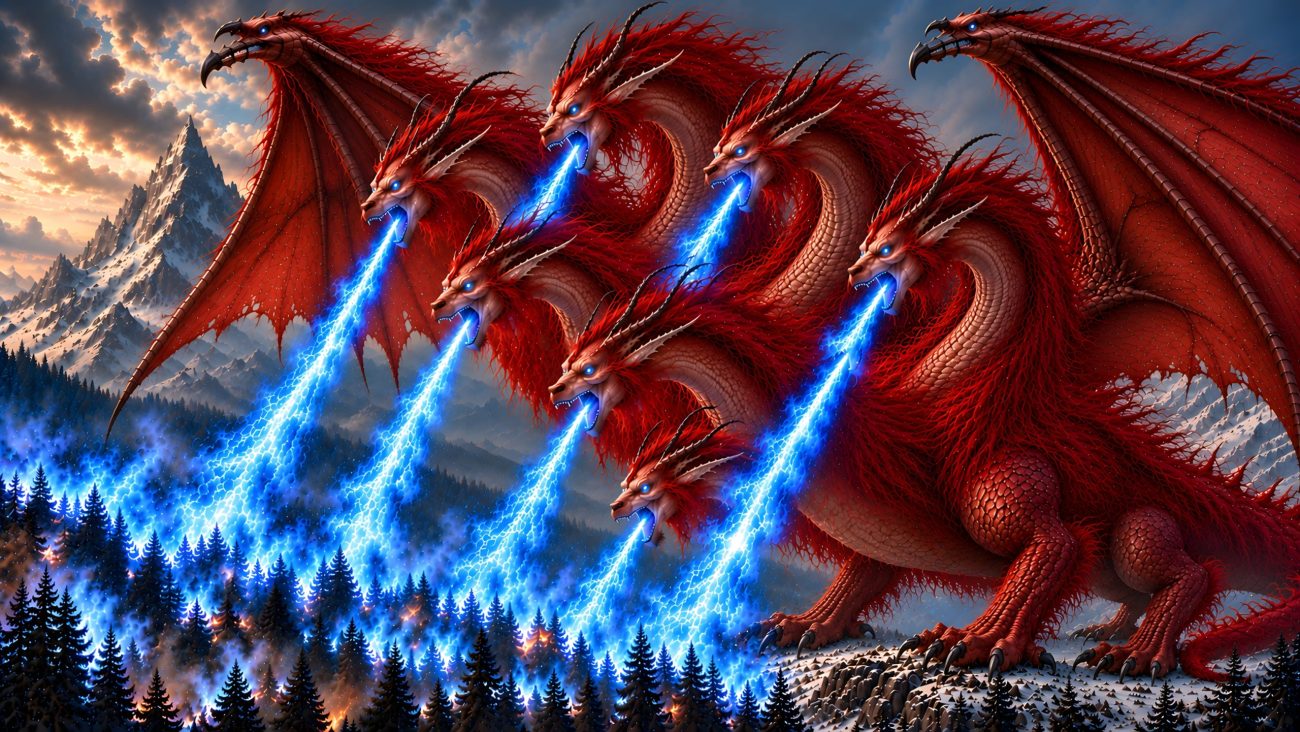
The Kulshedra is a gigantic female dragon, usually imagined as a monstrous multi-headed serpent covered in woolly red hair. She has a long tail, seven to twelve heads, and enormous pendulous breasts that hang down to the ground. She can spit fire, and her milk and urine are poisonous. She may also appear in the form of a woman, or as a female lizard, turtle, frog, or salamander.
The Kulshedra is a creature of water, storms, fire, and the earth beneath the world. She brings drought, torrents, tempests, floods, water shortages, earthquakes, and other disasters upon humanity. When her anger becomes dangerous, people may offer her human sacrifices in an attempt to persuade her to hold back the destruction.
In the southern traditions, the Kulshedra is so enormous that she surrounds the entire world. Should she ever manage to bring her mouth around to her own tail, the world itself would be destroyed. In northern traditions she can seize or possess the sun and moon, and people try to frighten her away by firing weapons into the sky, making great noise with metal objects, or ringing church bells.
The Kulshedra is opposed by the Drangue, a divine, winged hero who protects mankind. Their battles shake the natural world: thunder and violent storms erupt as the two enemies clash, while earthquakes, cyclones, and other catastrophes may accompany their struggles. Other celestial heroes can also fight her, including the Daughter of the Moon and the Sun, who uses her powers of light to protect those she loves, and Zjermi, the Fire, who is born with the sun marked upon his forehead.
The Kulshedra does not always reveal herself as a monster. She can disguise herself as an ordinary woman, hiding her true nature until the moment comes to strike. Her presence can even bring prosperity to the village where she dwells. She draws food and other nourishment toward herself with her breath, causing her own village to flourish while neighbouring villages become poor. Her children, the Shlligë, are themselves storm-bringing creatures.
The Kulshedra begins its existence as a Bolla, a demonic serpent with aquatic and chthonic qualities. The Bolla keeps its eyes closed throughout the year, opening them on Saint George’s Day, when it gazes upon the world and devours any human it sees. If it survives for the required number of years without being discovered by a human, it undergoes further transformations, passing through forms known as the Bollar and Errshaja before eventually becoming a Kulshedra.
Brave villagers sometimes seek out these serpents and kill them while they are sleeping, before they can grow into the far more dangerous Kulshedra.
In Albanian folklore, the struggle between the Kulshedra and the Drangue is the great battle between darkness and light, destruction and protection. When the dragon rises, storms and disasters threaten the world; when the celestial hero defeats her, the danger is driven back and the world is restored.
Sources
“Kulshedra.” Wikipedia: The Free Encyclopedia. Wikimedia Foundation. Accessed October 2, 2026. https://en.wikipedia.org/wiki/Kulshedra