Tradition: Romanian Mythology
Alternative Names: Balaur, Balauri, Balaurul
Category: Dragon
The Myth
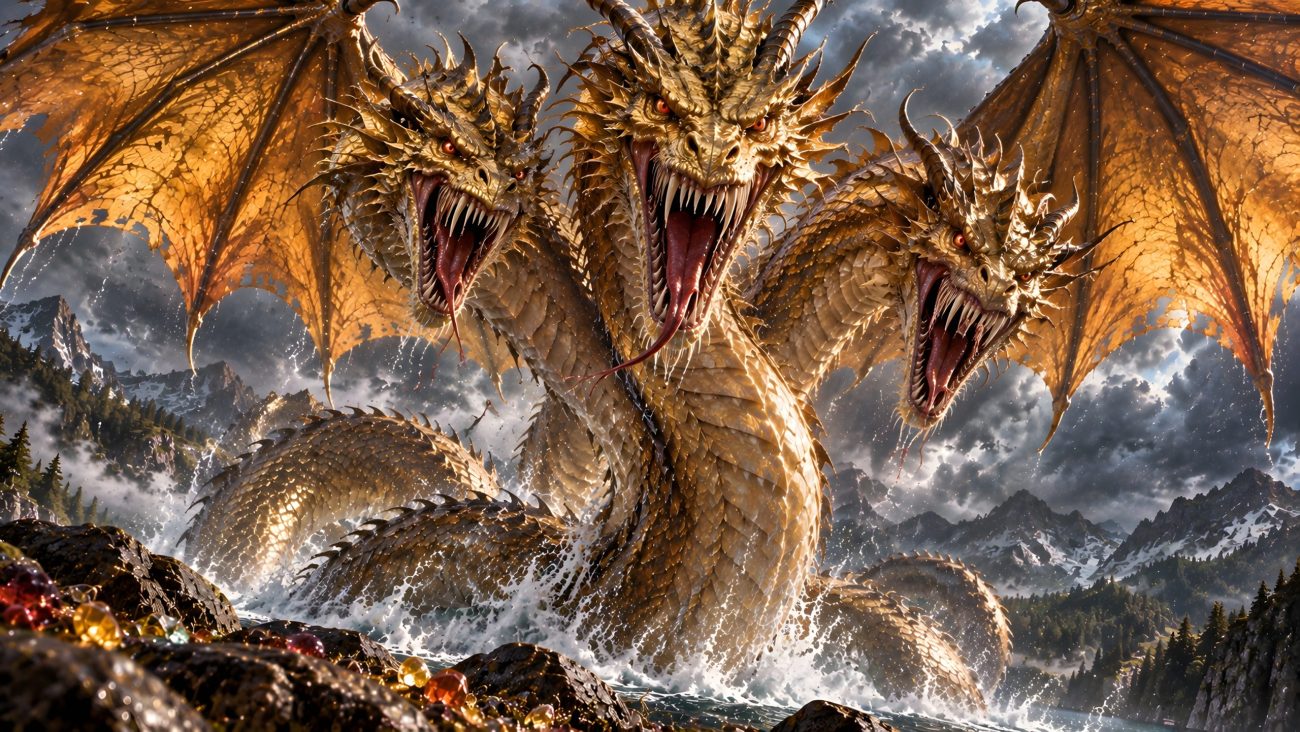
The Balaur is a monstrous serpent or dragon, usually described as having several heads. It commonly has three heads, although legends also describe Balauri with seven or twelve heads. Some versions give it wings, and descriptions may portray it as a winged, golden dragon.
Balauri inhabit different environments depending on the tradition. Some live in water, others on land, while others dwell in the air. Water-dwelling Balauri can inhabit wells, lakes, and other bodies of water. One seven-headed Balaur was said to live in a village well and demand young maidens as sacrifices until it was defeated by the hero Busuioc or Saint George.
Balauri are often portrayed as dangerous creatures that abduct or devour young maidens and princesses. In tales of Făt-Frumos, the dragon is defeated by the hero, while other stories describe a Balaur as the guardian or abductor of a princess. The Balaur is sometimes confused with the Zmeu, another Romanian monstrous being.
Some Balauri are associated with precious stones. One tradition says that Balauri living in the Armenian land produce precious stones, while in Wallachia it was believed that precious stones could form from a Balaur’s saliva. It was also said that anyone who succeeded in killing a Balaur would have one of their sins forgiven.
The air-dwelling Balaur is associated with storms and weather. When two Balauri meet and fight in the sky, their struggle causes destruction on the ground, uprooting trees and throwing objects through the air. Another tradition says that the Balaur travels along the rainbow and sucks moisture from the earth, causing rain. In other accounts, it draws water from the sea to fill the clouds.
Balauri could also serve the Solomonari, the weather-controlling sorcerers. In these traditions, the dragons were kept hidden in the depths of lakes until the Solomonari summoned them. A Solomonar controlled a Balaur with a golden bridle and rode it through the air to influence the weather. Some traditions instead describe the dragons ridden by the Solomonari as Zmei.
The Balaur therefore appears in several forms: as a water monster demanding sacrifices, a land-dwelling treasure-producing dragon, or a flying creature associated with storms and rain.
Sources
“Balaur.” Wikipedia: The Free Encyclopedia. Wikimedia Foundation. Accessed September 20, 2026. https://en.wikipedia.org/wiki/Balaur